
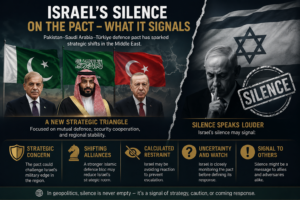
When three regional powers sign a mutual defence pact stating that an attack on one is an attack on all, you’d expect the country most likely to be affected by it to say something — anything — within a day or two. That hasn’t happened.
More than three days after Turkiye, Saudi Arabia, and Pakistan signed the Mecca Joint Defence Agreement on August 7, 2026, Israel had issued no official government response. Not from Prime Minister Benjamin Netanyahu’s office. Not from the Ministry of Foreign Affairs. Nothing on the record, at a time when Israeli officials typically comment quickly on anything touching Iran, Turkiye, or the broader balance of power in the region.
That silence is not nothing. In diplomacy, silence is a choice, and choices communicate. This essay looks closely at what Israel’s quiet has meant so far, why it may not last much longer, and what the eventual response — or the continued absence of one — is likely to reveal about how Israel’s government sees its own position in a rapidly shifting Middle East.
To understand the silence, you first need to understand what it’s a response to.
What Israel Is Staying Quiet About
The Mecca Joint Defence Agreement, signed in Saudi Arabia’s holiest city by Turkish President Recep Tayyip Erdogan, Saudi Crown Prince Mohammed bin Salman, and Pakistani Prime Minister Shehbaz Sharif, contains a single, consequential line: any armed attack against one of the three states will be regarded as an attack against all three. It builds on a bilateral Pakistan-Saudi pact signed in September 2025 and folds in Turkiye’s defence-industrial capacity and NATO-standard military experience.
None of the three countries named a target. But regional analysts have been unusually direct about who they think the pact is really about. Some have described it explicitly as a challenge to what they call Israeli regional expansionism — a reading rooted in the fact that all three signatories have, in different ways and to different degrees, found themselves on the receiving end of Israeli military action, rhetoric, or diplomatic pressure in recent years.
That framing puts Israel in an unusual position. A pact aimed even partly at containing Israeli influence is not something most governments would ignore. Yet ignoring it, at least publicly, is exactly what Israel has done so far.
Why the Silence Is Strange, on the Surface
To appreciate how unusual this quiet is, it helps to look at how loudly Israeli officials have spoken about each of the three countries individually in recent months.
Turkiye has been treated by Israeli politicians across the spectrum as an emerging adversary — described in some Israeli commentary as the country’s “next nemesis in waiting.” The rhetoric has escalated on both sides. Turkish Foreign Minister Hakan Fidan said last month that Israel had become something the world could no longer tolerate, a remark Israeli Foreign Minister Gideon Saar characterised as incitement. Erdogan, for his part, said in June that Israeli military activity in Syria and Lebanon posed a direct threat to Turkiye’s own security, extending Ankara’s declared security perimeter well beyond its borders. Netanyahu responded by calling Erdogan an authoritarian bigot unfit to lecture Israel on morality. This is not a relationship defined by silence — it’s defined by escalating public confrontation.
Pakistan, too, has drawn Israeli attention. Pakistan’s Defence Minister Khawaja Muhammad Asif described Israeli military assaults in Lebanon in harsh terms earlier this year, prompting a sharp — and subsequently deleted — response from the Israeli prime minister’s office accusing Pakistan of effectively calling for Israel’s destruction. Pakistan does not recognize Israel diplomatically and never has.
Saudi Arabia sits in a different category. Unlike Turkiye and Pakistan, Riyadh is a country Israel has actively wanted closer to it, not further away. Both Netanyahu and U.S. President Donald Trump have pushed for years to bring Saudi Arabia into the Abraham Accords, the normalization framework that already includes the United Arab Emirates and Bahrain. Saudi Arabia has kept its distance from that process since Israel’s war on Gaza began in October 2023, but it has never been framed by Israeli officials as an adversary the way Turkiye or Iran have been.
Given all of this — open hostility toward Turkiye, sharp exchanges with Pakistan, and an active, if stalled, courtship of Saudi Arabia — you might expect the announcement of a pact linking all three to provoke an immediate and pointed Israeli reaction. Instead: quiet.
Reading the Silence: Five Possible Explanations
There is rarely a single, clean explanation for a government’s silence on a major regional development. In this case, several plausible explanations exist simultaneously, and they are not mutually exclusive.
1. Timing and the Sabbath
The most mundane explanation is also a real one. The pact was signed on a Friday, and Saturday — the day immediately following — is the Jewish Sabbath, when Israeli political and government activity typically slows significantly. Analysts and government insiders have suggested that Israeli leadership was likely using that lull to work through the implications of the new alliance privately before saying anything in public. This doesn’t fully explain the days of silence that followed the Sabbath, but it does explain why an immediate same-day response was never realistic to begin with.
2. Genuine uncertainty about what the pact actually means
It’s worth remembering that the Mecca agreement itself is short on operational detail. It does not specify what “regarded as an attack against all” actually obligates each signatory to do. Even experts who study the region closely have said openly that they don’t know whether an attack on Saudi Arabia by, say, the Houthi movement in Yemen would actually draw in Turkiye or Pakistan militarily. If regional security specialists are uncertain about the pact’s real-world teeth, it stands to reason that Israeli policymakers may be taking real time to assess what, if anything, has actually changed before committing to a public position. A government that responds too quickly and too strongly to something that turns out to be mostly symbolic risks looking alarmist. A government that stays quiet and lets the situation develop keeps its options open.
3. Not wanting to hand the pact more legitimacy than it already has
There’s a broader diplomatic logic that applies well beyond this specific case: publicly reacting to a rival alliance can sometimes do more to validate it than ignoring it does. If Israeli officials view the Mecca pact as more political theater than binding military commitment, treating it with public alarm could inadvertently amplify its significance and hand Erdogan, in particular, a propaganda win. Saying nothing, or very little, denies the signatories the satisfaction of provoking a visible reaction from Israel.
4. The domestic political calendar
This is where the silence gets more interesting — and where Israel’s internal politics start to matter as much as its regional strategy. Israel is heading toward a general election in October 2026, and Netanyahu is running in a genuinely competitive race against his rival, former Israeli military chief Gadi Eizenkot, with recent polling showing them close. Elections change the incentives around how and when officials respond to foreign developments. A rushed, poorly calibrated statement on a major new regional alliance could become a liability in a campaign where every foreign policy statement gets picked apart by rivals. Silence, in this context, may be less about not having a view and more about not wanting to hand ammunition to political opponents before a considered position has been worked out.
5. Waiting to see how the pact gets used politically by others first
Closely related to the election point: some of Netanyahu’s most prominent domestic critics have already started using the pact as a political weapon against him, which may be giving his office reason to wait and see how the story develops before wading in. That dynamic deserves its own closer look.
The Domestic Israeli Politics Behind the Silence
Perhaps the most underappreciated part of this story is how much the Mecca pact has already become entangled in Israel’s internal political fight — a fight that may explain the official silence better than anything happening at the regional level.
Former Israeli Prime Minister Naftali Bennett, now a Netanyahu rival heading into the October election, gave a speech back in February — months before the pact was even signed — warning of exactly this kind of alignment. He labeled Turkiye “the new Iran” and warned specifically about the risk of what he called a hostile Sunni axis involving nuclear-armed Pakistan. Bennett’s supporters are now positioned to treat the Mecca agreement as vindication of a warning he issued well before it happened, which gives him a clear political incentive to make noise about the pact — and gives Netanyahu’s team an incentive to be careful about how they respond, since any reaction risks looking either like an admission that Bennett was right, or like an attempt to downplay a threat that Netanyahu himself has spent years warning about regarding Turkiye specifically.
Daniel Levy, a former Israeli government adviser turned critic of the current administration, has offered a useful read on how this might play out over the coming weeks. His assessment is that Netanyahu’s opponents are likely to use the pact — and Saudi Arabia’s inclusion in it, in particular — as evidence of a diplomatic failure on Netanyahu’s part, given how hard both Netanyahu and Trump have pushed to bring Saudi Arabia into the Abraham Accords rather than watch it align more closely with Turkiye and Pakistan instead. Levy’s expectation is that Netanyahu, for his part, may try to downplay the pact’s significance while redirecting attention toward what he would frame as a more important and personally cultivated relationship — his ties with India’s Narendra Modi, a leader who is, notably, a strategic rival of Pakistan’s.
There’s also a longer-running pattern worth noting: Netanyahu has already been actively working to frame Turkiye as a serious strategic threat well before the pact existed, including lobbying against the sale of American F-35 fighter jets to Ankara. Some Israeli commentators have suggested he may be using Turkiye as a convenient new rival to bolster his security credentials heading into a tight election, a strategy that predates the Mecca agreement but that the pact now feeds into directly.
Put all of this together, and a picture starts to form: the silence from Netanyahu’s office may have less to do with regional military calculus and more to do with domestic political calculus. Responding carelessly risks either validating Bennett’s earlier warnings, exposing the failure of the Saudi normalization push, or looking weak on Turkiye at a moment when looking tough matters enormously for an incumbent fighting for re-election.
Israel’s Own Alliance-Building: The “Hexagon” Context
It’s worth noting that Israel’s silence on the Mecca pact doesn’t mean Israeli officials have been passive about alliance-building generally. Netanyahu has been pursuing what’s been described as a “hexagon of alliances” — a security and diplomatic grouping involving Israel, Greece, Cyprus, and India, alongside a set of unnamed Arab, African, and Asian partners.
This detail matters for two reasons. First, it shows that Israel is engaged in exactly the same kind of regional alliance-building logic that produced the Mecca pact — just aimed in a different direction and with a different cast of partners. Second, it gives some insight into how Netanyahu might eventually choose to respond publicly: not by directly attacking the Mecca agreement, but by pointing to his own competing network of alliances as evidence that Israel isn’t isolated, regardless of what Turkiye, Saudi Arabia, and Pakistan have just signed.
India’s inclusion in Netanyahu’s hexagon is particularly relevant given Pakistan’s role in the Mecca pact. India and Pakistan are long-standing regional rivals, and a close Israel-India security relationship gives Netanyahu a ready-made counter-narrative: while critics can frame the Mecca pact as a diplomatic setback, Netanyahu can point to his own personally cultivated relationship with Modi as evidence that Israel has effective regional counterweights of its own.
What Regional Analysts Are Saying
Outside of Israeli domestic politics, regional security analysts have offered more measured assessments of what the pact is actually about — and their views complicate any simple story about Israel being the pact’s central target.
Andreas Krieg, a senior lecturer at King’s College London’s School of Security Studies, has framed Saudi Arabia’s motivation in terms of trust, not confrontation. His assessment is that the experience of the ongoing war has left Riyadh with an uncomfortable realization: American military power remains essential, but the U.S. relationship doesn’t guarantee protection from attack, and Washington won’t necessarily act according to Saudi priorities. In Krieg’s view, this has pushed Saudi Arabia to seek more strategic depth and more options — a logic that is about diversifying away from total dependence on the United States, not primarily about confronting Israel.
Ahron Bregman, an Israeli-British academic, has offered a similarly nuanced reading, describing the pact as reflecting a broader lack of trust in America’s willingness or ability to protect its Middle Eastern allies. Bregman’s assessment is notable for drawing a sharp distinction: he sees the agreement as more about the three countries banding together against Iran than against Israel, and he’s expressed real doubt that the pact would actually produce concrete mutual action — for instance, if Iran struck a Saudi oil tanker. In his view, the most Israel-relevant part of the pact isn’t its overall purpose but simply the fact that Turkiye, which he describes as having emerged as a serious challenge to Israel, is one of the three signatories.
This is an important distinction to hold onto. It suggests that the pact may be simultaneously about deterring Iran and about Turkiye positioning itself against Israel — with Saudi Arabia’s involvement driven mostly by the former concern rather than the latter. That nuance gets lost in some of the more dramatic framing of the pact as a unified “anti-Israel bloc,” and it may be part of why Israeli officials have been in no hurry to respond as though the entire agreement were aimed squarely at them.
What Israel’s Eventual Response Might Look Like
Silence rarely lasts forever, especially not on something this significant. Based on the political dynamics already visible, a few outcomes seem plausible for how Israel eventually addresses the pact publicly.
One likely path is that Netanyahu downplays the pact’s significance while pivoting attention to Israel’s own alliance-building successes — pointing to the India relationship in particular as a counterweight to Pakistan’s inclusion in the Mecca framework, and perhaps highlighting Israel’s own hexagon-of-alliances strategy as evidence that Israel is not without its own regional partnerships.
A second, related path involves Netanyahu selectively emphasizing Turkiye’s role in the pact rather than the pact as a whole, treating it as further confirmation of a Turkish threat narrative he has already been building for months — useful, from a campaign standpoint, because it lets him look tough on an adversary voters may already be primed to see as dangerous, without directly engaging with the more diplomatically awkward question of why Saudi Arabia chose this alignment over deeper ties with Israel.
A third possibility, and perhaps the most likely in the near term, is continued relative quiet from Netanyahu’s office specifically, paired with louder commentary from opposition figures like Bennett, who have clear political incentive to make the pact a campaign issue regardless of what the government says. In this scenario, Israel’s “official” response may end up being shaped as much by domestic political combat as by any considered foreign policy assessment — with different Israeli political figures offering competing interpretations of the same event for different electoral purposes.
What seems least likely, at least based on the pattern so far, is an early, forceful, unified Israeli government statement directly condemning or confronting the pact. The incentives — electoral caution, uncertainty about the pact’s real operational teeth, and a preference for not inflating its significance — all point toward continued measured public engagement rather than a dramatic response.
Why This Silence Matters Beyond Israel
It’s tempting to treat Israel’s non-response as a minor footnote to the Mecca pact story, but it actually says something important about how alliances like this one function in practice.
Mutual defence pacts are, in part, exercises in signaling — they’re meant to shape how other actors calculate risk, even before any shot is fired. If that’s true, then the target audience’s reaction is a meaningful part of the story, not an afterthought. Israel’s silence tells us that, at least for now, Jerusalem does not see the pact as requiring an urgent, high-stakes response — which itself may be a data point about how seriously Israeli strategists currently rate the pact’s operational threat, as opposed to its symbolic and political weight.
At the same time, the fact that the silence is being actively debated, analyzed, and politically exploited inside Israel suggests the pact has already achieved something meaningful regardless of what the government eventually says: it has entered Israeli domestic political discourse as a live issue, months ahead of a national election, in a way that will likely shape how Israeli voters and politicians think about Turkiye, Saudi Arabia, and Pakistan for the remainder of the campaign season.
Conclusion
Israel’s silence on the Mecca Joint Defence Agreement is not simply an absence of information — it’s a choice shaped by a tangle of overlapping factors: the practical rhythm of the Sabbath, genuine uncertainty about what the pact actually commits its signatories to, a diplomatic reluctance to inflate the agreement’s significance, and, perhaps most of all, a tightly contested election just months away that makes any hasty public statement politically risky.
What happens next will likely say as much about Israel’s internal political battles as it does about the Middle East’s shifting security architecture. Netanyahu’s rivals, led by Naftali Bennett, already appear ready to use the pact as evidence that Israel’s regional position is weaker than the government claims. Netanyahu, for his part, seems more likely to redirect attention toward his own alliance-building successes than to directly confront a pact whose practical implications remain genuinely unclear even to the experts studying it closely.
In the end, the silence may turn out to be the most honest response Israel could give right now — not because there’s nothing to say, but because what gets said, by whom, and when, has become inseparable from a domestic political contest that will do as much to shape Israel’s regional posture as anything written into the text signed in Mecca.
Same Pact, Three Different Stories: How Al Jazeera, Dawn, and the Atlantic Council Framed the Mecca Agreement
The Mecca Pact Already Failed Its First Test. Nobody Wants to Say So Out Loud.
How the Balochistan Insurgency Affects CPEC and Regional Trade
Artificial Intelligence and the Future of Global Power