
Introduction
For most of modern history, global power has been measured in fairly recognizable terms: the size of a nation’s economy, the reach of its military, the depth of its alliances, and its control over strategic resources like oil, minerals, or shipping lanes. Today, a new variable has entered that equation, and it’s rewriting the rules faster than most institutions can keep up with: artificial intelligence.
AI is no longer just a Silicon Valley buzzword or a productivity tool bolted onto existing software. It has become a strategic asset on par with energy, currency, and military hardware — something nations are racing to build, hoard, regulate, and weaponize. Compute clusters are now discussed in the same breath as aircraft carriers. Chip export controls have become as consequential as arms embargoes. And the question of who controls the algorithms shaping finance, defense, and information itself has become one of the defining geopolitical questions of the decade.
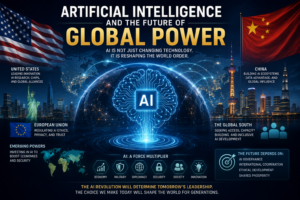
This article explores how artificial intelligence is reshaping the future of global power — from the US-China rivalry and the rise of “AI sovereignty,” to military applications, economic disruption, and the fragmenting landscape of global AI governance. Whether you’re a student of international relations, a business leader trying to understand geopolitical risk, or simply someone trying to make sense of the headlines, this guide lays out the landscape in plain language.
Why AI Has Become a Geopolitical Asset
To understand why AI now sits at the center of global power struggles, it helps to look at what makes it different from previous technological revolutions.
It’s a General-Purpose Technology
AI isn’t a single product — it’s closer to electricity or the internet: a foundational technology that touches nearly every sector at once. It affects manufacturing, healthcare, finance, agriculture, defense, education, and media simultaneously. A country or company that leads in AI doesn’t just gain an edge in one industry; it gains leverage across dozens of them at the same time.
It Compounds
Unlike a one-time infrastructure investment, AI capability tends to compound. Better models attract more users and more data, which improves the next generation of models, which attracts more investment, more talent, and more compute — creating a feedback loop that can turn a modest early lead into a dominant position. This dynamic is part of why governments are treating AI leadership as a race with real stakes for who ends up ahead structurally, not just temporarily.
It’s Dual-Use by Design
Almost every civilian AI capability has a military or intelligence application, and vice versa. A model trained to optimize logistics for e-commerce can just as easily optimize military supply chains. A vision model trained to detect defects on a factory line shares its core architecture with systems used for surveillance or autonomous targeting. This dual-use nature means that AI progress in the private sector has direct implications for national security — which is exactly why governments have stopped treating AI as a purely commercial matter.
Control Points Are Concentrated
Despite AI’s broad reach, the actual physical and technical chokepoints required to build frontier AI systems are remarkably concentrated: advanced semiconductor fabrication (dominated by a handful of companies and countries), large-scale data centers, specialized chip designs, and a small pool of top AI research talent. Whoever controls these chokepoints has outsized leverage over everyone else — which explains why export controls on chips and chipmaking equipment have become one of the sharpest tools of modern geopolitics.
The US-China AI Rivalry: The Defining Contest
No discussion of AI and global power is complete without addressing the central axis of competition: the United States and China.
America’s Edge — and Its Vulnerabilities
The United States maintains a substantial lead in several critical areas: frontier model research, advanced chip design (through companies like Nvidia), and access to the world’s largest pools of private capital for AI investment. American AI labs continue to set the pace for the largest and most capable general-purpose models, and US cloud providers remain the default infrastructure for much of the world’s AI development.
But this lead comes with vulnerabilities. The US AI ecosystem is heavily concentrated in a small number of companies, is highly dependent on semiconductor supply chains that run through Taiwan, and faces growing questions about energy capacity — training and running frontier AI models requires enormous amounts of electricity, and data centre power demand has become a genuine bottleneck for continued scaling.
China’s Rapid Catch-Up
China has narrowed the gap far faster than many Western analysts predicted just a few years ago. The emergence of highly efficient, lower-cost Chinese models — most famously the DeepSeek releases that shook global markets — demonstrated that Chinese labs could achieve near-frontier performance with a fraction of the compute historically assumed necessary. This matters enormously for the geopolitics of AI: if raw computing power becomes less of a bottleneck, US export controls on advanced chips lose some of their strategic bite.
China has also pursued a deliberate strategy of vertical integration — building out domestic chip manufacturing capacity, promoting home-grown AI frameworks, and pushing state-backed investment into AI infrastructure — precisely because it cannot always count on unrestricted access to the most advanced foreign hardware.
Export Controls as a Weapon
Washington has used export controls on advanced AI chips and chipmaking equipment as one of its sharpest tools against Beijing’s AI ambitions, restricting Chinese access to the most powerful Nvidia chips and the extreme ultraviolet lithography equipment needed to manufacture cutting-edge semiconductors. These controls have reshaped global supply chains, forced Chinese firms to develop workarounds, and pushed China to invest heavily in domestic chip production — with mixed results so far, but a clear long-term trajectory toward reduced dependency.
A Battle for Governance, Not Just Technology
The rivalry isn’t limited to who builds the best model. It extends into who sets the rules. China has been actively building alternative governance institutions and coalitions — most notably a new intergovernmental body announced in mid-2026 that brings together dozens of developing nations under a China-led framework for AI cooperation, explicitly positioned as an alternative to Western-dominated governance forums. Meanwhile, the US and its allies have pursued their own frameworks, such as the G7’s Hiroshima AI Process, aimed at coordinating AI safety and governance standards among like-minded democracies.
The result is a world edging toward two parallel governance tracks — one centred on Washington and its allies, another centred on Beijing and a coalition of developing and non-aligned nations — echoing earlier splits in telecom standards, 5G infrastructure, and semiconductor supply chains.
Beyond the US and China: Middle Powers and the Multipolar AI Race
While the US-China rivalry dominates headlines, it would be a mistake to treat AI geopolitics as a purely bilateral contest. A growing number of middle powers are carving out their own positions — not necessarily by trying to out-build the two AI superpowers, but by making smarter, more targeted bets.
The European Union: Regulation as Strategy
The European Union has taken a different path entirely: rather than compete head-on for frontier model dominance, it has positioned itself as the world’s leading AI regulator, having adopted the first comprehensive binding AI regulation of its kind. The EU’s strategy bets that setting the global standard for AI safety, transparency, and accountability can itself be a form of power — one that shapes how AI is built and deployed everywhere, even by companies based outside Europe, the same way EU data privacy rules ended up influencing global tech practices well beyond its borders.
India’s Rising Ambitions
India has emerged as one of the most closely watched middle powers in the AI race, leveraging its enormous pool of technical talent, a large domestic market, and government-backed initiatives like the India AI Mission. India has also positioned itself as a co-convener of major international AI summits, seeking to represent the interests of the Global South while also building out domestic compute and data capacity — an approach some analysts describe as chasing a kind of “data dividend” from its vast, uniquely diverse population of internet users.
The Gulf States: Capital and Compute as Leverage
Gulf nations, particularly the UAE and Saudi Arabia, have taken a distinctive approach: using massive sovereign wealth funds to buy stakes in leading AI labs and chip supply chains, while building some of the world’s largest new data center capacity. Their bet is that even without leading frontier research themselves, controlling capital and physical infrastructure gives them enduring leverage in the AI economy.
The “AI Sovereignty” Trend
Across nearly every region, a common theme has emerged: AI sovereignty — the idea that nations cannot afford to depend entirely on foreign-hosted AI models for critical functions like defence, finance, healthcare, and education. The logic goes that any country relying entirely on someone else’s AI stack risks becoming a kind of “digital colony,” renting its intelligence infrastructure from foreign powers and losing strategic autonomy in areas ranging from economic forecasting to cybersecurity.
This doesn’t mean every country is trying to build the entire AI stack — from chips to data centres to foundation models — from scratch. Analysts increasingly argue that most nations can’t and shouldn’t try to replicate the entire stack independently; instead, smart AI strategy involves choosing which layers to build domestically, which to buy from trusted partners, and where collaborative regional or bloc-based approaches make more sense than going it alone.
AI and Military Power
Perhaps nowhere are the stakes of AI competition higher than in defence and national security.
Autonomous Systems and Decision Advantage
Modern militaries are racing to integrate AI into everything from drone swarms and autonomous vehicles to logistics optimisation and battlefield intelligence analysis. The core promise is what strategists call “decision advantage” — the ability to process information, identify threats, and act faster than an adversary. In a conflict where both sides have similar hardware, the side with superior AI-driven situational awareness and faster decision loops may have a decisive edge.
Intelligence and Surveillance
AI has transformed intelligence gathering and analysis, allowing agencies to process vastly larger volumes of satellite imagery, communications intercepts, and open-source data than human analysts ever could alone. This has sparked debate within intelligence communities themselves about the balance between AI-assisted “smart spying” and the traditional tradecraft of human intelligence — with most experts concluding that the future lies in a hybrid model rather than a full replacement of human judgment.
Cybersecurity and Cyberwarfare
AI is reshaping cybersecurity on both offence and defence. On the defensive side, AI systems can detect anomalies and potential intrusions far faster than manual monitoring. On the offensive side, the same technology can be used to discover software vulnerabilities, craft more convincing phishing campaigns, or automate large-scale attacks — a dynamic that has made AI-related cybersecurity capability itself a matter of national security planning.
The Nuclear Question
A particularly sensitive frontier involves the intersection of AI with nuclear command and control. Most nuclear powers have publicly committed to keeping human decision-makers in the loop for any decision involving nuclear weapons, but as AI systems become more deeply embedded in early-warning and decision-support systems more broadly, questions about where automation ends and human judgment begins have become a recurring theme in arms control discussions.
Economic Power and the AI-Driven Restructuring of Global Trade
AI isn’t just reshaping military and governance dynamics — it’s restructuring the economic foundations of global power.
Compute as the New Oil
Just as oil defined 20th-century geopolitics — shaping alliances, wars, and economic dependencies — computing capacity has become one of the defining strategic resources of the AI era. Nations without adequate access to advanced chips, data centres, and energy to power them risk falling behind not just technologically, but economically, since AI is increasingly viewed as a core driver of future productivity and GDP growth.
Energy Constraints
The enormous energy demands of large-scale AI training and inference have turned electricity generation and grid capacity into a genuine bottleneck for AI ambitions. Countries with abundant, reliable energy — whether through nuclear power, natural gas, or renewables — have a structural advantage in hosting the data centres that AI development requires. This has sparked renewed interest in nuclear power specifically, along with growing competition over where new data centre capacity gets built.
Labor Markets and Economic Disruption
AI’s economic impact extends deep into labour markets, with automation increasingly affecting not just manufacturing jobs but white-collar knowledge work — including coding, legal research, customer service, and administrative functions. The geopolitical dimension here is significant: countries that manage this transition well, retraining workers and capturing the productivity gains, may see their competitive position strengthen, while those that don’t could face social and political instability that erodes their broader national power.
Currency and Financial Systems
Some analysts also point to a slower-moving but important dynamic: as AI reshapes global trade patterns and economic alliances, questions have emerged about the durability of existing financial architecture, including the US dollar’s role as the world’s reserve currency. While the dollar remains dominant given the lack of a clear alternative, growing geopolitical friction and a widening set of emerging alternatives have led some observers to expect the dollar’s relative position to gradually weaken over time — with knock-on effects for how AI infrastructure investment gets financed globally.
The Fragmenting Landscape of Global AI Governance
If there’s one clear trend running through all of this, it’s that global AI governance is fracturing rather than consolidating.
Competing Governance Blocs
Rather than one unified international framework for AI safety and regulation, the world appears to be splintering into multiple, only partially compatible governance tracks:
- A Western-aligned track, anchored by the G7’s Hiroshima AI Process and similar frameworks, emphasising frontier model safety, responsible-scaling commitments, and cooperation among like-minded democracies.
- A China-led track, built around new intergovernmental structures aimed at developing nations, emphasising capacity-building, technology transfer, and an explicitly non-conditional approach to membership that doesn’t tie participation to a country’s political system.
- A regulatory-first track, led by the European Union, which bets that comprehensive binding rules — even without leading frontier model development — can still shape global norms simply by virtue of market size and precedent.
- A middle-power convening track, exemplified by joint efforts between countries like France and India to host global AI summits aimed at translating high-level governance principles into practical, real-world partnerships.
Why Fragmentation Matters
This fragmentation has real consequences. Without a unified framework, companies operating internationally face a patchwork of divergent rules on data governance, model safety testing, and export restrictions — creating friction reminiscent of past divides in telecom standards and semiconductor supply chains. For smaller and developing nations, it also creates a difficult choice: align with one bloc’s technology and governance standards, try to straddle multiple blocs simultaneously, or attempt an independent path that risks isolation from the infrastructure investment either bloc can offer.
A Test of International Cooperation
Several analysts have framed the year ahead as a genuine test of whether international AI governance can evolve into something coherent and universally engaged, or whether it will remain fragmented — global in form, but geopolitical in substance, with parallel systems that coexist without ever truly integrating.
AI, Democracy, and Information Power
Beyond hard power — military and economic — AI is also reshaping a subtler dimension of global influence: the battle over information and narrative control.
Disinformation at Scale
Generative AI has dramatically lowered the cost of producing convincing text, images, audio, and video, raising serious concerns about the potential for state and non-state actors alike to conduct disinformation campaigns at a scale and sophistication that was previously impractical. This has become a recurring concern in discussions of election security and democratic resilience around the world.
Platform and Model Bias as Soft Power
The values, guardrails, and training data embedded in widely used AI models carry an inherent point of view — whether around historical events, political sensitivities, or social norms. As AI assistants become a primary way people access information, the question of whose values are baked into the world’s dominant AI systems becomes a genuine soft-power concern, not unlike debates in past decades over the global reach of Western media versus state-controlled broadcasters.
Digital Sovereignty as a Democratic Safeguard
For some nations, pursuing home-grown AI capacity isn’t just about economic competitiveness — it’s framed as a democratic safeguard, ensuring that critical information infrastructure isn’t entirely dependent on models built, trained, and governed by a foreign power with different values or interests.
What Comes Next: Signals to Watch
Given how quickly this landscape is evolving, a few concrete signals are worth watching closely in the months and years ahead:
Compute efficiency breakthroughs. Any further breakthroughs that reduce the amount of computing power needed to train frontier-level models — following the pattern set by highly efficient Chinese models in the past two years — could rapidly reshape the balance of power by making export controls on advanced chips less decisive.
Middle-power alignment. Watch which governance blocs attract additional middle powers over time. Growth in membership for China-led frameworks, expansion of Western-aligned coalitions, or the emergence of genuinely independent blocs will indicate how the multipolar AI order is settling.
Energy investment. Because AI scaling is increasingly constrained by electricity availability, national investments in nuclear, renewable, and grid infrastructure will be a leading indicator of which countries can sustain long-term AI leadership.
Military integration. The pace at which AI is integrated into core military decision-making — and the guardrails nations put around that integration — will shape both deterrence dynamics and arms control debates for years to come.
Talent flows. Where top AI researchers choose to live and work remains one of the most important, and most overlooked, indicators of long-term national advantage in this race.
Frequently Asked Questions
Why is artificial intelligence considered a geopolitical issue, not just a technology issue?
Because AI functions as a general-purpose technology with direct military, economic, and informational applications, it affects nearly every dimension of national power simultaneously — from GDP growth and military capability to information control and diplomatic leverage. That combination is why governments now treat AI development as a strategic priority rather than purely a private-sector matter.
Is the United States or China currently winning the AI race?
Most analysts agree the US retains an edge in frontier model research, chip design, and private capital, while China has narrowed the gap significantly through efficient model architectures and aggressive state-backed investment in domestic chip production. Neither side has a decisive, permanent lead, and the picture continues to shift quickly.
What is “AI sovereignty,” and why do countries care about it?
AI sovereignty refers to a country’s ability to build, host, and control its own AI infrastructure and models rather than depending entirely on foreign-owned systems. Countries pursue it to protect national security, preserve economic competitiveness, and avoid becoming overly dependent on infrastructure controlled by rival powers.
How are export controls being used in the AI race?
The United States has restricted exports of advanced AI chips and chipmaking equipment to China in an effort to slow Chinese progress on frontier AI systems. These controls have pushed China to invest more heavily in domestic semiconductor production and to pursue more compute-efficient AI training methods.
Is there a single global framework governing AI?
No. Global AI governance is currently fragmented across multiple competing frameworks, including Western-aligned processes like the G7’s Hiroshima AI Process, EU-led binding regulation, and newer China-led intergovernmental initiatives aimed at developing nations. There is no single, universally adopted governance structure.
How does AI affect military power?
AI enhances military capability through autonomous systems, faster intelligence analysis, improved logistics, and cyber capabilities, contributing to what strategists call “decision advantage” — the ability to observe, decide, and act faster than an adversary. Most nuclear powers maintain that humans remain in the loop for nuclear decisions specifically.
Why does energy matter so much for AI competition?
Training and running large AI models requires enormous amounts of electricity, making energy generation and grid capacity a real bottleneck for AI ambitions. Nations with reliable, abundant power sources have a structural advantage in hosting the data centre infrastructure that frontier AI development depends on.
Can smaller or developing countries compete in the AI race?
Most cannot realistically compete at the frontier model level, but many are finding other ways to build leverage — through regulatory influence, capital investment, hosting data infrastructure, participating in regional cooperation blocs, or focusing AI investment on practical, high-impact applications like agriculture, healthcare, and disaster preparedness rather than trying to build the entire AI stack independently.
What role does information and disinformation play in AI geopolitics?
Generative AI has made it dramatically easier and cheaper to produce convincing synthetic text, audio, image, and video content, raising concerns about large-scale disinformation campaigns, election interference, and the broader influence of AI model design choices on public discourse and democratic resilience worldwide.
Conclusion
Artificial intelligence has moved from the margins of geopolitics to its very centre. It shapes military doctrine, economic competitiveness, diplomatic alliances, and the information environments that underpin democratic and authoritarian systems alike. The contest for AI leadership is no longer confined to Silicon Valley boardrooms or academic conferences — it now runs through export control regimes, sovereign wealth fund investments, energy policy, and the founding charters of new international institutions.
What emerges from this landscape isn’t a single race with one finish line, but a multidimensional competition playing out simultaneously across chips, compute, capital, governance, and information. The United States and China remain the two central players, but a widening cast of middle powers — the European Union, India, Gulf states, and regional blocs across Africa, Asia, and Latin America — are carving out their own strategies rather than simply picking a side.
The future of global power, in other words, will increasingly be written in the language of algorithms, chips, and compute clusters — and the nations, alliances, and institutions that adapt fastest to that reality are likely to shape the balance of power for decades to come.
What is WAICO? CHINA’S new AI organisation explained
Top free AI tools for students in 2026.
Understanding International Relations: How the World Really Works
Realism in International Politics: Power, Security, and the Struggle for Survival