
Introduction
If you’ve been following global tech news over the past few weeks, you’ve probably seen the acronym WAICO popping up alongside headlines about China, artificial intelligence, and a “new world order” for AI governance. For many readers, it’s the first time the name has crossed their radar, and understandably so. This isn’t a startup, a chatbot, or a chip — it’s something bigger and, in some ways, more consequential: a brand-new intergovernmental organisation built entirely around artificial intelligence.
In this article, we’ll break down exactly what WAICO is, why China created it, who has joined, what it aims to do, and what it means for the future of global AI governance. Whether you’re a policy researcher, a tech journalist, a student, or just someone trying to make sense of the AI headlines, this guide will walk you through everything currently known about WAICO in plain, accessible language.
What Does WAICO Stand For?
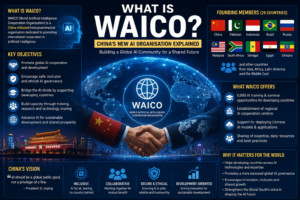
WAICO stands for the World Artificial Intelligence Cooperation Organisation. It is a newly established intergovernmental body, headquartered in Shanghai, China, designed to coordinate international cooperation on AI development, safety, and governance among its member states.
Unlike a company, a research lab, or a trade group, WAICO is meant to function the way organisations like the World Health Organisation or the World Trade Organisation function — as a permanent, treaty-based institution with member states, a secretariat, a headquarters, and an ongoing mandate. It is not a one-off summit or a temporary working group. It is designed to be a lasting piece of global infrastructure for AI diplomacy.
The organisation was formally established on July 16, 2026, in Shanghai, when representatives from 29 countries signed the founding agreement. It was then publicly unveiled the following day by Chinese President Xi Jinping in his keynote address at the opening of the 2026 World Artificial Intelligence Conference (WAIC), the annual flagship AI event that China has hosted in Shanghai since 2018.
The Origin Story: How WAICO Came to Be
WAICO didn’t appear out of nowhere. Its roots trace back roughly a year before its official founding.
The 2025 Proposal
The idea was first floated at the 2025 World Artificial Intelligence Conference in Shanghai, where Chinese Premier Li Qiang proposed the creation of a global body dedicated to AI cooperation. At the time, it was framed largely as a concept — a vision of AI as an “international public good” that shouldn’t be controlled or monopolised by a handful of countries or corporations.
Later that same year, President Xi Jinping reinforced the idea at the November 2025 APEC leaders’ summit, positioning China as an advocate for a more equitable, development-focused approach to AI governance — one that would give developing nations a genuine seat at the table, rather than leaving them to react to rules set elsewhere.
This proposal was part of a broader initiative China had already been pushing: the Global AI Governance Initiative, which argues that international AI rules should weigh development needs as seriously as safety concerns, rather than treating safety and control as the only priorities.
From Proposal to Institution
For a full year, the WAICO idea remained just that — an idea. No country had formally committed. That changed on July 16, 2026, when the concept was translated into a signed, binding founding agreement. Representatives from 29 countries signed the charter establishing WAICO as an actual institution, with Shanghai named as its permanent headquarters.
The timeline is notable: it took only about twelve months to go from a proposal with no committed members to a functioning organisation with 29 signatories. That pace surprised many observers, who had expected the initiative to remain largely rhetorical for longer.
The Official Launch: July 16-17, 2026
The formal signing of the WAICO charter took place a day before the opening of WAIC 2026, which ran from July 17 to July 20, 2026, in Shanghai. Chinese Foreign Minister Wang Yi signed the agreement on behalf of Beijing, alongside foreign ministers and senior officials from the other 28 founding states.
United Nations Secretary-General António Guterres was present for the proceedings, lending a degree of international legitimacy to the launch, alongside other heads of state and government, including Thailand’s Prime Minister Anutin Charnvirakul and Pakistan’s Deputy Prime Minister Mohammad Ishaq Dar.
The following day, Xi Jinping delivered his keynote address at WAIC 2026 — notably, his first appearance delivering the conference’s opening keynote. In his speech, Xi argued that AI is becoming a new engine of economic growth and is moving from the “digital world” into the “physical world,” and called for nations to pursue open collaboration, faster innovation, and real-world applications so that AI can benefit industries across the entire economy. He also pushed for a consensus-based, globally shared framework for AI governance — one built on cooperation rather than domination by a single country.
Alongside the WAICO announcement, WAIC 2026 itself was a massive showcase: more than 1,100 international AI companies displayed over 3,000 products and technologies, including more than 300 global debuts. Among the headline unveilings was an agentic AI smartphone capable of operating autonomously rather than simply responding to commands, and Huawei’s Atlas 950 supercomputer, reportedly built with 8,192 chips.
Who Are WAICO’s Founding Members?
One of the most talked-about aspects of WAICO is who signed on — and, just as importantly, who didn’t.
The 29 Founding Countries
According to the founding agreement and official Chinese government sources, the 29 founding member states of WAICO are:
Algeria, Belarus, Brazil, Cambodia, Cameroon, China, Congo, Cuba, Ethiopia, Indonesia, Kazakhstan, Kenya, Kyrgyzstan, Laos, Lesotho, Malaysia, Myanmar, Mozambique, Nicaragua, Oman, Pakistan, Russia, Senegal, Serbia, South Africa, Tajikistan, Uzbekistan, Venezuela, and Zambia.
Roughly speaking, this list breaks down into about ten African nations, a dozen Asian nations, and a cluster of Latin American and Eastern European members, alongside China itself.
Notable Absences
Perhaps just as important as who joined is who stayed away. No G7 economy and no European Union member state appears on the founding roster. That means the United States, the United Kingdom, the European Union as a bloc (and its member states individually), Japan, South Korea, Australia, and New Zealand are all absent — essentially every country currently leading frontier AI model development sat this one out.
This is not a coincidence. It reflects a deliberate structural choice, one that both supporters and critics have pointed to as defining WAICO’s character from day one.
What Does WAICO Actually Aim to Do?
WAICO’s stated mission, as described in its founding materials and by Chinese officials, centres on a few core goals:
1. Promoting a “People-Centered” and Inclusive Approach to AI
WAICO’s founding language frames its purpose as making sure AI remains beneficial, safe, and fair for everyone, aligned with the principles of the UN Charter. The emphasis is on a “people-centred” approach to AI development, rather than one dictated purely by commercial or national-security considerations.
2. Closing the Global AI Divide
A recurring theme across WAICO’s messaging is narrowing the technology gap between wealthy, AI-advanced nations and developing countries that lack the infrastructure, talent, or capital to compete. Xi Jinping has framed AI development as something that should be a shared global endeavour rather than the property of any single nation.
Concretely, China has pledged:
- 5,000 AI training and seminar opportunities for developing countries over the next five years.
- Cooperation centres established jointly with regional blocs including ASEAN, the African Union, and BRICS.
- AI systems applied to meteorology for around 30 countries, intended to strengthen early-warning systems for extreme weather and natural disasters.
3. A Development Fund for AI Startups
Reports around the launch also describe plans for a WAICO Development Innovation Fund — a pool of capital, financed by contributions from developed countries and major technology companies, earmarked specifically to support AI startups in developing nations.
4. Open Membership, No Political Conditions
A defining feature of WAICO, according to its founding agreement, is that membership is open to any sovereign state, without conditions tied to political systems or values. This stands in contrast to Western-led AI governance efforts, which tend to be limited to like-minded, similarly aligned democracies.
According to an analysis from Tsinghua University’s Centre for International Security and Strategy, WAICO’s design combines three features that no existing multilateral AI body currently offers together: open membership to any sovereign state, no political or regime-type test for entry, and an agenda explicitly built around development and closing the global capability gap.
How Is WAICO Structured?
WAICO is designed to function as an independent, membership-based intergovernmental organisation — not a subsidiary of the United Nations, and not a private industry consortium. Its headquarters is planned for Shanghai, reinforcing the city’s role as a national AI innovation hub within China.
That said, as of this writing, a great deal about WAICO’s internal machinery remains unpublished or unclear, including:
- The full text of WAICO’s founding charter and bylaws.
- How the secretariat will be staffed, funded, and run day-to-day.
- Whether membership involves binding obligations, or is purely voluntary and symbolic.
- What, if anything, the organisation can actually enforce among its members.
- How WAICO will interface with existing UN structures on AI governance, rather than duplicating them.
Several analysts have pointed out that a founding ceremony marks the start of an institution, not proof that the institution will function as intended. The real test, they argue, will come from three signals in the months ahead: whether the charter and secretariat details are published, whether additional countries — especially non-aligned middle powers — join, and how WAICO members behave inside existing UN AI processes.
Why Is China Doing This Now?
To understand WAICO, it helps to understand the broader context China is operating in.
Competing With Western-Led AI Governance Bodies
Several Western-led efforts already exist to govern AI at an international level, including the Hiroshima AI Process (associated with the G7) and reported US-led efforts sometimes referred to as the “Pax Silica” initiative. These bodies tend to bring together advanced economies — wealthy, similarly aligned democracies — and have comparatively strict membership criteria.
China has openly criticised this model, arguing that governance forums hosted in places like the United Kingdom, South Korea, France, and India have tended to concentrate power among a small club of advanced economies while sidelining the developing world. WAICO is explicitly framed as an alternative: broader, less restrictive, and oriented toward nations that have historically been left out of the conversation.
Navigating US Export Controls
There’s also a harder-edged strategic dimension. The United States has aggressively restricted China’s access to advanced AI chips and related technology through export controls. WAICO gives China — and its partner countries — an institutional venue to coordinate on AI development and standards outside the reach of US-controlled supply chains, at least in terms of governance and cooperation frameworks, even if the underlying hardware constraints remain a separate battle.
Building Soft Power and Global Influence
By positioning itself as the convenor of a body focused on training, capacity-building, and technology transfer, China is also making a broader soft-power play. Offering thousands of training slots, dedicated cooperation centres with ASEAN, the African Union, and BRICS, and AI-powered tools for things like disaster preparedness gives China tangible, easy-to-point-to benefits it can offer partner nations — benefits that may resonate more with developing economies than abstract debates about model safety standards.
An Emerging Pattern Familiar From Other Tech Sectors
Some commentators have noted that this mirrors a pattern seen before in other technology domains — telecom standards, 5G infrastructure rollout, and semiconductor supply chains have all, over time, split into a “Western track” and a “Chinese track,” each with its own preferred vendors, standards, and geopolitical alignments. WAICO, in this reading, is simply the AI governance version of a divide that has already played out elsewhere in global tech.
Global Reactions to WAICO
Reactions to WAICO’s launch have varied sharply depending on where you’re standing.
Reactions From ASEAN and the Global South
Among many ASEAN nations — Cambodia, Indonesia, Laos, Malaysia, and Myanmar are all founding members — the response has generally been positive, at least in the short term. These governments have welcomed the emphasis on capacity-building and closing the technology gap, since many face similar structural challenges: limited AI talent pipelines and underdeveloped digital infrastructure.
Reactions From Western Capitals
Reactions in Western capitals have been notably muted, bordering on dismissive in some quarters. Analysis from groups like the Simon Institute for Longterm Governance has characterised WAICO’s membership structure as deliberately designed to exclude Western democracies while giving China outsized influence over AI standards across the developing world.
France, in particular, has been among the most vocal European critics. French officials have argued that WAICO risks normalising authoritarian approaches to AI governance and have described it as, in effect, an attempt to undermine the existing Hiroshima Process framework that Western nations have invested in.
A Fracturing Global Governance Landscape
Taken together, most analysts agree on one point: WAICO is a strong signal that AI governance is fragmenting along geopolitical lines, potentially solidifying into parallel ecosystems for standards, data governance, and infrastructure — with limited interoperability between them. Rather than one unified global framework for AI safety and regulation, the world may be heading toward two or even three separate tracks: a Western-aligned model (built around bodies like the Hiroshima Process), a China-led model (WAICO), and a patchwork of countries and regional blocs still deciding where to align.
WAICO vs. Western AI Governance Efforts: Key Differences
It’s worth laying out, side by side, how WAICO differs from existing Western-led AI governance initiatives.
Membership criteria: WAICO is open to any sovereign state with no political or regime-type conditions attached. Western-led bodies like the G7’s Hiroshima AI Process tend to be restricted to like-minded, similarly governed democracies.
Primary focus: WAICO’s stated priority is narrowing the development gap between rich and poor nations — training, infrastructure, and capacity-building. Western frameworks have generally centred more heavily on frontier model safety, existential risk, and responsible-scaling commitments from leading AI labs.
Founding members: WAICO’s 29 founding states are drawn overwhelmingly from Africa, Asia, Latin America, and Eastern Europe, plus China and Russia. Western initiatives draw their membership from G7 nations, the EU, and closely aligned democracies such as South Korea, Japan, and Australia.
Institutional model: WAICO positions itself as an independent, UN-Charter-aligned intergovernmental body headquartered in Shanghai. Western efforts are often structured as multilateral processes or summits (like Hiroshima) rather than standalone treaty organisations with a permanent secretariat — though this is an area where WAICO’s own institutional details are still being finalised.
Underlying motivation: WAICO is explicitly tied to countering a perceived Western monopoly on AI governance and offering an alternative venue outside the reach of US export controls. Western frameworks have generally emerged from concerns about AI safety, misuse, and maintaining leadership among allied democracies.
What Happens Next? Three Things to Watch
Several China-watchers and AI policy analysts have pointed to three concrete signals that will determine whether WAICO becomes a substantive institution or remains largely symbolic:
1. Publication of the charter and secretariat details. A real institution needs a published founding document, a functioning headquarters build-out in Shanghai, and named staff running day-to-day operations. Their continued absence would suggest WAICO remains more of a signalling exercise than an operating body.
2. Membership growth. Whether additional countries — particularly non-aligned middle powers that haven’t yet picked a side — choose to join in the months following the launch will indicate whether WAICO has genuine pull, or whether its membership is effectively fixed at the initial 29.
3. Behaviour inside UN AI processes. Perhaps the clearest test of WAICO’s real intent will be how its members act within existing United Nations AI governance processes: whether they begin coordinating positions as a bloc, and what kind of norms they push for when they do.
For context, 29 member states is a meaningful founding cohort, but it’s small compared to the roughly 190 countries in the UN system, and it currently doesn’t include any of the world’s largest advanced economies. If WAICO’s membership grows — especially by attracting additional middle powers — it could meaningfully increase its institutional weight. If it stays roughly where it started, it may end up functioning more as a China-aligned bloc than a truly universal governance body.
Frequently Asked Questions About WAICO
What does WAICO stand for?
WAICO stands for the World Artificial Intelligence Cooperation Organisation, a new intergovernmental body focused on AI cooperation and governance.
When was WAICO founded?
WAICO was formally established on July 16, 2026, when 29 countries signed its founding agreement in Shanghai, China. It was publicly unveiled by President Xi Jinping the following day at the opening of the 2026 World Artificial Intelligence Conference.
Where is WAICO headquartered?
WAICO’s headquarters is based in Shanghai, China.
Which countries are members of WAICO?
The 29 founding members are Algeria, Belarus, Brazil, Cambodia, Cameroon, China, Congo, Cuba, Ethiopia, Indonesia, Kazakhstan, Kenya, Kyrgyzstan, Laos, Lesotho, Malaysia, Myanmar, Mozambique, Nicaragua, Oman, Pakistan, Russia, Senegal, Serbia, South Africa, Tajikistan, Uzbekistan, Venezuela, and Zambia.
Is the United States a member of WAICO?
No. The United States, the United Kingdom, the European Union and its member states, Japan, South Korea, Australia, and New Zealand are all absent from WAICO’s founding membership.
What is WAICO trying to achieve?
WAICO’s stated goals include promoting a people-centred, cooperative approach to AI development, narrowing the technology gap between wealthy and developing nations, funding AI startups in developing countries through a dedicated investment fund, and offering thousands of AI training opportunities to developing nations over the next five years.
Is WAICO connected to the United Nations?
WAICO is not a UN body, but its founding agreement states that it aims to operate in line with the principles of the UN Charter. UN Secretary-General António Guterres attended the launch event, but WAICO itself is an independent organisation.
How is WAICO different from the G7’s Hiroshima AI Process?
The Hiroshima Process is limited to G7 nations and like-minded democracies and focuses heavily on frontier model safety. WAICO is open to any sovereign state regardless of political system, and centres its agenda on development, capacity-building, and closing the AI access gap for the Global South.
Why didn’t Western countries join WAICO?
No official Western government has explained an outright refusal to join, but analysts point to structural reasons: Western nations already have their own AI governance frameworks (like the Hiroshima Process and the EU AI Act), and some officials — particularly in France — have expressed concern that WAICO could normalise governance models incompatible with existing Western regulatory approaches.
Will more countries join WAICO in the future?
That remains to be seen. Analysts are watching closely to see whether additional middle-power or non-aligned countries join in the months following the July 2026 launch, which would be a strong signal of WAICO’s real-world influence.
Conclusion
WAICO — the World Artificial Intelligence Cooperation Organisation — represents one of the most significant developments in global AI policy so far this decade. Born from a proposal floated just a year earlier at WAIC 2025, it moved remarkably quickly from concept to signed institution, with 29 countries committing to a Shanghai-headquartered body built around open membership, development-focused priorities, and an explicit break from Western-led AI governance norms.
Whether WAICO becomes a genuinely influential institution or remains a largely symbolic bloc will depend on details that are still unfolding: the publication of its charter, the buildout of its secretariat, whether its membership grows beyond the initial 29, and how its members behave inside broader UN AI governance conversations. What’s already clear, though, is that WAICO marks a turning point — a visible, concrete step toward a world where AI governance is no longer shaped by a single bloc of nations, but is instead splitting into competing tracks, each offering a different vision of who gets a seat at the table and what “responsible AI” should actually mean.
For now, the world is watching Shanghai as closely as it’s watching Washington and Brussels — and WAICO is likely to be a name that keeps reappearing in AI policy discussions for years to come.