
An opinion
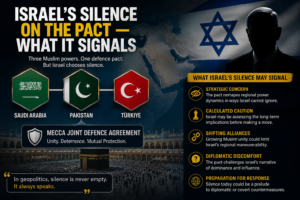
There is a school of thought, popular among foreign policy commentators, that treats silence as a form of mastery. The wise state, in this telling, says nothing while its rivals posture, and lets the noise of others expose their weakness. I don’t buy it — not in this case. When Saudi Arabia, Turkiye, and Pakistan signed a mutual defence pact in Mecca on August 7, 2026, and Israel’s government responded with days of official silence, I don’t think we were watching restraint. I think we were watching a government that, for the first time in a long while, genuinely did not know what to say — and decided that saying nothing was safer than admitting it.
That’s a stronger claim than most of the coverage of this story has been willing to make. Most of what’s been written treats the silence as a puzzle to be explained, a set of neutral possibilities laid out on a table: maybe it’s the Sabbath, maybe it’s caution, maybe it’s strategy. I think that even-handedness misses the point. The pieces of the puzzle, once you actually look at them together, point overwhelmingly in one direction. This isn’t a government carefully calibrating its response to a genuinely ambiguous development. This is a government cornered by its own contradictions, unable to say anything about the Mecca pact without indicting itself on one front or another — and choosing, as cornered governments often do, to say nothing at all.
I want to walk through why I believe that, because I think the case is actually pretty strong once you stop treating “we don’t know Netanyahu’s inner thoughts” as a reason to avoid drawing any conclusions. You don’t need to read minds to read patterns. And the pattern here is not subtle.
The Silence Doesn’t Fit the Pattern — And That’s the Point
Start with the baseline. Israeli officials are not, as a rule, quiet people when it comes to regional security developments. This is a government that has spent the better part of a year in open verbal combat with Turkiye’s leadership — Erdogan calling Israeli military activity in Syria and Lebanon a direct threat to Turkish security, Netanyahu calling Erdogan an authoritarian bigot in return, foreign ministers trading accusations of incitement. This is a government whose prime minister’s office fired off a public accusation against Pakistan’s defence minister within what appears to have been hours of a critical remark, before quietly deleting it. This is not a government that sits on its hands.
So when that same government says nothing — not a statement, not a background briefing, not even the usual anonymous “senior official” quote that Israeli outlets can usually produce on demand — for more than three days after a pact is signed that ties together two of its most vocal recent antagonists with the one Gulf state it has spent years trying to court, I don’t think “they were being careful” is a sufficient explanation. Care that convenient looks a lot like avoidance.
I think the honest reading is this: Netanyahu’s government doesn’t have a clean story to tell about the Mecca pact, because every available story it could tell makes it look bad in some way. And rather than pick the least damaging option, it has, for now, picked none of them.
Three Bad Stories and No Good One
Let me lay out why I think there isn’t a comfortable narrative available here, because I think this is the crux of the whole thing.
Story one: “This is a serious new threat.” The problem with this story is obvious — it’s an admission of failure. If the Mecca pact really is a meaningful new alignment against Israeli interests, then it represents years of Israeli regional strategy failing to prevent exactly the kind of coalition-building that strategy was supposed to prevent. Worse, it would mean that the courtship of Saudi Arabia — the yearslong, high-profile push by both Netanyahu and Donald Trump to fold Riyadh into the Abraham Accords — has not just stalled but actively lost ground to a rival bloc. No incumbent prime minister wants to stand up two months before an election and say, in effect, “my signature regional diplomatic project just got outflanked by Ankara and Islamabad.”
Story two: “This is nothing to worry about.” This story has its own trap. If Netanyahu’s government dismisses the pact as insignificant and then something does happen down the line — a Houthi strike on a Saudi target that triggers even a limited, symbolic response from Turkiye or Pakistan — the dismissal becomes a liability instantly. It hands every political rival a ready-made line: he told you not to worry. In a country where security misjudgments have ended political careers before, that is not a risk any embattled incumbent takes on lightly, and Netanyahu, heading into a genuinely competitive race against Gadi Eizenkot, is about as embattled as he’s been in years.
Story three: “This proves I was right about Turkiye all along.” This is the story that fits Netanyahu’s own prior rhetoric best — he has, after all, spent months building up Turkiye as a strategic threat, reportedly even lobbying against F-35 sales to Ankara. On the surface, this looks like the easiest of the three narratives to reach for. But it has a hidden cost: leaning into it means implicitly conceding that Saudi Arabia — the country he has spent so much political capital trying to bring into Israel’s orbit — chose the Turkish-Pakistani axis over him. You cannot claim vindication on Turkiye without also explaining why Riyadh just stood next to Erdogan and signed something with him instead of moving closer to Jerusalem. That is not a comfortable position to defend in a campaign.
Three stories, three different ways of looking weak, evasive, or wrong. I don’t think it’s a coincidence that the government has instead chosen a fourth option: none of the above, for now.
Bennett Is Already Telling the Story Netanyahu Won’t
Here’s what I find most revealing about the whole episode, and what I think gets underplayed in a lot of the coverage: Netanyahu’s silence has not created a vacuum. It’s just left the space open for someone else to fill it — and Naftali Bennett has filled it eagerly.
Back in February, months before the Mecca pact existed, Bennett gave a speech warning specifically about the danger of a “hostile Sunni axis” involving a nuclear-armed Pakistan, and he described Turkiye in stark terms as “the new Iran.” That’s not a vague, after-the-fact prediction dressed up to look prescient. That’s a specific warning about a specific configuration of countries, delivered before the thing it warned about happened. Whatever else you think about Bennett’s politics, that’s a genuinely uncomfortable coincidence for Netanyahu to sit with two months before an election.
And Bennett’s allies are not being shy about using it. The pact is already being framed, in some corners of the Israeli political conversation, as proof that Netanyahu’s foreign policy has left the country more exposed, not less — that the prime minister’s signature achievement, the normalization push with the Gulf, has been quietly overtaken by an alternative alignment he didn’t see coming and can’t now spin his way out of. Daniel Levy’s read on this seems right to me: expect Netanyahu’s opponents to treat Saudi Arabia’s presence in this pact as living proof of a diplomatic failure, and expect Netanyahu himself to respond not by engaging directly but by changing the subject — pivoting to his relationship with India’s Narendra Modi, a leader who happens to be Pakistan’s most obvious strategic rival, as if that were an adequate answer to the actual question being raised.
I don’t think that’s a strategy. I think that’s a dodge. And voters — Israeli voters in particular, who tend to be unusually attentive to security questions — are generally pretty good at recognising a dodge when they see one, even when it’s wrapped in a warm photo-op with a foreign leader.
The “We’re Just Being Careful” Defence Doesn’t Hold Up
I want to take the more charitable explanations for the silence, because I think dismissing them without engagement would be intellectually lazy. So let’s actually test them.
The Sabbath explanation is real but limited. Yes, the pact was signed on a Friday, and yes, that meant an immediate Saturday response was never realistic. But the Sabbath ends at sundown on Saturday. It does not explain three-plus days of continued silence through Sunday, Monday, and beyond. If this were purely a matter of religious observance delaying an otherwise-ready statement, we’d have seen that statement by Sunday morning at the latest. We didn’t.
The “we don’t want to inflate its significance” explanation is more interesting, and I think it contains a kernel of truth — but it’s not the whole truth, and I think people who lean on it too heavily are being generous in a way the evidence doesn’t fully support. It’s true that governments sometimes choose not to dignify a rival’s move with a response, on the theory that engaging with it lends it credibility it might not otherwise have. But that logic usually applies to symbolic gestures, not to formal, signed, trilateral security agreements involving a nuclear-armed state, a G20 economy, and the custodian of Islam’s two holiest sites. You can decide the Mecca pact is mostly symbolism — plenty of credible analysts, including Ahron Bregman, have made exactly that argument, suggesting the pact is really about deterring Iran rather than confronting Israel directly. But “mostly symbolic” is a conclusion you reach after analysis, not a default assumption a government gets to hide behind indefinitely while it works out what it actually thinks.
And the “genuine uncertainty about what the pact means” explanation, while real, cuts against the “careful strategy” narrative rather than supporting it. If Israeli officials genuinely don’t know whether this pact has operational teeth, that’s not evidence of masterful restraint — it’s evidence that Israeli intelligence and diplomatic channels didn’t see this coming clearly enough to have a ready assessment when it happened. That’s not a flattering admission, even if it’s an honest one.
Put these together, and what you get isn’t a coherent, deliberate strategy of silence. What you get is a government caught between multiple unappealing options, buying time not because it has a plan, but because it doesn’t yet have one — and doesn’t want to be seen not having one.
Why “Wait and See” Is Itself a Signal
There’s a version of this argument that says: isn’t “wait and see” just prudent statecraft? Shouldn’t a government take time to assess a new development before committing to a public position?
In the abstract, sure. But context matters, and the context here is an Israeli government that has, on nearly every other regional flashpoint of the past year, reacted quickly and often sharply — sometimes too sharply, as with the prime minister’s office’s deleted statement about Pakistan’s defence minister. A government that reacts fast to individual insults but goes quiet on a formal trilateral defence pact isn’t demonstrating a consistent doctrine of careful deliberation. It’s demonstrating that this particular development doesn’t fit neatly into any of the reactive scripts it already has on hand.
That inconsistency is itself the signal. Governments that have a clear read on a situation, even a cautious one, tend to say something — a holding statement, a general reaffirmation of security commitments, a vague expression of concern. The complete absence of even that minimal, low-risk category of response suggests something closer to genuine internal disagreement or uncertainty about how to characterize the pact at all. I don’t think that’s a controversial inference. It’s how most experienced diplomats and journalists read this kind of gap, even if they’re more diplomatic than I’m being about saying so directly.
The Deeper Problem: Israel’s Regional Story Isn’t Adding Up
Step back from the immediate pact and I think there’s a bigger issue underneath all of this, and it’s the one I find genuinely important rather than just tactically interesting.
For the better part of a decade, the dominant Israeli narrative about the region has rested on a specific bet: that traditional Arab-Israeli hostility was giving way to shared threat perception, mainly around Iran, and that this shared interest would eventually produce deeper normalization — first with the UAE and Bahrain, then, the hoped-for crown jewel, with Saudi Arabia. That bet was never crazy. It had real evidence behind it. But it also required Gulf states to keep reading their security interests the same way Israel wanted them to be read: Iran as the primary threat, Israel as a useful, if imperfect, partner in containing it.
The Mecca pact complicates that story in a way that I don’t think Israeli officials have fully reckoned with yet, at least not publicly. It suggests that Saudi Arabia’s answer to “how do I get more secure in a dangerous neighbourhood” isn’t necessarily “get closer to Israel.” It’s “build a security relationship directly with other regional and Muslim-majority powers instead” — powers that, unlike Israel, don’t come with the political cost, at home and across the Muslim world, of normalisation amid an unresolved and increasingly bloody conflict in Gaza. Andreas Krieg’s assessment — that Riyadh’s calculation is fundamentally about not trusting any single external guarantor, including the United States, to have its back — is worth sitting with, because it applies at least as much to Israel as it does to Washington. If Saudi Arabia doesn’t fully trust America’s security guarantees, why would it place any more trust in a security partnership with Israel, a country whose own regional standing has become dramatically more contested over the same period?
That is, I think, the real story Israel’s silence is protecting against having to tell out loud: not “we’re facing a new military threat,” but “our theory of how this region was going to reorganize itself around us may have been wrong.” That is a much harder thing for any government to say, and it’s a much harder thing for Netanyahu specifically to say, given how much of his political identity has been built around claiming exactly the opposite — that his diplomacy was reshaping the Middle East in Israel’s favor, one normalization deal at a time.
The Election Makes Honesty Even More Costly
None of this happens in a vacuum, and I don’t think you can separate Israel’s foreign policy silence from its domestic political moment right now. With elections scheduled for October and Netanyahu locked in a close race against Gadi Eizenkot, the incentive structure around any public statement on the Mecca pact tilts heavily toward avoidance rather than candor.
A prime minister fighting for political survival does not, generally, choose this moment to say something that could be read as an admission that a rival regional bloc has formed partly in response to his own government’s approach to the region. He also doesn’t want to hand his opponents — Bennett especially — a fresh news cycle built around his own past statements looking prophetic. The safest political move, in the short term, is exactly what we’ve seen: silence, paired with a quiet pivot to friendlier narratives, like the relationship with India, whenever the subject comes up in a controlled setting.
I understand the political logic. I even understand why, from inside a campaign war room, it might look like the smart play. But I think it’s worth naming plainly what this actually is: a foreign policy response being shaped primarily by electoral risk management rather than by a clear-eyed assessment of what the pact means and what, if anything, Israel should do about it. That’s not unique to Israel — plenty of governments let election calendars distort foreign policy responses — but it’s worth calling out rather than dressing up as strategic patience.
What I Think Happens Next
If I had to bet on how this plays out, I don’t think Israel stays silent forever — silence has a shelf life, and this story isn’t going away before October. I expect Netanyahu’s eventual public position, whenever it comes, to look something like what Daniel Levy has already sketched out: a downplaying of the pact’s practical significance, paired with a redirection toward Israel’s own alliance-building wins, India chief among them. I expect Turkiye, not Saudi Arabia or Pakistan, to be singled out as the primary target of whatever rhetorical pushback does eventually come, because criticizing Ankara fits neatly into a threat narrative Netanyahu has already spent months constructing, while criticizing Riyadh directly would mean confronting the failure of his own normalization strategy head-on — something I don’t expect him to do voluntarily, especially not in the middle of a campaign.
I also expect this to keep being litigated more aggressively by Netanyahu’s opponents than by Netanyahu himself. Bennett has too clean a narrative hook here — a specific, dated, public warning that now reads as prescient — to let this fade quietly. If anything, I’d expect the loudest Israeli voices on this pact over the next few months to belong to people trying to unseat Netanyahu, not to Netanyahu’s own government.
Why This Matters Beyond One Government’s Discomfort
It would be easy to read all of this as a fairly narrow story about Israeli electoral politics, interesting mainly to people who follow Knesset horse-races closely. I don’t think that’s the right takeaway.
The more important point is this: mutual defence pacts like the one signed in Mecca work, in part, by forcing exactly this kind of reckoning on the states they implicitly concern. A pact doesn’t need to fire a single shot to change the strategic picture — it changes it simply by making the target audience recalculate its assumptions, publicly or privately, competently or clumsily. What we’re watching with Israel’s silence isn’t a sideshow to the Mecca pact story. It is, in a very real sense, the pact already working exactly as a piece of strategic signaling is supposed to work — producing hesitation, internal disagreement, and a scramble for the least damaging public posture in the country it was arguably most aimed at, whether or not its authors ever say so out loud.
That, to me, is the real lesson of the last few days. Not that Israel is being clever by staying quiet. But that the quiet itself is proof of how much the ground has shifted — enough that the country most likely to be affected by a new regional alignment still, days later, cannot find a version of the truth about it that it’s willing to say out loud.
A Final Word
I don’t think Israel’s silence on the Mecca pact will look, in hindsight, like a masterstroke of restraint. I think it will look like what it currently feels like: a government caught between an uncomfortable set of truths, none of which it wants to be the one to say first, buying time not because it has found the right words, but because it hasn’t yet — and because, with an election bearing down, the cost of getting those words wrong has never felt higher.
Silence can be strategy. But it can also just be the sound a government makes when it doesn’t yet know what to say. I think, right now, this is the second kind.
The Mecca Pact Already Failed Its First Test. Nobody Wants to Say So Out Loud.
Israel’s Silence on the Mecca Defence Pact: What It Really Signals