
Introduction
Read enough coverage of the Mecca Joint Defence Agreement from enough different outlets, and a strange thing starts to happen. You begin to notice that you’re not really reading about one event anymore. You’re reading about three.
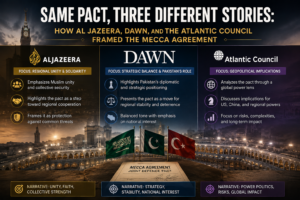
There’s the event as Al Jazeera describes it — a defensive pact born of Middle Eastern crisis, explained through the language of deterrence and regional stability, sourced heavily to the three governments’ own joint statement. There’s the event as Dawn describes it — a Pakistani strategic achievement, a “safety net,” a maritime and economic opportunity as much as a military one, covered with the pride and specificity of a home audience watching its country do something significant on the world stage. And there’s the event as the Atlantic Council describes it — an “inflection point” in a “multipolar order,” analyzed less for what it says about the three signatories themselves and more for what it says about the erosion of a US-centered security architecture that Western foreign-policy institutions have spent decades studying, defending, or worrying about.
None of these three framings is dishonest. That’s the part worth sitting with. Each outlet is reporting real facts, quoting real officials, and drawing conclusions that follow logically from the evidence available to it. But the emphasis, the sourcing, the implicit audience being addressed, and — most tellingly — the questions each outlet chooses to ask first, differ enough that a reader who only consumed one of these three accounts would walk away with a meaningfully different understanding of what just happened in Mecca on August 7, 2026.
This is not a story about bias in the pejorative sense. It’s a story about perspective, and about how the same set of facts gets filtered through different institutional purposes, different national vantage points, and different assumed readerships. Understanding those filters is, I’d argue, one of the more useful media-literacy exercises available right now, because the Mecca pact is exactly the kind of story — multinational, security-focused, ideologically loaded — where framing differences tend to be sharpest and most instructive.
Al Jazeera: The Regional Explainer, Sourced to the Signatories
Start with Al Jazeera, because its coverage sits closest to the ground — literally, given the network’s headquarters in Doha and its long-standing role as the dominant English- and Arabic-language news outlet covering Middle Eastern affairs from within the region rather than from outside it.
Al Jazeera’s initial coverage of the signing leads with the practical, almost procedural details: who signed, where, under what name, and against what backdrop. Its reporting identifies the agreement’s formal title — the Mecca Joint Deterrence Agreement, distinct from some of the alternate names used elsewhere — and describes its core mechanism in the same language the three governments themselves used: intended to provide collective deterrence against any act of aggression, with an armed attack against any of the three to be regarded as an attack on all. This is significant. Al Jazeera’s framing choice here is to let the signatories define their own agreement in its own words, rather than immediately reaching for external comparisons or analytical framing devices.
That’s a meaningful editorial decision, and it’s consistent with how Al Jazeera generally covers major Middle Eastern diplomatic developments: with heavy reliance on official statements and regional expert voices, and comparatively less immediate reach for Western analytical frameworks like NATO comparisons. When Al Jazeera does introduce outside analysis, it tends to frame the pact in terms of what it will do to the region’s own “security architecture” — its own coverage includes the assessment that the pact would “reshape” that architecture, attributed to unnamed experts, without immediately trying to slot the agreement into a pre-existing Western category like “Islamic NATO.”
There’s also something worth noting in Al Jazeera’s choice of secondary detail. Its reporting mentions that the deal followed nearly a year of negotiations — a detail that reframes the pact from a sudden reaction to the ongoing US-Israel war on Iran into something more deliberate and longer-planned, undercutting a narrative of panic or crisis improvisation. It also details the existing defence relationships underpinning the new agreement: decades of Pakistani training and technical assistance to Saudi forces, warship and training-aircraft exchanges between Turkiye and Pakistan, and a major 2023 Saudi purchase of Turkish drones. This is coverage aimed at readers who are assumed to already understand, or want to understand, the texture of intra-regional relationships — coverage that treats Middle Eastern military cooperation as a longstanding, evolving fact of regional life rather than a novel geopolitical surprise requiring translation for an outside audience.
What Al Jazeera’s coverage notably underplays, at least in its initial reporting, is skepticism about the pact’s practical enforceability. There’s little early emphasis on whether the “attack on one is an attack on all” clause would actually produce binding military action, and comparatively little space given to the kind of “will it actually work” questioning that shows up more prominently in Western commentary. This isn’t necessarily an omission driven by boosterism — it may simply reflect an editorial judgment that the diplomatic and symbolic significance of the agreement is the more immediately newsworthy angle, with operational questions to be explored in follow-up analysis once more details or real-world tests become available. But the effect, intentional or not, is coverage that treats the pact’s stated purpose and the pact’s actual capability somewhat interchangeably in its earliest framing.
Dawn: The Home-Team Achievement, Told Through National Pride and Strategic Opportunity
If Al Jazeera’s coverage reads like a regional explainer, Dawn’s reads like something closer to a national milestone being narrated for the people it directly affects.
This shows up first in small but telling details. Dawn’s reporting captured, for instance, that Islamabad police held a flag march to celebrate the joint defence agreement — the kind of granular, domestically resonant detail that a Pakistani outlet covers almost reflexively and that an outlet without a Pakistani readership would likely never think to include at all. That single detail says something important about how this story is being consumed inside Pakistan: not merely as a diplomatic development to be analyzed, but as a moment of national significance to be celebrated, marked, and narrated with the emotional register of an achievement.
Dawn’s longer-form analytical coverage — notably a piece by Muhammad Faisal published a week after the signing under the headline “The Mecca Pact, a safety net with no strings attached” — goes further still, framing the agreement in explicitly opportunity-centered terms rather than primarily threat-centered ones. The piece describes the pact as allowing the three countries to “take defense into their own hands as a backup without snubbing the US or leaning towards China” — language that frames Pakistan’s participation as a savvy, careful act of strategic balancing rather than a reactive alignment against any particular adversary. It goes on to describe the pact converting “one-on-one rivalries with Iran” into “a three-front headache for Tehran,” and highlights the agreement’s dimension of combining naval power to keep oil shipments and trade routes safe.
This is a substantively different emphasis than what you find in Al Jazeera’s or the Atlantic Council’s coverage. Dawn’s analysis spends real space on the Pakistan Navy’s expanding strategic horizon — coordinating maritime domain awareness, joint patrols, and naval exercises with Saudi and Turkish forces — treating the pact not primarily as a crisis response to the Iran war but as a long-term expansion of Pakistan’s own regional reach and relevance, building on and extending the 2025 bilateral Saudi-Pakistan agreement. Where Al Jazeera frames the pact through the lens of regional deterrence and the Atlantic Council frames it through the lens of great-power realignment, Dawn frames it substantially through the lens of what it means for Pakistan specifically: prestige, naval opportunity, economic access, and a diplomatic hedge that lets Islamabad deepen Gulf ties without alienating Washington or Beijing.
There’s also a notably different treatment of the “who is this aimed at” question. Dawn’s coverage of official Pakistani statements — including Foreign Minister Ishaq Dar’s comment that the agreement was purely defensive in nature, not directed against any country, and open to others willing to uphold its principles — is reported largely without the skeptical framing that Western commentary tends to layer on top of similar statements. Islamabad-based defence analyst Abdullah Khan is cited making a similar point: that despite being signed during heightened regional tensions, the agreement should not be interpreted as being directed against Iran or any other specific country. Dawn’s coverage largely takes this framing at something close to face value, consistent with an outlet whose primary audience has a direct stake in Pakistan’s government being seen internationally as a stabilizing, non-provocative actor rather than a party to an anti-Iran bloc — a framing that would carry real diplomatic and even domestic-political costs for Pakistan given its own complicated, historically important relationship with Tehran.
Dawn’s coverage also reveals a detail that other outlets treat more briefly: that pre-pact consultations reportedly involved Egypt, suggesting the emerging framework is intended as something broader and more flexible than a closed trilateral club. This detail supports Dawn’s broader “opportunity, not threat” framing — a pact designed to grow, invite, and stabilize, rather than one designed primarily to confront.
The Atlantic Council: The Systemic Read, Filtered Through Great-Power Competition
Turn to the Atlantic Council’s coverage, and the frame shifts again — this time toward the vocabulary and preoccupations of Western foreign-policy analysis, an institutional tradition built around assessing how developments like this one affect the durability of US-led global and regional order.
The Atlantic Council’s own dispatch on the signing opens with language that immediately signals this orientation: the agreement “represents an inflection point in the emerging multipolar order in the Middle East and South Asia.” That phrase — multipolar order — is doing significant framing work. It situates the Mecca pact not primarily as a story about Saudi Arabia, Turkiye, and Pakistan’s own regional relationships, but as a data point in a much larger, ongoing Western foreign-policy conversation about whether the post-Cold War, US-centered international system is giving way to something more fragmented and competitive. This is a framework built for a Washington-based, policy-community readership — one interested less in what the pact means for pilgrims in Mecca or army units patrolling Pakistan’s Gulf-facing naval assets, and more in what it means for the long-term trajectory of American influence.
Consistent with this framing, the Atlantic Council’s analysis places unusually heavy emphasis on how the pact affects each country’s relationship to rivals other than each other. Its coverage describes Saudi Arabia seeing “important counterweights to Iran,” Pakistan providing a counterweight relevant to India, and — notably — frames Turkiye’s calculation in terms of enhancing “deterrence against Israel,” describing Ankara’s relationship with Israeli leaders as increasingly defined by rhetoric of “enmity and potential conflict.” This is a substantially more explicit invocation of Israel as a relevant frame than either Al Jazeera’s or Dawn’s initial coverage offers — and it reflects a broader pattern in how Western analytical outlets have approached this story: treating Turkiye-Israel tension as one of the more analytically interesting and geopolitically consequential threads running through the pact, worth foregrounding even though none of the three signatory governments named Israel in their own joint statement.
The Atlantic Council’s coverage also references the aftermath of “last year’s Israeli airstrike on Doha” as a contributing factor pushing regional states toward collective air-defence thinking — a piece of context that neither Al Jazeera’s nor Dawn’s early coverage foregrounds as prominently, and one that fits a broader pattern in Western think-tank analysis of treating Israeli military assertiveness as a central variable shaping the behavior of other regional actors, sometimes more central than those actors’ own public statements suggest it is to them.
This is where the contrast with Dawn becomes especially sharp. Where Dawn frames the pact substantially in terms of what Pakistan gains — naval reach, strategic balance, prestige — the Atlantic Council frames the same set of facts substantially in terms of what the pact reveals about shifting alignments relative to India, Iran, and Israel: the traditional “great powers and their rivals” lens that dominates Western security-studies writing. Neither framing is factually wrong. But a reader relying only on the Atlantic Council would likely come away thinking of Pakistan’s involvement primarily as a move in a broader India-Pakistan and Israel-Turkiye rivalry chess game, whereas a reader relying only on Dawn would likely come away thinking of Pakistan’s involvement primarily as a confident, opportunity-driven expansion of its own independent regional role — two readings that are compatible but carry very different emotional and political weight.
The Overlap: What All Three Actually Agree On
It would be misleading to make this sound like the three outlets are describing entirely different events. There’s a solid core of shared, verifiable fact running through all of this coverage, and it’s worth naming clearly, because the differences discussed above are differences of emphasis and framing layered on top of a genuinely common factual foundation, not competing versions of the basic story.
All three outlets agree on the mechanics: the pact was signed August 7, 2026, in Mecca, by Erdogan, Mohammed bin Salman, and Shehbaz Sharif; it builds on the September 2025 bilateral Saudi-Pakistan Strategic Mutual Defence Agreement; its core clause treats an attack on one signatory as an attack on all; and it arrives amid the ongoing US-Israel war on Iran, which has produced missile and drone strikes reaching Gulf oil exporters. All three also report, in some form, the same complementary-capabilities framing: Pakistan’s nuclear status and military experience, Saudi Arabia’s financial and political weight, and Turkiye’s defence-industrial and NATO-standard capabilities.
This shared foundation matters, because it tells you that the differences between these outlets are not primarily disputes over fact. They’re disputes over salience — over which facts deserve to lead the story, which need more elaboration, and which barely need mentioning at all given what each outlet assumes its readers already know or care about.
Why These Differences Exist: Audience, Institutional Mission, and Geography
It’s worth being explicit about why these framing differences show up so consistently, because I don’t think it reflects any single outlet doing something illegitimate. It reflects three fundamentally different institutional positions relative to the story.
Al Jazeera is a regional broadcaster whose core mission, self-understanding, and competitive advantage rests on covering Middle Eastern affairs from within the region, for audiences across the Arab and broader Muslim world as well as an international English-language audience seeking that regional vantage point. Its incentive structure rewards access to regional officials, credibility with Middle Eastern governments and publics, and a reporting style that treats intra-regional dynamics as the main event rather than as a subplot in someone else’s story. That naturally produces coverage that stays close to official statements and regional expert voices, and that is comparatively less quick to import external analytical frameworks.
Dawn is Pakistan’s most established English-language newspaper, and its core readership is Pakistani — inside the country and among its large global diaspora. A defence pact that meaningfully elevates Pakistan’s regional standing, expands its naval reach, and offers a diplomatic win without the domestic political costs of appearing to take sides against Iran is, almost definitionally, a good-news story for that audience, and Dawn’s coverage reflects the natural pull of covering a national achievement with something closer to pride than pure detachment — while still maintaining real reportorial rigor about the pact’s mechanics and regional context.
The Atlantic Council is a Washington-based foreign-policy think tank whose institutional purpose is explicitly about assessing developments through the lens of American strategic interest and the health of the broader US-led international order. Its analysts are trained in, and its readership expects, a vocabulary of polarity, alliance structures, and great-power competition — the same intellectual toolkit developed to analyze the Cold War and adapted since to analyze everything from Chinese Belt and Road investments to Gulf hedging strategies. A pact like this one almost inevitably gets read, in that environment, primarily as a symptom of American relative decline or recalibration, because that is the central preoccupying question the institution exists to examine.
None of these orientations are secret or dishonestly concealed — they’re baked into what each outlet is for. But they do mean that a reader who wants a genuinely well-rounded understanding of the Mecca pact needs more than one of these sources. Reading only Al Jazeera risks under-appreciating how the pact is being read as a signal about American and Israeli regional standing. Reading only Dawn risks under-appreciating how skeptically outside analysts view claims that the pact isn’t aimed at anyone in particular. Reading only the Atlantic Council risks over-indexing on great-power competition framing at the expense of the more immediate, human, regionally grounded stakes the pact carries for the people actually living in Pakistan, Saudi Arabia, and Turkiye.
The Israel Question: A Case Study in Framing Divergence
One of the clearest illustrations of how differently these outlets handle the same underlying fact set is the question of Israel’s place in the story.
None of the three signatory governments named Israel in their joint statement. All three insisted, publicly and repeatedly, that the pact was purely defensive and not aimed at any specific country. Given that shared starting point, you might expect roughly similar treatment of the Israel question across outlets that are all, in theory, reporting the same event.
Instead, the divergence is stark. The Atlantic Council’s analysis foregrounds Israel prominently and early, explicitly describing the pact as enhancing Turkiye’s “deterrence against Israel” and citing the prior year’s Israeli strike on Doha as important regional context — treating Israel as one of the central analytical keys to understanding why the pact exists at all. Dawn’s coverage, by contrast, keeps Iran as the dominant threat referent and treats Israel as a much more peripheral factor, consistent with Pakistan’s own diplomatic position of not officially recognizing Israel and generally avoiding language that would frame its own foreign policy in explicitly anti-Israel terms even when tension clearly exists. Al Jazeera’s early coverage sits somewhere in between — its broader coverage of the region’s tensions, including Turkiye-Israel friction over Gaza, is extensive elsewhere on the platform, but its direct reporting on the pact’s signing keeps closer to the signatories’ own “not aimed at anyone” language rather than immediately layering on an Israel-centric interpretive frame the way the Atlantic Council does.
This single thread — how much weight to give Israel in explaining why the pact exists — is, I think, the clearest evidence available that these outlets are making real editorial choices about emphasis, not simply relaying identical facts in different words. A reader encountering only the Atlantic Council’s framing could reasonably conclude that countering Israel is close to the pact’s central purpose. A reader encountering only Dawn’s or the earliest Al Jazeera coverage could reasonably conclude Israel is a marginal factor at most, with Iran doing almost all of the explanatory work. Both readings draw on real elements of the actual regional picture. Neither, on its own, is complete.
What Gets Lost When You Only Read One Source
Step back from the specific outlets, and there’s a broader lesson here about how coverage of multinational security pacts tends to fragment along predictable lines — regional outlets emphasizing intra-regional relationships and official framing; national outlets from within a signatory country emphasizing domestic significance and strategic opportunity; and Western policy-analysis outlets emphasizing systemic, great-power implications, often filtered through concerns — American decline, Israeli security, the durability of existing alliance structures — that may matter enormously to that outlet’s own readership without necessarily being the primary lens through which the signatory governments themselves understand what they just did.
I’d argue the healthiest way to read a story like this one is to deliberately consume at least one outlet from each of these three categories, precisely because each is likely to surface facts, sources, and interpretive angles the others underweight or omit. Al Jazeera will get you closer to how the signatories themselves are choosing to present the agreement, and to the texture of decades-old regional military relationships that make the pact feel less sudden than it might otherwise appear. Dawn, or an equivalent outlet from any of the other signatory countries, will get you closer to the domestic stakes, national pride, and strategic-opportunity framing that rarely survives translation into international coverage but that matters enormously to understanding why a government signed on in the first place. And the Atlantic Council, or comparable Western policy analysis, will get you closer to how the pact is likely to be read, worried about, or leveraged by the very great powers — the United States, Israel, China, India — whose reactions will shape how much the pact actually ends up mattering in practice.
None of these three lenses is more “objective” than the others in any meaningful sense. Objectivity, in coverage of an event this geopolitically loaded, isn’t really a property any single outlet can claim on its own — it’s something closer to an emergent property of reading across outlets with genuinely different vantage points and reconciling what they each notice and what they each leave out.
Conclusion
The Mecca Joint Defence Agreement is, factually, one event: three leaders, one signing ceremony, one core clause about collective deterrence. But the moment that event gets filtered through the editorial priorities of Al Jazeera, Dawn, and the Atlantic Council, it becomes something closer to three related but distinct stories — a regional deterrence pact grounded in decades of Middle Eastern military cooperation; a Pakistani strategic and naval achievement worth celebrating with a flag march in Islamabad; and a symptom of an eroding, US-centered global order, read partly through the lens of what it means for Israel’s regional position.
Understanding those differences isn’t about deciding which outlet got it “right.” It’s about recognizing that a story this consequential, touching this many national interests, was never going to be told the same way twice — and that the version most readers encounter probably says as much about which outlet they happened to read as it does about what actually happened in Mecca on the seventh of August.
The Mecca Pact Already Failed Its First Test. Nobody Wants to Say So Out Loud.
Israel’s Silence on the Mecca Pact Isn’t Strategy. It’s Paralysis.
Israel’s Silence on the Mecca Defence Pact: What It Really Signals