
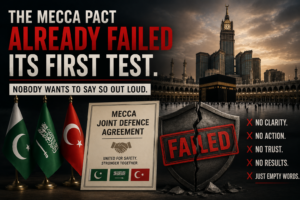
 An opinion
I don’t usually get to write a piece like this so soon after the thing I’m writing about happened. Normally, when you argue that a new defence pact is unlikely to produce real, binding action, you’re speculating — reasoning from history, from precedent, from the vague language in the text itself. You’re making an educated guess about the future.
I don’t have to guess this time. The future already happened.
Forty-eight hours after Saudi Arabia, Turkiye, and Pakistan stood together in Mecca and signed a pact declaring that an attack on one would be treated as an attack on all, the Houthi movement in Yemen fired a drone into a Saudi Aramco refinery in Jazan. It hit. It started a fire. Nobody was killed, but a facility processing 400,000 barrels of crude a day was damaged badly enough to require evacuation and firefighting. This was not a hypothetical test case dreamed up by a columnist trying to make a point. It was the real thing, arriving with almost comedic speed — as if the region itself wanted to know the answer just as badly as the analysts did.
And the answer arrived just as fast. Turkiye said nothing. Pakistan said nothing. No aircraft scrambled. No joint statement of retaliation. No consultation process visibly kicked into gear. The Jerusalem Post’s own reporting on the incident captured it about as bluntly as journalism gets: Turkey said nothing, Pakistan said nothing, and there was never really any reason to think otherwise.
I want to sit with that for a moment, because I think it deserves more attention than it’s gotten. A brand-new mutual defence pact, less than three days old, was tested by exactly the kind of attack it was ostensibly designed to deter — and the two treaty partners not directly hit did essentially nothing visible in response. If you were designing an experiment to test whether pacts like this actually produce NATO-style Article 5 responses, you could not have designed a cleaner one. And the experiment returned a result almost immediately: no.
I think the honest, if unfashionable, conclusion is this: pacts like the Mecca agreement are not built to produce Article 5 responses, and I don’t think they’re really designed to. I think they’re built to look like they might, which is a very different thing — and one worth taking seriously precisely because it’s less flattering than the alternative.
What Article 5 Actually Requires — And Why That’s the Wrong Bar
Before going further, it’s worth being precise about what we’re actually comparing here, because I think a lot of the commentary around “Islamic NATO” framing gets sloppy on this point.
NATO’s Article 5 doesn’t obligate every member to send troops the instant one member is attacked. What it does is establish a treaty-level commitment, backed by decades of joint military planning, integrated command structures, shared intelligence infrastructure, standardised equipment and training, and — critically — a track record of the alliance actually being invoked, as it was after September 11, 2001, when NATO allies did in fact commit forces to Afghanistan. Article 5 works not because of the sentence itself but because of everything built underneath that sentence over seventy-plus years: joint exercises, interoperable command chains, a habit of collective action reinforced again and again until it became close to automatic.
The Mecca pact has none of that scaffolding. It has a single sentence, signed on a Friday, by three countries that have never run a joint military exercise together as a trilateral bloc, that don’t share a unified command structure, and that — as Turkish Foreign Minister Hakan Fidan himself has now confirmed — don’t even commit to automatic action once that sentence is invoked. Fidan has said plainly that an attack on one member would not necessarily trigger an automatic military response, and that the members would instead consult first to determine the nature and scale of any assistance. That’s not Article 5. That’s a promise to talk about maybe doing something, which is a meaningfully different commitment, and I think it’s important to say so plainly rather than letting “similar to NATO’s Article 5” comparisons do rhetorical work the actual text doesn’t support.
So when I ask whether this pact “worked” after the Jazan strike, I want to be fair about what working would even mean. Nobody should have expected Turkish fighter jets over the Red Sea within forty-eight hours. But something should have happened — a statement of solidarity, a diplomatic protest lodged jointly, a visible consultation process, anything that signalled the pact was more than a signing ceremony. Instead, based on everything reported, we got silence from two of the three signatories, and a Saudi Arabia left to manage its own response, evaluating military options and pursuing diplomacy largely on its own.
The Precedent Nobody Wanted to Remember
Here’s what frustrates me most about how this pact was covered in its first forty-eight hours: the precedent for exactly this outcome was sitting in plain view the entire time, and almost nobody brought it up until the Jazan strike forced the comparison.
Saudi Arabia has belonged to a mutual defence framework through the Gulf Cooperation Council since the year 2000. That framework has existed through multiple Houthi attacks on Saudi territory, including previous strikes on Aramco facilities in Jazan and Yanbu, and through the 2019 drone and missile attack on Abqaiq and Khurais that temporarily knocked out roughly half of Saudi Arabia’s oil production — an attack far more consequential than the Jazan refinery fire. In none of those cases did the GCC’s collective defence framework produce anything resembling a coordinated Article 5-style military response from fellow member states. What it produced was statements, condolences, and Saudi Arabia handling its own retaliation and air defence, largely alone, sometimes with quiet American support behind the scenes.
If a twenty-five-year-old regional defence pact, involving countries that share language, religion, geography, and decades of institutional cooperation through actual joint military structures, has never produced a binding collective military response to a Houthi attack, why would anyone have expected a three-day-old trilateral pact between countries with far less institutional overlap to behave differently? I don’t think there was ever a good reason to expect otherwise. I think what happened instead was a lot of excited commentary in the pact’s first two days — Islamic NATO, Sunni axis, nuclear umbrella — that outran the evidence, followed by a very fast and very awkward correction once the evidence actually arrived.
Deterrence Without Enforcement Is Just a Hope
There’s a concept worth introducing here, because I think it explains what’s actually going on better than “the pact failed” does. Deterrence, as a strategic idea, works by raising the expected cost of an attack in the mind of a potential attacker before the attack happens. It doesn’t require an ironclad enforcement mechanism to have some effect — even a vague, uncertain threat of wider retaliation can make an adversary hesitate, because uncertainty itself carries a cost.
But deterrence that fails to hold — as it clearly did here, since the Houthis attacked anyway, less than two days after the pact’s ink dried — puts the pact in a genuinely awkward position. Either the Houthis and their backers in Iran didn’t believe the pact changed anything about their risk calculus, or they did believe it and attacked anyway to test it, betting correctly that the response would be muted. Either reading is bad news for the pact’s credibility. The first suggests the deterrent effect never existed in the first place. The second suggests it existed and was called, immediately, and lost.
I lean toward thinking it’s some mixture of both, but I don’t think it much matters which explanation is more accurate, because the practical result is the same either way: a real-world adversary tested the pact within seventy-two hours of its signing and paid no visible price for doing so. That is about as close to an empirical falsification of the “this changes the deterrence equation” argument as international relations ever produces. Most of the time, we’re left arguing in the abstract about whether a treaty’s deterrent effect is real. Here, we got a direct answer, almost immediately, and the answer wasn’t encouraging for anyone hoping this pact would function as advertised.
The Consultation Clause Is Doing a Lot of Quiet Work
I want to spend some real time on Fidan’s comment about consultation, because I think it’s the single most important — and most underdiscussed — detail to come out of this entire episode.
When a government builds an “attack on one is an attack on all” clause but attaches a consultation requirement before any response, it has, whether intentionally or not, built itself an escape hatch. Consultation takes time. Consultation can produce disagreement. Consultation can conclude, quietly and without any public announcement, that the triggering event didn’t rise to the level requiring a collective response — a determination that three governments with three different sets of domestic political pressures and three different relationships with Iran can reach through entirely private channels, with no obligation to explain their reasoning to anyone.
This is not a criticism of Fidan for saying it — I’d actually give him credit for a rare moment of candor in a diplomatic environment that usually prefers vague, aspirational language over honest description of limitations. But I think it’s worth being blunt about what that candor reveals: this pact, structurally, is built to allow non-response as a legitimate outcome. It’s not a bug that showed up after the fact. It was baked into the design from the start, and the Jazan strike simply gave the world its first chance to watch the design work exactly as built.
Compare this, again, to actual NATO practice. Article 5 also technically leaves room for members to determine what action is “necessary,” and it’s true that NATO doesn’t obligate identical military contributions from every member in every case. But NATO’s post-9/11 invocation still produced visible, coordinated, publicly announced action from multiple allies within weeks. The Mecca pact’s first test produced nothing visible within days — not even a joint statement condemning the strike, which would have cost the signatories nothing and would have at least demonstrated the “consultation” process Fidan described was actually happening.
What Pakistan’s Actual Track Record Tells Us
There’s one more piece of evidence worth bringing in here, because I think it actually complicates my own argument in an interesting way, and I want to be honest about that rather than pretend the case is entirely one-sided.
Reuters has reported that Pakistan deployed roughly 8,000 troops to Saudi Arabia earlier this year, along with around sixteen aircraft — mostly JF-17 fighters — plus two drone squadrons and a Chinese-built HQ-9 air defence system, financed by Saudi Arabia and operated by Pakistani personnel, during the earlier phase of the Iran conflict. That’s real. That’s not nothing. If your entire argument is “these pacts never produce anything,” this deployment is a genuine counterexample worth taking seriously.
But look closer at what that deployment actually was. Security officials cited by Reuters described the principal role of that Pakistani personnel as advisory and training-related, not combat deployment in the sense most people imagine when they hear “an attack on one is an attack on all.” Pakistan sent trainers and operators for defensive systems Saudi Arabia had purchased and Pakistan helped run. That’s meaningful military cooperation. It is not the same thing as Pakistani forces entering combat on Saudi Arabia’s behalf in response to a specific attack, which is the scenario the Mecca pact’s language seems to promise and which the Jazan strike would have been a natural opportunity to demonstrate, if the pact were going to demonstrate it at all.
I think this actually strengthens my broader argument rather than undermining it. It shows that when there’s a slower-moving, negotiated, financially compensated arrangement — Saudi Arabia paying for equipment, Pakistan providing trained personnel to operate it, over months of planning — real cooperation can and does happen between these countries. What doesn’t happen, at least not so far, is the fast, unplanned, crisis-triggered kind of collective response that “an attack on one is an attack on all” implies to anyone reading that sentence without a law degree. The slow stuff works. The fast stuff, the stuff the headline commitment actually promises, hasn’t shown up yet — and had its best chance to show up within the pact’s first week and didn’t.
Why Everyone Involved Has an Incentive to Let This Slide Quietly
Here’s the part of this story I find most interesting, and it’s not really about military capability at all — it’s about who benefits from nobody making a big deal out of the Jazan non-response.
Saudi Arabia has every incentive to downplay the absence of a Turkish or Pakistani response, because loudly complaining about it would be an admission that the pact it just signed with great fanfare doesn’t actually deliver what its language implies — an embarrassing thing to admit two days after a Mecca signing ceremony with heads of state. Better, from Riyadh’s perspective, to let the story fade quietly, handle the Jazan response through its own existing channels — air defence intercepts, diplomatic protests, quiet coordination with Washington — and let the pact’s credibility rest on the theory rather than the test case.
Turkiye and Pakistan have an equally obvious incentive to say nothing, because saying anything forces an uncomfortable choice: either explain why they didn’t act, which draws attention to the gap between the pact’s language and its actual behavior, or announce some symbolic gesture after the fact that would look transparently reactive and manufactured, drawing even more attention to the fact that nothing happened when it mattered.
And I’d argue Israel, oddly enough, also has an incentive not to make too much noise about this particular failure, even though it would seem to validate Israeli skepticism about the pact’s seriousness. Loudly pointing out that the Mecca pact just failed its first test risks looking like Israeli officials are rooting for regional instability, or worse, mocking an ally’s — or potential ally’s — vulnerability to an Iranian-backed attack, which is not a good look for a government still hoping to eventually bring Saudi Arabia into a broader normalization framework.
So you end up with a strange equilibrium: every government with a stake in this story has a reason to let the non-response pass without much comment, and the loudest voices calling attention to it are, tellingly, independent commentators and outlets like the Jerusalem Post and the National Security Journal rather than any of the governments directly involved. That equilibrium tells you something important on its own. When every relevant government prefers silence over explanation, it’s rarely because the silence reflects well on anyone.
The Broader Pattern: Symbolic Pacts in an Age of Real Threats
I don’t think what happened with the Mecca pact is unique to these three countries, and I want to be careful not to make this sound like a story about Pakistani, Saudi, or Turkish unreliability specifically. I think it’s a broader pattern showing up repeatedly across the current moment in international relations: governments reaching for the language and symbolism of hard security commitments — mutual defence, collective deterrence, Article 5-style formulations — without building the underlying institutional machinery that made those commitments meaningful in the alliances where they actually originated.
That’s not necessarily dishonest. Sometimes a symbolic pact is exactly what a government wants and needs — a signal to a domestic audience that leadership is taking security seriously, a signal to rivals that isolation isn’t guaranteed, a foundation that could, in theory, be built upon later with real joint exercises, integrated command structures, and genuine crisis-response protocols. Andreas Krieg’s read on Saudi motivations — that Riyadh’s real driver is not trusting any single security guarantor completely, America included, and wanting more strategic depth and more options — is entirely compatible with the pact being mostly symbolic today while still representing a genuine first step toward something more substantial down the road.
But I think it’s important not to let “this could become something real eventually” substitute for an honest assessment of what it is right now. Right now, based on the only real-world test case we have, it is a sentence without an enforcement mechanism, tested within seventy-two hours, and found, as tested, to produce silence rather than solidarity.
What I Think Happens From Here
I don’t expect this episode to kill the pact or trigger any of the three governments to walk away from it. Symbolic value doesn’t disappear just because a real-world test came up short — Saudi Arabia, Turkiye, and Pakistan all still have reasons to want this relationship to exist and to deepen, Iran-related deterrence signaling among them, whether or not the Jazan response lived up to the language.
What I do expect is a quiet effort, out of public view, to build more of the institutional scaffolding this pact currently lacks — joint exercises, clearer consultation timelines, maybe eventually something resembling the kind of standing command coordination that gives NATO’s Article 5 its actual teeth. That’s the boring, unglamorous work that turns a signing ceremony into a functioning alliance, and it typically takes years, not days. I’d also expect future Houthi or Iran-aligned attacks on Saudi Arabia to be watched even more closely than this one was, as a second and third data point in an emerging pattern — because one non-response can be explained away as teething trouble, but a second or third starts to look like a structural feature of the pact rather than an early hiccup.
And I expect the public conversation around “Islamic NATO” comparisons to quiet down considerably, at least for a while, because the comparison took a real hit within the pact’s first week — an unusually fast reality check for a piece of diplomatic symbolism that, until Sunday morning, had mostly been discussed in the safely theoretical terms of what it might someday mean.
A Final Word
I started this piece with a claim that I think the evidence now genuinely supports rather than merely suggests: pacts like the Mecca agreement are not built to produce Article 5-style responses, and this one didn’t, the very first time it had the chance to. That’s not speculation anymore. It’s what happened.
I don’t think that makes the pact worthless, and I don’t think it means nothing has changed in the region. Symbolic commitments can matter, can shift long-term calculations, can lay groundwork for real cooperation later. But I think anyone still describing this agreement as a Middle Eastern NATO, or treating “an attack on one is an attack on all” as a meaningful operational guarantee, owes the evidence from the last few days an honest accounting. A refinery burned. The treaty partners said nothing. And the country that actually got hit was left, once again, to handle it largely on its own — which is, I’d argue, exactly what the region’s defence pacts have tended to do for the last twenty-five years, dressed up this time in a newer, more dramatic-sounding name.
Israel’s Silence on the Mecca Pact Isn’t Strategy. It’s Paralysis.
Israel’s Silence on the Mecca Defence Pact: What It Really Signals
What Is the Mecca Joint Defence Agreement? A Plain-Language Breakdown of the Pakistan-Saudi-Turkiy