
Introduction
There is a moment in every major technological shift when the map of the world gets redrawn — not in terms of borders, but in terms of who holds leverage. The steam engine did it. Oil did it. The internet did it. Artificial intelligence is doing it now, and it is doing it faster and more unevenly than almost anything that came before. Within the space of a few years, AI has moved from a niche academic pursuit to the organizing logic of great-power competition, corporate strategy, and national policy alike. Compute clusters are now spoken of the way oil fields once were. Chip export controls have become a instrument of foreign policy. Foundation models are treated as strategic assets on par with fighter jets or currency reserves.
Against this backdrop, a new global AI order is taking shape — one with clear tiers. At the top sit the United States and China, locked in a contest over chips, talent, and model supremacy. Just below them, the European Union has carved out a different kind of power: not the power to build the most advanced AI, but the power to write the rules that govern how it is used. Beneath that tier, a group of ambitious middle powers — India, the Gulf states, parts of Southeast Asia — are moving quickly to avoid being mere spectators, investing heavily in compute infrastructure, sovereign models, and talent pipelines.
Where does Pakistan sit in this picture? It is a fair question, and an uncomfortable one, because the honest answer is: not yet anywhere firm. Pakistan is not a compute power. It is not a chip manufacturer. It has no foundation model of global significance. Yet it has a young population of over 140 million people under the age of 30, a sizable and growing freelance technology workforce, elite universities producing capable engineers, and a geographic position wedged between three centers of AI capital and ambition — China, the Gulf, and, at a greater distance, the United States and Europe.
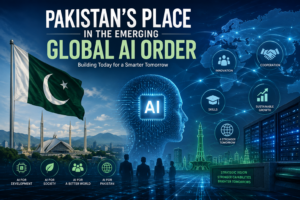
This essay argues that Pakistan’s place in the emerging AI order is not predetermined. It is a country whose future position — as a genuine, if modest, participant in the AI economy, or as a passive consumer permanently dependent on the tools and terms set by others — will be decided in the next five to ten years, and largely by choices Pakistan makes about infrastructure, education, and strategic alignment. To understand what those choices should look like, we first need to understand the shape of the global order itself, then take an honest inventory of where Pakistan currently stands, the structural constraints holding it back, the comparative advantages it can actually build on, and the geopolitical tightrope it must walk between Beijing, Washington, and the Gulf capitals. The essay closes with a set of concrete policy directions — not a wish list, but a realistic path suited to a country with limited fiscal space and urgent competing priorities.
The Global AI Order: A Quick Map
To understand where any country fits into the AI order, it helps to think in terms of four rough tiers, defined less by wealth and more by what kind of leverage a country holds over the AI stack.
At the very top are the AI superpowers — the United States and China — who control the full stack: chip design and (in the US case) advanced fabrication, hyperscale cloud infrastructure, frontier model development, and the capital markets to fund all of it. The US retains a lead in chip design (Nvidia, AMD) and in frontier model labs (OpenAI, Anthropic, Google DeepMind, Meta). China has responded with massive state-directed investment in domestic chip production, a fast-growing open-source model ecosystem (Alibaba’s Qwen, DeepSeek, and others), and an industrial policy explicitly aimed at reducing dependence on American technology. The contest between these two is now the central axis of the global AI order, expressed through export controls on advanced semiconductors, restrictions on model access, and competing standards for AI governance.
Below this sits a tier we might call the AI regulators — most notably the European Union, which lacks a frontier lab of Silicon Valley’s scale but has positioned itself as the world’s primary rule-maker through the AI Act and related data protection regimes. The EU’s leverage comes not from building the technology first, but from the size of its market: companies that want to sell into Europe must comply with European rules, giving Brussels outsized influence over global AI norms despite trailing in raw capability.
A third tier consists of ambitious middle powers actively trying to avoid dependency. India is the clearest example, having launched a national AI mission with dedicated compute infrastructure, leveraging its enormous software talent base and its position as a back-office hub for global tech firms to build indigenous AI capacity. The Gulf states — the UAE and Saudi Arabia in particular — are pursuing a different strategy: using sovereign wealth to buy their way into the AI economy, funding chip purchases, data centers, and homegrown models (the UAE’s Falcon series being the most visible example) while positioning themselves as neutral ground where both American and Chinese AI companies can operate. Southeast Asian states like Singapore and Indonesia are building regional compute and governance frameworks of their own.
Finally, there is a much larger and less discussed tier: AI-adopting or AI-dependent states — the majority of the world’s countries, which will neither build frontier models nor set global rules, but will consume AI tools built elsewhere, often on terms they did not negotiate. The risk for countries in this tier is not that AI passes them by entirely — mobile apps, chatbots, and automation tools will arrive regardless — but that they become permanently price-takers and rule-takers: dependent on foreign platforms for critical infrastructure, unable to shape how AI is deployed in their own economies, and vulnerable to being cut off from access during moments of geopolitical tension, much as has already happened with advanced chips.
Pakistan, as of today, sits uncomfortably in this fourth tier, with faint aspirations — visible in government white papers and startup pitch decks — toward the third. Whether those aspirations translate into anything real is the question this essay tries to answer.
Pakistan’s Current AI Landscape
Policy and Governance
Pakistan’s government has not been silent on AI. The Ministry of Information Technology and Telecommunication has produced draft national AI policies over the past several years, aiming to establish frameworks for AI adoption, ethics, and industry development. The rhetoric in these documents is often ambitious — talk of AI-driven economic transformation, digital public infrastructure, and a “Digital Pakistan” vision that predates the current AI boom but has been retrofitted to include it.
The institutional landscape includes the Pakistan Software Export Board (PSEB), the Pakistan Software Houses Association (PASHA), which represents the private tech sector, and provincial IT boards such as the Punjab Information Technology Board (PITB), which has run some of the country’s more concrete digital governance experiments. These bodies have, at various points, hosted hackathons, funded incubators, and produced strategy papers. What has been consistently missing is follow-through: the gap between policy documents and implemented infrastructure remains wide, a pattern common across many areas of Pakistani governance but particularly costly in a field that moves as fast as AI.
Talent and Human Capital
This is arguably Pakistan’s strongest card, and also its most poorly played one. Universities such as NUST, LUMS, FAST-NUCES, and the Information Technology University (ITU) in Lahore have built credible computer science and data science programs, and Pakistani engineers are visible in AI labs and tech companies around the world. The country also has one of the largest freelance workforces globally, with hundreds of thousands of Pakistanis doing remote technical and creative work for international clients — a workforce that has, in recent years, begun shifting into AI-adjacent work such as data labeling, prompt engineering, and model evaluation.
The problem is retention and scale. Pakistan’s top graduates routinely leave for the Gulf, North America, or Europe, where salaries for AI talent can be five to ten times higher. This is not unique to Pakistan — India faces the same dynamic — but India has enough scale and enough returning diaspora capital and talent to offset the loss. Pakistan does not yet have that cushion. The freelance economy, meanwhile, represents genuine income and skill-building, but it is largely extractive in the sense that the value created flows outward to foreign platforms and clients rather than building durable domestic firms or intellectual property.
Infrastructure
AI at any serious scale requires reliable electricity, broadband, and cloud access — three things Pakistan has struggled to guarantee consistently. Urban centers like Karachi, Lahore, and Islamabad have reasonably good internet connectivity by regional standards, but power outages remain a recurring problem, and the cost of electricity has risen sharply in recent years amid broader economic difficulties. Pakistan has no domestic hyperscale cloud infrastructure and no data centers capable of supporting large-scale model training; local firms and researchers rely almost entirely on foreign cloud providers (AWS, Google Cloud, Microsoft Azure), which is itself a form of quiet dependency, since pricing, access, and even service availability are decided elsewhere.
Private Sector and Startups
There is a small but real ecosystem of AI-adjacent startups in Pakistan, concentrated in fintech, e-commerce logistics, agri-tech, and healthcare diagnostics. Companies have built tools using AI for credit scoring, crop disease detection, and Urdu-language chatbots for customer service. Venture capital interest in Pakistani tech has grown over the past decade, though it remains small relative to peers like India, Indonesia, or even Bangladesh, and has been dampened further by Pakistan’s macroeconomic instability, which makes foreign investors nervous about currency risk and capital repatriation.
Structural Constraints Holding Pakistan Back
It would be dishonest to write about Pakistan’s AI prospects without confronting, directly, the structural weight bearing down on them.
The most immediate constraint is economic. Pakistan has spent much of the past several years under an IMF program, managing chronically low foreign exchange reserves and a currency under persistent pressure. In this environment, government R&D spending on emerging technology is a low priority compared to debt servicing, energy subsidies, and basic fiscal survival. Private capital, both domestic and foreign, is similarly cautious, since AI infrastructure requires long investment horizons that are hard to justify amid currency volatility.
Energy is the second major bottleneck. Training or even running AI models at scale requires reliable, affordable power — something Pakistan’s grid, plagued by circular debt and periodic load-shedding, cannot presently guarantee. This is not a minor technical detail; it is close to a hard ceiling on the country’s ability to host any serious compute infrastructure domestically, regardless of policy ambition.
Brain drain compounds both problems. Pakistan trains capable engineers and then loses a significant share of its best talent to the Gulf, North America, and Europe, where pay and stability are far higher. Political instability and frequent changes in government priorities have also meant that IT and AI strategies rarely survive a change of administration long enough to be fully implemented, leaving a graveyard of unfinished digital initiatives.
There are also deeper, less visible constraints. Pakistan lacks large, high-quality datasets in Urdu and its regional languages (Punjabi, Sindhi, Pashto, Balochi), which limits the ability to build AI tools that serve the population in its own languages rather than relying on English-first models built elsewhere. And Pakistan has essentially no presence in semiconductor design or fabrication, meaning it will remain, for the foreseeable future, entirely dependent on imported chips — a vulnerability made sharper by the fact that advanced AI chips are now explicitly subject to export controls tied to geopolitical alignment.
Finally, there is a mismatch between what universities produce and what the AI industry actually needs. Many computer science graduates are trained in general software development rather than the more specialised skills — machine learning engineering, data infrastructure, applied research — that AI work increasingly demands, leaving a gap that companies must fill through costly in-house training or, more often, simply hiring from abroad.
Pakistan’s Potential Comparative Advantages
None of this means Pakistan’s position is hopeless. It means Pakistan’s advantages are narrower and more specific than its government’s rhetoric sometimes suggests, and success will depend on playing to them deliberately rather than trying to compete broadly with countries that have vastly more capital and infrastructure.
The most obvious advantage is demographic. Pakistan has one of the youngest populations in the world, a significant share of which is bilingual in English and Urdu and increasingly digitally literate through mobile internet access. This is precisely the kind of population that can staff the less glamorous but economically significant layers of the AI supply chain: data annotation, model evaluation, content moderation, and localisation work that global AI companies increasingly need in bulk. Pakistan’s existing freelance economy is, in effect, an underdeveloped version of this capacity already in motion.
Geopolitically, Pakistan occupies a genuinely unusual position: a long-standing, deep relationship with China through the China-Pakistan Economic Corridor (CPEC), a historical security and economic relationship with the United States, and growing financial ties with Gulf states seeking to diversify their own economies and expand influence in South Asia. Few countries sit at the intersection of all three. If managed skillfully, this position could allow Pakistan to draw on Chinese infrastructure investment, Gulf capital, and Western market access simultaneously — though, as the next section discusses, it could just as easily leave Pakistan squeezed between competing pressures rather than benefiting from all three.
There is also a specific, underexploited opportunity in local-language AI. Because Urdu and Pakistan’s regional languages are poorly served by existing large language models, there is a genuine gap for locally built tools — voice assistants, educational software, agricultural extension services, health information systems — that work well in the languages people actually speak at home. This is not a frontier-model ambition; it is a modest, achievable niche that plays to local knowledge of language and context, areas where foreign labs have little incentive to invest deeply.
Finally, Pakistan’s greatest realistic opportunity may lie not in general-purpose AI but in narrow, high-impact applications suited to a developing economy: AI-assisted crop disease detection for smallholder farmers, early-warning systems for floods and other climate disasters (a subject of urgent national importance after the catastrophic 2022 floods), mobile-based financial inclusion tools, and diagnostic support in a healthcare system that suffers from a severe shortage of doctors relative to population. In each of these areas, “good enough” AI, built cheaply on existing open-source models, can produce outsized development benefits without requiring frontier-level infrastructure.
Geopolitical Positioning: Between China, the US, and the Gulf
Pakistan’s AI future cannot be separated from its foreign policy, because so much of the underlying infrastructure and capital will have to come from outside its borders.
China’s role is already substantial. CPEC has brought Chinese investment into Pakistani telecommunications and digital infrastructure, and Huawei has long been a major supplier of network equipment. A “digital CPEC” — extending Chinese involvement into cloud infrastructure, AI-enabled surveillance and smart city systems, and possibly discounted access to Chinese-designed AI chips less encumbered by US export restrictions — is a plausible next phase. The benefit is real: Chinese capital is more readily available to Pakistan than Western capital given the depth of the existing relationship. The risk is equally real: deepening technological dependency on a single external power narrows Pakistan’s room to manoeuvre and could complicate its relationship with Washington, which has grown increasingly wary of Huawei and Chinese AI infrastructure operating within allied or partner countries.
The United States, for its part, remains central to the global AI order through its control over the most advanced chips and frontier models, and Pakistan’s historical security relationship with Washington still carries some economic weight. But the current era of aggressive export controls on advanced semiconductors means that countries seen as too closely aligned with China risk being cut off from the most capable American AI hardware and software. Pakistan does not currently loom large in Washington’s AI strategy one way or another, which is itself telling: the country is not yet significant enough to be a central concern in this rivalry, which grants some breathing room but also reflects its marginal position.
The Gulf states offer perhaps the most promising near-term partnership. The UAE and Saudi Arabia have both signalled interest in expanding their economic footprint in South Asia and are actively investing in AI infrastructure themselves, sometimes as an explicit hedge against being caught entirely within the US-China rivalry. Pakistan’s existing labour and remittance ties to the Gulf, along with shared cultural and religious links, provide a natural channel for Gulf capital to flow into Pakistani AI infrastructure, talent programs, or joint ventures, if Islamabad can present a credible investment case.
India adds a final layer of complexity. As a direct regional rival with vastly greater scale, capital, and international attention, India’s rapid progress in building sovereign AI capacity puts pressure on Pakistan to keep pace, if only to avoid a widening capability gap that could translate into economic and strategic disadvantage. But India’s path — building indigenous compute clusters, funding a national AI mission, leveraging a much larger diaspora — is not one Pakistan can simply replicate at its current scale of resources; it will need a narrower, more targeted strategy rather than a mirror image of India’s ambitions.
The overarching risk across all these relationships is the same: that Pakistan becomes a digital dependency rather than a sovereign AI actor — reliant on Chinese hardware, American software platforms, and Gulf capital, without ever building the domestic capacity to set its own terms. Avoiding that outcome will require Islamabad to treat AI partnerships the way it treats energy or defence partnerships: as strategic relationships to be diversified and balanced, not simply accepted on whatever terms are offered first.
Illustrative Examples
A few concrete examples help ground this discussion. Pakistan’s Benazir Income Support Programme (later folded into the Ehsaas framework) built one of the largest social protection data systems in the developing world, using data analytics to identify and disburse cash transfers to millions of low-income households. While not “AI” in the frontier sense, it demonstrates that Pakistani institutions are capable of building and operating large-scale data systems when there is sufficient political will and international donor support — a capacity that could, in principle, be extended toward more sophisticated AI-driven public service delivery.
On the private side, several Pakistani fintech startups have incorporated machine learning into credit scoring models, using alternative data sources (mobile phone usage patterns, utility payment history) to extend credit to populations without formal financial histories — a genuinely useful application of AI to a real developing-world constraint, built largely on open-source tools rather than expensive proprietary infrastructure.
In agriculture, pilot projects using satellite imagery and machine learning for crop monitoring and pest detection have been tested by both local startups and international development organisations working in Punjab and Sindh, showing measurable results in a sector that employs a large share of the population but has historically had minimal access to precision technology.
Each of these examples shares a pattern: real, useful applications, built cheaply, addressing tangible local problems, mostly powered by tools developed elsewhere. They represent the kind of “smart adopter” model — thoughtful application of existing AI capability to local problems — that plays to Pakistan’s actual capacity rather than an unrealistic aspiration to compete at the frontier.
Policy Recommendations: A Path Forward
Given everything above, Pakistan’s AI strategy should be built around realistic goals rather than prestige projects. A number of concrete directions follow.
First, Pakistan should abandon any notion of building sovereign compute infrastructure at scale in the near term and instead focus on securing reliable, cost-effective access to cloud compute through negotiated partnerships — with Gulf-based data centres, Chinese providers, or global hyperscalers — rather than attempting to build domestic data centres that the national grid cannot reliably support. Regional compute-sharing arrangements, potentially in partnership with the Gulf states, could provide access without requiring Pakistan to solve its energy crisis first.
Second, government and academic institutions should prioritise building large, high-quality datasets in Urdu and regional languages, releasing them as open resources for both domestic and international researchers. This is a comparatively low-cost investment that plays directly to an underserved niche and could make Pakistan a genuine, if modest, contributor to the broader open-source AI ecosystem rather than a pure consumer of it.
Third, education reform should focus specifically on applied AI and machine learning engineering skills rather than general computer science, potentially through partnerships with international universities or online credentialing programs, alongside fellowship and return-incentive programs aimed at bringing skilled diaspora engineers back for defined project-based work, even if permanent return remains unlikely.
Fourth, Pakistan should actively court Gulf capital for AI infrastructure and startup investment while being deliberate about not becoming overly dependent on any single external partner — treating diversification among China, the Gulf, and Western partners as a strategic objective in its own right, not an afterthought.
Fifth, rather than pursuing a broad national AI champion strategy, Pakistan should concentrate public investment on a small number of high-impact sectors where AI can meaningfully improve outcomes at low cost: agricultural extension, disaster early-warning systems (especially climate and flood-related, given recent history), maternal and child healthcare diagnostics, and financial inclusion. A narrow, well-executed sectoral strategy will do more good than a broad, underfunded one.
Sixth, Pakistan needs basic regulatory groundwork — data protection law, clear rules on AI use in government decision-making, and alignment with emerging international norms — not because it will shape global AI governance, but because credible domestic regulation is a prerequisite for attracting serious foreign investment and for protecting citizens as AI tools proliferate in critical services like banking and healthcare.
Finally, public-private partnerships that pool resources between government, universities, and the private sector, along with structured diaspora engagement programs, could help stretch Pakistan’s limited public resources further than they would go if agencies worked in isolation, as has too often been the pattern.
Conclusion
Pakistan will not be a frontier AI power in the coming decade, and pretending otherwise would be a waste of scarce resources. It has no realistic path to competing with the United States or China on chips or foundation models, nor the fiscal capacity to match India’s scale of state-directed investment. But the alternative to frontier competition is not irrelevance. There is a meaningful, achievable position available to Pakistan: a country that thoughtfully adopts and localises AI tools built elsewhere, builds a genuine service economy around the less glamorous but economically significant layers of the AI supply chain, and carves out narrow but real niches — Urdu-language AI, agricultural and disaster-response applications, fintech inclusion — where its specific circumstances and knowledge give it a real edge.
Getting there is not automatic. It requires sustained political attention to a set of unglamorous problems — electricity reliability, education reform, dataset-building, diversified foreign partnerships — that rarely generate headlines but determine whether a country ends up shaping its own digital future or simply renting it from someone else. The global AI order is still being written. Its major chapters will be authored in Washington, Beijing, and Brussels. But the footnotes matter too, and for a country of Pakistan’s size and potential, being a well-placed footnote rather than an afterthought is itself a meaningful and attainable goal — provided the choices made in the next few years are the right ones.