
Introduction
Walk into a jewellery shop on Karachi’s Mithadar Sarafa Bazar on any given afternoon in August 2026, and you’ll see a number chalked up somewhere near Rs 453,700 per tola for 24-karat gold. Do the maths on the international price quoted the same day — somewhere around $4,357 an ounce, converted at the prevailing rupee-dollar rate — and you’ll come up with a lower figure. Not by a small margin, either. The gap between what the London gold market says an ounce of pure gold is worth and what a Pakistani buyer actually pays for it has become, in its own quiet way, one of the more revealing numbers in the country’s economy.
Most people who buy gold in Pakistan never stop to ask why. Gold is gold, the thinking goes — you check today’s rate, you pay it, you move on. But that gap between the “world price” and the “Pakistan price” isn’t random noise. It’s not a rounding error, and it’s not simply greedy jewellers padding their margins, though that plays a role too. It’s a fairly precise reflection of several things at once: the government’s tax and duty structure, the chronic weakness of the rupee, the informality of how gold actually moves through this country, and a public that has learned, generation after generation, that gold is one of the few assets you can trust when everything else — the currency, the banks, the promises of economic stability — keeps letting you down.
I want to make an argument in this piece that goes a bit further than a simple explainer would. It’s not enough, I think, to just list “import duties” and “exchange rate” as if they were two abstract line items on an invoice. I want to argue that Pakistan’s gold premium is really a mirror held up to the country’s deeper economic dysfunction — and that understanding why gold costs more here than almost anywhere else tells you more about Pakistan’s economic condition than most of the headline indicators the government likes to talk about.
The Basic Mechanics: How a Global Price Becomes a Local One
Before getting into the more opinionated part of this argument, it’s worth being precise about the mechanics, because a lot of confusion around this topic comes from people not understanding the actual formula.
Gold trades globally in US dollars per troy ounce, benchmarked against the London Bullion Market Association price — the LBMA fix that effectively sets the “world price” every trading day. To turn that into a Pakistani rupee price per tola (the traditional South Asian unit equal to 11.6638 grams), you take the international ounce price, multiply it by the prevailing USD/PKR exchange rate, convert from ounces to tolas using the standard conversion factor, and then — critically — add what’s generally referred to as the “local premium” or, more bluntly, the “Pakistan Premium.”
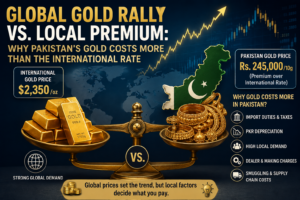
That local premium isn’t one single thing. It’s a stack of several distinct costs layered on top of each other: customs duty on imported gold (currently around 3% under standard rates, though this has fluctuated over the years and periodically spikes when the government needs revenue), an 18% general sales tax that applies to a meaningful share of formally imported gold, transportation and logistics costs to move bullion from ports to inland cities, dealer margins that vary from city to city and shop to shop, and — this is the part most explainer articles gloss over — a substantial informal-market premium driven by the fact that, according to market trackers, over 90% of gold trading in Pakistan happens outside formal, documented channels altogether.
That last point deserves more attention than it usually gets, and I’ll come back to it, because I think it’s actually the single most important factor in explaining why Pakistan’s premium behaves so differently from, say, India’s or the UAE’s.
It’s Not Just Pakistan — But Pakistan’s Premium Is Unusually Large
I want to be fair here, because there’s a version of this article that could exaggerate how unique Pakistan’s situation is. Every country that imports the bulk of its gold rather than mining it domestically has some version of a local premium. India, the world’s second-largest gold consumer, has its own well-documented import duty structure and its own local premium over international rates, one that has been the subject of endless government tinkering over the years as New Delhi tries to balance jewellery-industry interests against a persistent desire to discourage gold imports that drain foreign exchange reserves.
But the scale of Pakistan’s gap is worth dwelling on. Multiple market trackers and financial explainers put Pakistan’s local premium anywhere from 2% to 8% over the raw international-price conversion in a “normal” market, and that range can spike sharply during periods of currency instability, smuggling crackdowns, or import policy changes. Compare this to Dubai, which — as more than one guide aimed at overseas Pakistanis points out — has essentially no import duty on gold and minimal local taxes, making Dubai gold routinely 8% to 12% cheaper than the equivalent purchase in Pakistan. That gap is large enough that it has spawned its own small industry: Pakistani travellers bringing gold back from the UAE, within the duty-free allowance of 50 grams per person, specifically because the arithmetic makes it worth the hassle.
When the price difference between two countries is large enough to justify structuring your travel plans around it, that’s not a rounding error in exchange-rate conversion. That’s a real, economically meaningful distortion — and distortions of that size don’t happen by accident. They happen because of policy choices, structural weaknesses, and market behaviours that compound on top of each other.
The Rupee Is Doing More Damage Than the Duties
Here’s where I think most coverage of this topic gets the emphasis slightly wrong. Import duties and sales tax get most of the attention in explainer articles, because they’re the most visible, most quotable, most “government policy” part of the story. But I’d argue the single biggest driver of Pakistan’s gold premium over the medium term isn’t the duty structure at all. It’s the rupee.
Since gold is priced globally in dollars, any Pakistani rupee depreciation mechanically pushes the local gold price higher even if the international dollar price doesn’t move an inch. This isn’t a subtle effect — it’s baked directly into the pricing formula every gold tracker in Pakistan uses. A weakening rupee against the dollar shows up, dollar for dollar, in the local gold rate, and Pakistan’s rupee has spent the better part of the last several years on a fairly relentless downward trajectory against the dollar, punctuated by periods of sharper devaluation during balance-of-payments crises.
This is, I think, the part of the story that gets buried under all the duty-and-tax explainer content, and it’s the part that actually matters most for understanding why Pakistani buyers experience gold price increases as feeling so much more painful and so much more frequent than international headlines about “gold rallying to record highs” would suggest. When international gold rises 5% in a month, and the rupee simultaneously loses another percentage point or two against the dollar in the same window, Pakistani buyers experience something closer to a 6-7% increase — a compounding effect that has nothing to do with jewellers’ margins or customs policy and everything to do with the currency itself losing purchasing power.
Look at the numbers from earlier this month: gold in Pakistan gained roughly 8.7% in the first two weeks of August 2026 alone, even as international gold prices moved in a comparatively narrower band around $4,350-4,380 per ounce. Some of that gap is pure local demand dynamics. But a meaningful chunk of it, I’d argue, is the rupee quietly doing what it always does — eroding, and dragging every dollar-denominated asset’s local price higher in the process, gold included.
This is why I think framing Pakistan’s gold premium purely as a story about “why does gold cost more here” slightly misses the point. The better question is “why does everything priced in dollars cost disproportionately more in rupee terms in Pakistan” — and gold just happens to be one of the most visible, most closely tracked examples of a much broader phenomenon, one that shows up just as clearly in fuel prices, in imported machinery, in medicine, in anything this economy can’t produce domestically at scale.
The Informal Market: Pakistan’s Real Gold Story
Now here’s the part I think deserves the most attention and gets the least of it in mainstream coverage: the fact that more than 90% of gold trading in Pakistan happens outside formal, documented channels.
Think about what that actually means. It means the “official” Sarafa Bazar rate that gets published twice daily, that every gold-tracking website in the country cites as gospel, that this very article has been quoting throughout — that rate is, in a very real sense, the benchmark for a market where the overwhelming majority of actual transactions aren’t happening through the channels that rate is supposed to describe. The formal, dutied, taxed, above-board gold import system exists, and it does set a real reference price. But the actual gold moving through Pakistani households, jewellery shops, and informal savings arrangements is substantially smuggled, under-invoiced, or otherwise routed around the formal system entirely.
This creates a strange and, I’d argue, somewhat perverse dynamic. On one hand, informal gold — smuggled gold that never paid the 3% customs duty or the 18% sales tax — should, in theory, be cheaper than formally imported gold, since it avoids those costs entirely. And at various points, that’s exactly what happens: periods of aggressive smuggling can actually push local premiums down, because informal supply floods the market and undercuts formally taxed gold. But the informal market is also inherently unstable and subject to sudden disruption — border crackdowns, enforcement actions, shifts in smuggling routes through Iran or Afghanistan — and those disruptions can spike the local premium sharply and suddenly, exactly when formal supply can’t fill the gap fast enough.
What this means, practically, is that Pakistan’s gold premium isn’t a stable, predictable number the way a simple “import duty plus tax” model would suggest. It’s a number that reflects, in real time, the state of a shadow economy that the government has spent decades failing to either formalize or effectively suppress. When gold trackers describe the “Pakistan Premium” as something that “smuggling disruptions, import duty changes, and border crackdowns can spike sharply,” what they’re really describing is a market whose actual pricing dynamics are substantially outside the government’s direct control — a formal regulatory structure sitting on top of an informal system nearly ten times its size, with the formal rate essentially chasing a reality it doesn’t fully govern.
I don’t think this is a minor technical footnote. I think it’s arguably the central fact of Pakistan’s gold market, and I think it says something uncomfortable about the broader economy that a nearly $30 billion-scale annual import category — Pakistan brought in over $27 million in gold according to some trade figures, though estimates vary wildly depending on how much smuggled volume actually gets captured — operates so substantially outside formal state visibility and control.
Why Pakistanis Keep Buying Anyway
It would be easy to read everything above and conclude that Pakistani gold buyers are simply getting fleeced — paying an inflated, duty-and-informality-laden premium for an asset they could get cheaper almost anywhere else in the region. There’s truth in that. But I think it misses something important about why demand for gold in Pakistan remains so resilient even as the premium grows, and I think that resilience tells its own story.
Gold in Pakistan isn’t really competing with other financial assets on a purely rational, premium-adjusted, risk-return basis for most buyers. It’s competing with a national experience of currency instability, banking-sector distrust, and a documented history of the rupee simply losing value, year after year, in ways that make holding rupee-denominated savings feel like a losing proposition over any meaningful time horizon. Against that backdrop, gold’s function isn’t primarily investment in the sense a portfolio manager would use the word — it’s insurance. It’s a hedge not just against inflation in the abstract economic sense, but against a specific, lived, generational memory of currency crises, devaluations, and moments when paper savings simply evaporated in relative value while gold held its worth.
This is why wedding-season demand spikes — running roughly October through March and again in the spring — continue to push local premiums even higher, by anywhere from Rs 500 to Rs 1,500 per tola above the official benchmark in peak periods, according to industry trackers. Gold in Pakistani weddings isn’t optional discretionary spending that responds cleanly to price signals the way a consumer good would. It’s cultural infrastructure — dowries, gifts, family obligations — that people will pay a premium to fulfil regardless of what the Sarafa Bazar chalkboard says that morning.
I think this is worth stating plainly, because I think it’s the part of the story that pure economic-explainer content tends to underweight: Pakistan’s gold premium isn’t just a tax-and-currency phenomenon. It’s also a demand-side phenomenon, driven by a population that has rationally concluded, over decades of lived experience, that paying a premium for gold is often still a better deal than trusting the rupee, the banking system, or government economic promises to hold their value instead. You don’t have to agree with every individual purchasing decision to recognize that the underlying logic is sound, given the alternatives on offer.
The Government’s Uncomfortable Position
Here’s where I want to get more directly opinionated, because I think there’s a real policy failure sitting underneath all of this that doesn’t get named often enough.
Pakistan’s government faces a genuinely awkward set of incentives around gold. On one hand, gold imports represent a real drain on foreign exchange reserves that are chronically under pressure — every dollar spent importing gold is a dollar not available for fuel, machinery, or debt servicing, all of which matter enormously to a country that has spent years bouncing between IMF programs and balance-of-payments anxiety. That gives the government a real incentive to keep import duties high, discourage formal gold imports, and treat gold consumption as something closer to a foreign-exchange liability than a legitimate consumer market to be nurtured.
On the other hand, high duties are exactly what pushes the market underground in the first place. The 90%-plus informal trading share isn’t happening despite government policy — it’s happening substantially because of it. When the formal cost of importing and selling gold through fully documented, taxed channels is meaningfully higher than the cost of moving it through informal networks, you shouldn’t be surprised when the market votes with its feet. This is about as textbook an example of a policy-induced informal economy as you’ll find anywhere in Pakistan’s regulatory landscape, and the government’s own repeatedly-floated but never-implemented proposal for a Pakistan Gold and Gemstone Authority — a regulator that has been discussed for years without materializing — is itself a pretty telling symbol of a state that recognizes the problem but hasn’t mustered the institutional capacity, or perhaps the political will, to actually fix it.
I don’t think this is a case of malicious neglect. I think it’s a case of a government with too many simultaneous fires to put out — currency stability, IMF conditionality, fiscal deficits, energy costs — treating the gold market’s dysfunction as a manageable side issue rather than a priority worth the political and administrative capital required to formalize properly. But “manageable side issue” is a generous description for a market where nearly all trading activity happens outside the state’s own visibility, in a country that badly needs every formal-economy data point and every tax rupee it can get.
What This Says About Pakistan’s Broader Economy
I promised at the start that I’d argue this isn’t really a story about gold. I think it’s a story about Pakistan’s broader relationship with formality, taxation, and trust — and gold is simply the asset where that relationship is easiest to measure, because gold prices are published, tracked, and compared against an international benchmark every single day in a way that most of the rest of the informal economy isn’t.
Consider what the gold premium is actually made of, once you strip it down: currency weakness reflecting decades of macroeconomic mismanagement and external-debt pressure; duty and tax structures that push economic activity into informal channels rather than capturing it formally; a population that has learned, through repeated hard experience, not to fully trust either the currency or the formal financial system; and a state that has the regulatory tools to address much of this but has consistently under-delivered on implementation. That combination doesn’t just describe the gold market. It describes an enormous share of the Pakistani economy — from the size of the undocumented retail sector to persistent tax-to-GDP ratios that remain stubbornly low by regional standards to the country’s long, difficult relationship with reliable foreign exchange management.
Gold just happens to be unusually visible. Most Pakistanis can’t tell you the informal-economy discount on, say, unregistered retail transactions or under-invoiced imports of consumer electronics. But almost anyone who has ever bought jewellery for a wedding, or watched a parent buy gold coins as a hedge against rupee weakness, has an intuitive, lived sense that the price on the chalkboard at the Sarafa Bazar carries a story about the state of the country layered underneath the price of the metal itself.
Is the Premium Justified, or Is It a Failure?
I want to end with the most opinionated part of this piece, because I don’t think a purely neutral “here’s how the formula works” conclusion does justice to what’s actually at stake.
Some portion of Pakistan’s gold premium is entirely legitimate and defensible — logistics costs are real, dealer margins in a competitive market aren’t inherently exploitative, and a reasonable customs duty on a luxury-adjacent import in a foreign-exchange-constrained economy isn’t an unreasonable policy choice on its own terms. I’m not arguing gold should be duty-free, and I don’t think most serious observers of Pakistan’s fiscal position would either, given how badly the country needs every source of formal revenue it can find.
But I think the size of the gap between Pakistan’s premium and comparable markets like Dubai’s — large enough to make personal gold-smuggling via airline baggage allowance a genuinely common financial strategy among overseas Pakistanis — is not a sign of a well-calibrated policy. It’s a sign of a regulatory structure that has pushed far more of its own gold market into shadow than it has managed to keep in the light, and a currency policy environment that keeps handing gold buyers a bigger and bigger rupee bill regardless of what’s happening to the actual metal on international markets.
If I had to state the argument as bluntly as I can: Pakistan’s gold premium isn’t really a story about gold at all. It’s a story about a state that taxes formality more heavily than it can currently police informality, wrapped around a currency that has spent years losing value against the dollar faster than most of its regional peers. Every time a Pakistani family pays Rs 453,700 for a tola of gold that would cost meaningfully less across the border in Dubai, they’re not just paying for a precious metal. They’re paying, in a very direct and measurable way, for decades of accumulated policy choices they had no hand in making.
Conclusion
The gap between the international gold price and what Pakistanis actually pay at the Sarafa Bazar isn’t a mystery, and it isn’t really about greedy jewellers padding their margins, however satisfying that explanation might feel in the moment. It’s the visible, daily, chalkboard-updated sum of a weak currency, a duty structure that pushes activity underground rather than capturing it, an informal market nearly ten times the size of the formal one, and a population that has learned, the hard way, to treat gold as insurance against a state and a currency it has good reason not to fully trust.
Global gold rallies make headlines everywhere. But in Pakistan, the headline number was never really the whole story. The premium on top of it — the gap between the world’s price and Pakistan’s price — is where the more honest and more uncomfortable story actually lives. And I don’t think that story gets meaningfully better until the deeper structural issues underneath it — the rupee, the tax base, the informal economy — get addressed directly, rather than treated as background noise to a commodity price chart.