
 Introduction
In August 2026, Pakistan’s Interior Minister Mohsin Naqvi stood before the Pakistan Economic Summit and declared that the country’s four-province system had “collapsed.” He said the existing structure was incapable of governing a nation of over 240 million people, and that new provinces or administrative units were the only real solution. Within days, an unverified map began circulating on social media showing Punjab sliced into six pieces, Balochistan and Khyber Pakhtunkhwa into four each, and Sindh into three. Government allies rushed to endorse the idea. Legal experts scrambled to explain that the Constitution has no real mechanism for creating new provinces, only for altering boundaries. A “28th Constitutional Amendment” is now rumoured to be in the works.
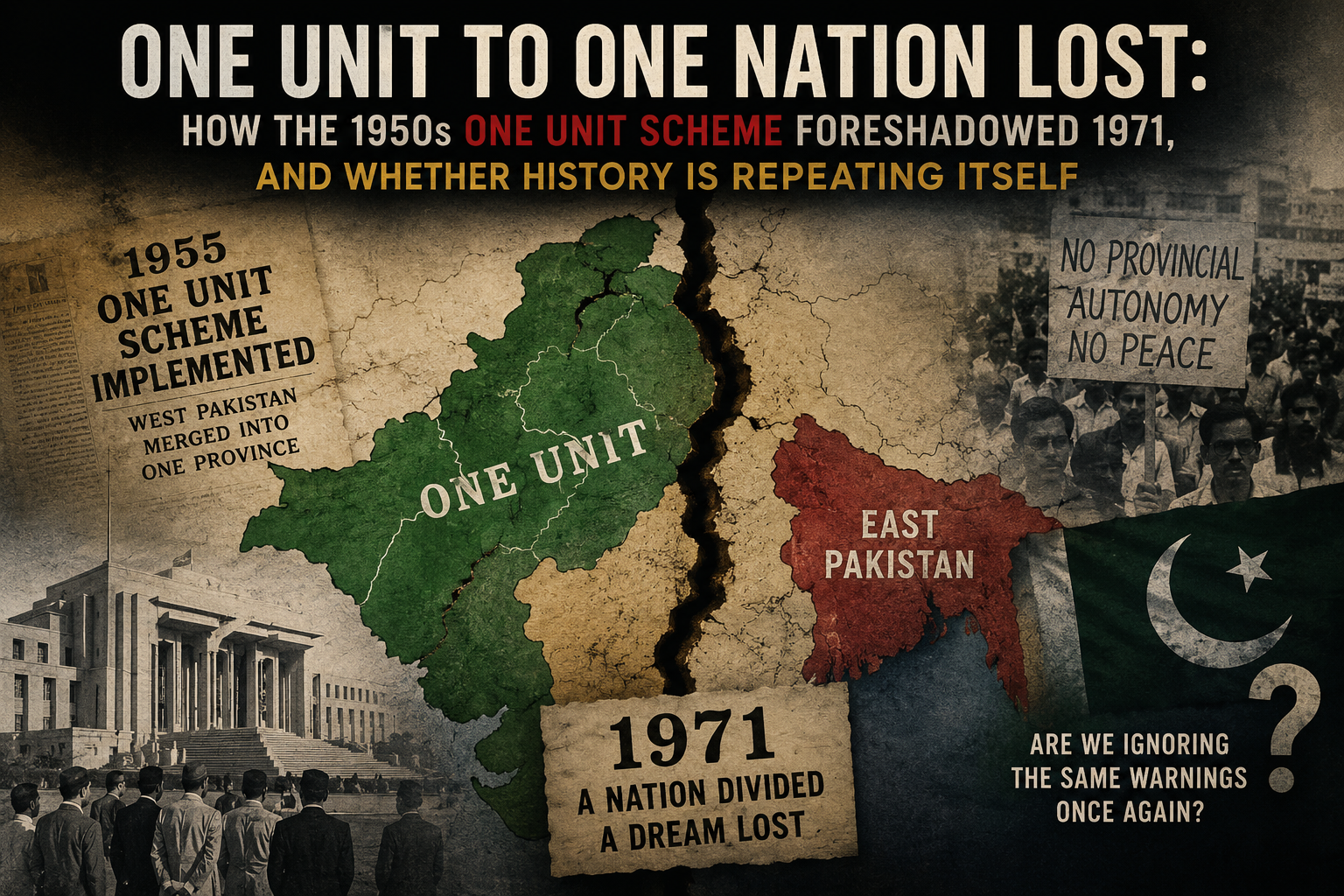
If this story sounds familiar to anyone who has studied Pakistani history, it should. Seventy years ago, in 1955, Pakistan’s rulers pushed through a scheme called “One Unit,” which merged the four provinces of West Pakistan into a single administrative bloc. It, too, was sold as a cure for administrative dysfunction. It, too, was pushed through with minimal genuine debate. And it, too, ignored the concerns of smaller ethnic communities in favour of a plan that consolidated power in the hands of a central elite.
We now know how that story ended. One Unit did not solve Pakistan’s problems. It deepened them, fed resentment in the country’s smaller nationalities, and became one of the threads that unravelled into the traumatic break-up of the country in 1971, when East Pakistan seceded to become Bangladesh.
This essay asks a direct question: does the current push to redraw Pakistan’s provincial map risk repeating the mistakes of One Unit? To answer it, we need to walk through what One Unit actually was, why it failed, how its failure fed into the events of 1971, and then hold today’s proposals up against that history to see how closely the pattern matches. Along the way, I will explain key terms — federalism, unitary government, provincial autonomy, devolution — in plain language, since understanding this debate requires understanding these concepts clearly.
Part One: What Is Federalism, and Why Does It Matter for Pakistan?
Before diving into history, it helps to define some basic terms that will recur throughout this essay.
Federalism is a system of government in which power is divided between a central (national) government and regional governments (in Pakistan’s case, the provinces). Each level has its own areas of authority, protected by the constitution, so that the central government cannot simply overrule or abolish the provinces whenever it wishes.
The opposite of this is a unitary system, where all real power sits with the central government, and any regional or provincial administration exists only because the centre allows it to, and can be reshaped or eliminated by central decision.
Pakistan was born in 1947 as a federation of provinces and regions with very different languages, cultures, and historical identities: Punjab, Sindh, the North-West Frontier Province (NWFP, now called Khyber Pakhtunkhwa), Balochistan, and — separated by more than a thousand miles of Indian territory — East Bengal (which became East Pakistan, and today is Bangladesh). This geographic and cultural diversity meant that federalism was not just a nice theory for Pakistan; it was practically necessary. A country made up of distinct nations and language communities cannot be governed as though it were one uniform block without generating resentment.
Provincial autonomy refers to the degree of self-rule and control over local affairs, resources, and decision-making that a province holds, independent of the central government. The more autonomy a province has, the more it can set its own priorities on issues like education, health, agriculture, and local development, without needing permission from Islamabad (or, in the earlier period, Karachi, which was the first capital).
Understanding these terms matters because the entire history covered in this essay — from One Unit to 1971 to today’s debate — is really a single long argument about how much power the provinces should have relative to the centre, and who gets to decide.
Part Two: The Birth of a Lopsided Federation
When Pakistan was created through the partition of British India in August 1947, it had an unusual shape. It consisted of two wings separated by over a thousand miles of Indian territory: West Pakistan (comprising Punjab, Sindh, NWFP, Balochistan, and various princely states) and East Pakistan (present-day Bangladesh, then called East Bengal).
This geography alone created enormous governance challenges. But the deeper problem was demographic and political. East Pakistan, despite being physically smaller and economically less developed at the time of independence, had a larger population than all of West Pakistan combined. Bengali speakers made up the single largest linguistic group in the entire country.
This mattered enormously because Pakistan’s political system, at least on paper, was meant to be based on the principle of “one person, one vote.” If representation in the national parliament were to be based purely on population, East Pakistan would have a majority of seats — and therefore the most say in national government. But the political, military, and bureaucratic elite that dominated the new state’s institutions was overwhelmingly drawn from West Pakistan, and especially from Punjab. This elite viewed the prospect of Bengali-majority rule with real alarm.
This tension — between a Bengali-majority population and a West Pakistan-dominated elite unwilling to accept the political consequences of that majority — is the essential backdrop against which One Unit must be understood.
Part Three: The One Unit Scheme — What It Was and Why It Was Created
The Basic Mechanics
The idea of merging all of West Pakistan’s provinces into a single administrative unit had actually been floated as early as 1949 by Punjabi politicians, but it gathered real momentum in the early 1950s. Prime Minister Mohammad Ali Bogra announced the plan on 22 November 1954, and it was formally enacted on 14 October 1955. Under the scheme, the separate provinces of Punjab, Sindh, NWFP, and Balochistan — along with various smaller princely states and tribal areas — were dissolved and merged into a single new province, simply called “West Pakistan.”
The declared purpose was to create administrative “parity” between West Pakistan and East Pakistan: one unified western wing to balance the more populous eastern wing, so that the country’s two halves could be treated as roughly equal partners in the national parliament, regardless of the actual population difference between Bengali East Pakistan and the diverse West.
The Official Justifications
The government’s public case for One Unit rested on several claims, all of which are strikingly similar to arguments being made in Pakistan today:
- Administrative efficiency: Officials argued that having four separate provincial governments in West Pakistan, each with its own bureaucracy, was needlessly expensive and inefficient. A single unified administration, they claimed, would cut costs and streamline governance.
- Reducing “provincial prejudices”: The government argued that separate provinces encouraged narrow, parochial thinking, and that merging them would foster a broader “Pakistani” identity above narrower ethnic or regional loyalties.
- Developing backward areas: It was claimed that a unified West Pakistan administration could direct resources more effectively to underdeveloped regions, rather than leaving smaller, poorer provinces to fend for themselves.
- Balancing East Pakistan: Perhaps most importantly, though less openly stated, One Unit was meant to prevent East Pakistan’s larger population from translating into political dominance over West Pakistan in a future parliament based on direct population-based representation.
The Real Motivations
Historical scholarship, however, paints a less flattering picture. According to research on the episode, the One Unit project had mainly been pushed since 1953 by the Punjabi political elite of West Pakistan, with the specific aim of preventing East Pakistani politicians from gaining power at the national centre. General Ayub Khan, who would later seize power in a 1958 military coup, had reportedly prepared the scheme’s outline while in London in 1954, and it was implemented at the forceful urging of the Punjabi leadership.
In other words, One Unit was not primarily a technocratic response to inefficiency. It was a political manoeuvre by a dominant faction — Punjabi civil-military elites — to neutralise both the numerical strength of East Pakistan and the distinct political identities of Sindh, NWFP, and Balochistan, all of which stood to lose their separate provincial status and voice.
This is a crucial point, because it establishes a pattern that recurs throughout Pakistani history: proposals to “restructure” provinces or centralise administration are typically framed in the neutral, technical language of efficiency and development, while the underlying motivation is often about which group holds power and how to keep it.
How It Was Imposed
The manner in which One Unit was implemented also matters. It was not the product of a broad national consensus freely arrived at through parliamentary debate. Multiple provincial leaders objected. The Sindh Assembly opposed the scheme. The Chief Minister of NWFP, Sardar Abdur Rashid, clashed publicly with central authorities over the plan and was subsequently dismissed from office. In Balochistan, the merger of the Balochistan States Union into One Unit was reportedly carried out under considerable duress and coercion applied to the Khan of Kalat, rather than through a genuinely voluntary process.
An “Anti-One Unit Front” formed in the NWFP, demanding a referendum in the smaller provinces before the merger was imposed — a demand the government ignored. The scheme was pushed through by executive and legislative manoeuvring rather than by a process that carried the confident backing of the smaller provinces it directly affected.
This detail is worth underlining because it foreshadows a complaint that recurs constantly in Pakistani political history, right up to the present debate: major changes to the country’s federal structure being decided in the “power corridors” of Islamabad, with smaller provinces and the wider public treated as an afterthought rather than genuine partners in the decision.
Part Four: What One Unit Actually Did — and Failed to Do
For fifteen years, from 1955 to 1970, West Pakistan existed as a single province, with its capital eventually settled in Lahore. What were the real consequences?
Deepening Alienation, Not Reducing It
Far from dissolving “provincial prejudices” as promised, One Unit intensified them. Smaller provinces — particularly Sindh, NWFP, and Balochistan — experienced the merger as a loss of their political identity and a subordination of their interests to Punjab, which was by far the largest and most powerful of the four former provinces. Punjabi dominance within the unified administration, in terms of bureaucratic appointments, resource allocation, and political representation, became a continual source of resentment.
A scholarly assessment of the scheme notes plainly that the One Unit arrangement sustained a highly centralized and bureaucratic political order that suffered from a legitimacy crisis in NWFP and Sindh, and that some Baloch leaders opposed it as well. Rather than forging a unified “West Pakistani” identity, the scheme reinforced separate ethnic and regional identities as a defensive response to perceived Punjabi domination.
It Coincided With, and Enabled, Military Rule
One Unit was not simply a one-time administrative reform; it became a tool that helped sustain an increasingly centralized and undemocratic system of government. Just three years after its creation, in 1958, General Ayub Khan overthrew the civilian government and imposed martial law, becoming Pakistan’s first military ruler. One Unit’s concentration of West Pakistan’s administration into a single, centrally controlled bloc dovetailed conveniently with a military-bureaucratic style of governance that preferred fewer, larger, more easily managed administrative units over a genuine, messy, multi-provincial federal democracy.
It Failed to Prevent the Real Crisis: East-West Relations
Crucially, even as it reorganised West Pakistan, One Unit did nothing to resolve — and arguably worsened — the underlying tension between East and West Pakistan. The scheme was explicitly designed to offset East Pakistan’s population advantage by creating a single “West Pakistan” that could be treated as numerically equal to the East in a future parliamentary arrangement based on “parity” between the two wings, rather than pure population-based representation.
But this was seen by Bengalis in the East as exactly what it was: a mechanism to deny them the political power that their larger population would otherwise have earned them under a straightforward democratic system. Bengali nationalists, led eventually by Sheikh Mujibur Rahman and the Awami League, increasingly viewed the government in Karachi (and later Islamabad) — and the political arrangements like One Unit that propped it up — as instruments of Bengali disenfranchisement and West Pakistani, especially Punjabi, domination.
This sense of being structurally and permanently sidelined, no matter how large their population, became one of the central grievances feeding the Bengali nationalist movement. Combined with deep economic disparities between the two wings (East Pakistan received a much smaller share of national development spending and foreign exchange earnings despite its larger population and its dominant role in Pakistan’s export economy through jute), and cultural grievances (including the government’s early attempt to impose Urdu as the sole national language over a Bengali-majority population), the sense of political exclusion helped drive East Pakistan toward outright separatism.
Abolition, Too Late
By 1969, the mounting political crisis — including growing unrest in East Pakistan and renewed agitation for provincial rights in the smaller provinces of the West — forced a change in course. Ayub Khan, weakened by widespread protests, resigned, and General Yahya Khan took over. One of Yahya’s early acts was to dissolve One Unit on 1 July 1970, restoring Punjab, Sindh, NWFP, and Balochistan as separate provinces, and announcing that the next general election would be based on direct adult franchise and the principle of “one man, one vote” — finally acknowledging East Pakistan’s population majority.
But this reform came far too late to repair the political damage. In December 1970, Pakistan held its first-ever general election based on adult franchise. The Awami League, campaigning on a platform of regional autonomy for East Pakistan, won an overwhelming majority of East Pakistan’s seats — enough, in fact, to command an outright majority in the national assembly as a whole. Under a genuinely democratic, population-based system, Sheikh Mujibur Rahman’s party had won the right to form the next government of Pakistan.
West Pakistan’s political and military establishment refused to accept this outcome. The transfer of power was delayed and obstructed. Negotiations broke down. In March 1971, the Pakistan Army launched a brutal military crackdown in East Pakistan, triggering a war that, with Indian military intervention, ended in December 1971 with the creation of the independent state of Bangladesh.
Connecting the Dots
To be clear: One Unit did not, by itself, cause the break-up of Pakistan. The 1971 crisis had many causes — economic disparity between the two wings, cultural and linguistic grievances, the refusal to honour election results, and a brutal military response, among others. But One Unit was an important part of the chain of decisions that built toward that outcome. It was a scheme explicitly designed to deny East Pakistan the political power its population warranted; when it was finally abolished and a truly democratic election was held, the very outcome it had been designed to prevent occurred — and the West Pakistani establishment’s refusal to accept that outcome led directly to civil war and secession.
The broader lesson historians draw from this period is that attempts to engineer federal structures for the political convenience of a dominant group — rather than to reflect the genuine will and identity of the country’s constituent peoples — tend to store up resentment that eventually erupts, often at a moment and in a form more damaging than the problem the scheme was meant to solve.
Part Five: After 1971 — A Pattern That Continued
Pakistan’s troubles with federalism did not end with the loss of its eastern wing. If anything, the underlying instinct that produced One Unit — the preference of central and Punjab-based elites for centralised control over genuine federal power-sharing — continued to shape Pakistani politics for decades.
The 1973 Constitution: A Fragile Balance
After the trauma of 1971, Pakistan’s remaining four provinces (Punjab, Sindh, NWFP, and Balochistan) adopted a new constitution in 1973 that attempted to strike a careful balance between federal authority and provincial autonomy. It enshrined provincial rights, established mechanisms for sharing federal resources, and created a bicameral parliament with a Senate meant to give smaller provinces equal representation alongside the more populous Punjab.
Yet this balance was, in practice, repeatedly violated. Provincial governments — especially those controlled by opposition parties — were dismissed by the central government on several occasions in the years that followed, a pattern begun even before 1973 and continued under both civilian and military rule. This reinforced smaller provinces’ sense that constitutional guarantees of autonomy meant little in practice whenever the centre found them inconvenient.
Balochistan and Pakhtun Nationalism
The insurgency in Balochistan, which first flared in the 1970s and has recurred in various forms ever since (including a significant intensification during the 2000s), is widely understood by analysts as rooted in decades of perceived political marginalization, resource exploitation without adequate provincial benefit, and heavy-handed central and military responses to Baloch demands for greater autonomy — the same grievances, in essence, that fueled opposition to One Unit in the 1950s. Authoritarian central rule also fed Pashtun nationalist sentiment in NWFP for a period, although this eased over time as the province gained greater political representation.
The 18th Amendment: A Course Correction
In 2010, Pakistan’s parliament passed the 18th Constitutional Amendment, with the support of all major political parties. This was widely regarded as the most significant devolution of power to the provinces in Pakistan’s history. Over a dozen federal ministries — covering areas like health, education, and agriculture — were transferred to provincial control, and provinces were guaranteed a larger, more predictable share of national tax revenue through the National Finance Commission (NFC) award mechanism.
Devolution, in this context, means the transfer of powers and responsibilities from the central government down to provincial or local governments. The 18th Amendment was, in many ways, an attempt to finally deliver on the promise of genuine federalism that had been undermined since the earliest days of the state — including during the One Unit period.
It was not without controversy. Critics pointed to capacity problems: some provinces struggled to administer newly devolved responsibilities effectively. And the fiscal side of the equation created real strain — the substantial transfer of tax revenue to the provinces left the federal government with a smaller pool of resources to meet its own obligations, a tension that persists in budget debates to this day.
But for defenders of the amendment, these growing pains were the price of correcting decades of over-centralisation, not a reason to reverse course.
Part Six: Today’s Debate — Is History Repeating Itself?
This brings us to the present moment. As of August 2026, a renewed and increasingly loud debate is underway in Pakistan about creating new provinces or administrative units. It is worth examining this debate carefully against the template set by One Unit, point by point.
The Trigger and the Justifications
The current debate was sparked chiefly by Interior Minister Mohsin Naqvi, who told the Pakistan Economic Summit that Pakistan’s four-province system had “collapsed” and could not meet the country’s contemporary governance needs. Other officials, including Federal Minister Abdul Aleem Khan and Health Minister Mustafa Kamal, have echoed the call, arguing that smaller administrative units would bring government services closer to citizens who currently must travel long distances to reach provincial capitals.
Notice the resemblance to the justifications for One Unit: administrative efficiency, better service delivery, and addressing the practical difficulties of governing a large and diverse population. These are not unreasonable concerns on their face — Pakistan’s population has more than quadrupled since 1955, and provinces like Punjab, with over 120 million people, are larger than most countries on earth. There is a genuine administrative case to be examined.
The Same Absence of Genuine Parliamentary Debate
As with One Unit, the current push has proceeded largely through statements by senior officials, viral social media speculation, and closed-door discussions among “power corridors,” rather than through an open, transparent parliamentary process. Reports indicate that a “28th Constitutional Amendment” may be in preparation, with discussions about its contents occurring before any public draft has been shared or debated in parliament. This echoes a pattern seen throughout Pakistani history: major constitutional changes being pushed through with minimal deliberation, sometimes with parliament presented a fait accompli rather than a genuine choice.
The Same Ambiguity About Real Motives
Just as with One Unit, observers are divided on whether the current push is a sincere effort to improve governance or a manoeuvre for political advantage. Some commentary explicitly connects the discussion to addressing “the consequences of the 18th Amendment” — suggesting that, for some proponents, the underlying goal may be to claw back some of the provincial autonomy and fiscal resources that devolution handed to the provinces in 2010, dressed in the language of creating smaller, more “manageable” units. If this reading is correct, it would mirror the original One Unit logic disturbingly closely: use administrative restructuring as a tool to recentralize power that had been devolved, while presenting it publicly as a service-delivery reform.
The Constitutional Obstacles Are Real — and Are Being Taken More Seriously This Time
One important difference from 1955 is that today’s proponents face a much higher constitutional bar. Any change to a province’s boundaries under Article 239 of Pakistan’s Constitution requires a two-thirds majority in both the National Assembly and the Senate, plus a two-thirds majority resolution from the affected provincial assembly itself. No single party currently commands anything close to that majority. Legal experts have also pointed out a further complication: unlike India’s constitution, which explicitly provides a mechanism (Articles 2 and 3) for creating new states, Pakistan’s constitution has no explicit provision at all for creating entirely new provinces — only for altering existing boundaries. This is a substantially higher hurdle than existed in 1955, when One Unit could be — and was — imposed through more centralised executive and legislative manoeuvring under a much less developed constitutional order.
This matters because it means today’s proponents cannot simply repeat the top-down imposition that characterised One Unit. Any serious move toward new provinces would, by constitutional design, require the kind of broad multi-party and multi-provincial consensus that was conspicuously absent in 1955 — and that critics say is still absent today, given that “ruling party” allies appear divided and opposition parties largely sceptical.
The Same Old Fault Lines Are Visible
The debate has already reproduced some of the exact regional grievances that ran through the One Unit episode:
- Seraiki-speaking southern Punjab continues to press for its own province, a genuine, long-standing ethnic and linguistic demand distinct from the top-down restructuring proposals now circulating — much as NWFP, Sindh, and Balochistan had genuine, distinct identities that One Unit steamrolled in the 1950s.
- Balochistan and KP, already grappling with security challenges and long-standing grievances about resource distribution and political marginalisation, would be directly affected by proposals to carve them into multiple smaller units — proposals being discussed, once again, without their full and free participation.
- Fears of ethnic fragmentation are explicit in the current debate, with critics warning that redrawing boundaries along or across ethnic lines could reopen old wounds, much as One Unit’s erasure of provincial identity did in its time.
A Notable Voice of Caution: Local Government Over New Provinces
Interestingly, one of the strongest threads running through today’s debate — one that was largely absent from the 1955 discussion — is a growing counter-argument that the real fix lies not in creating new provinces at all, but in empowering local government: the tier of elected administration below the provincial level (districts, tehsils, and municipalities). Voices across the political spectrum, from PTI’s Salman Akram Raja to policy think tanks like the Sustainable Development Policy Institute (SDPI), have argued that Pakistan already possesses a layer of administrative division — its districts and tehsils — that simply needs real constitutional power, protected financial resources, and genuine devolution under Article 140-A of the Constitution (which is meant to guarantee local government), rather than an entirely new, more disruptive layer of provinces.
This argument — that bringing government closer to citizens can be achieved by strengthening what already exists rather than redrawing the map — is precisely the conclusion reached by critics of the current push, and it is also, notably, the same conclusion many historians draw when assessing what Pakistan should have done differently in the 1950s: reform and empower existing structures rather than impose a politically convenient but artificial reorganization from above.
Part Seven: Assessing the Parallel — Where It Holds and Where It Doesn’t
It is worth being precise about where the historical parallel is strong and where it should not be overstated.
Where the Parallel Is Strong
- The justificatory language is nearly identical: both episodes are framed around administrative efficiency, cost reduction, and bringing government “closer to the people,” while critics in both eras suspect the underlying motive is political control.
- The process is similarly opaque: both involve major constitutional change being shaped in closed political circles before being presented to the public and parliament, rather than emerging from an open, deliberative process.
- The underlying tension is the same: a centre (or a dominant coalition within it) seeking to reorganise the federation in ways that smaller or more autonomous units did not request and, in some cases, actively oppose.
- The risk to ethnic and regional cohesion is comparable: any large-scale redrawing of provincial boundaries risks reopening exactly the kind of identity-based grievances that One Unit inflamed, particularly in Balochistan and KP, which already face serious internal security and political challenges.
Where the Parallel Breaks Down
- Pakistan today is a different, and more fragmented, country than West Pakistan of 1955. It no longer has an East Pakistan whose exclusion from power was the central, defining crisis of the state. The current debate is about internal reorganisation of the existing four provinces, not about managing a bipolar east-west relationship. The stakes, while serious, are not structurally identical to the 1955 situation that led to a civil war and secession.
- The constitutional and political environment is far more resistant to unilateral imposition. Article 239’s supermajority requirements, an independent judiciary, an assertive media, and a far more mobilised civil society make a repeat of the top-down imposition of 1955 considerably harder, even if some actors might wish for it.
- There is now a competing, credible policy alternative on the table — strengthening local government — that simply did not exist as a serious part of the conversation in the 1950s. Pakistan’s local government institutions, however imperfect, are far more developed today than in 1955, giving the country a genuine alternative path that the earlier era lacked.
- Devolution has already happened once, successfully, through the 18th Amendment. Pakistan has direct, recent experience of provinces gaining more power leading to a broadly accepted, multi-party consensus outcome — unlike One Unit, which was imposed against significant provincial objection. This gives today’s debate a recent positive precedent for what genuine, consensus-based federal reform can look like, if the current push chooses to follow that model rather than the 1955 model.
Part Eight: What History Actually Teaches
Pulling these threads together, the lesson of One Unit is not that administrative reform is inherently dangerous, or that Pakistan’s four-province structure must never change. Provinces are not sacred, unchangeable objects; boundaries can, in principle, be redrawn to serve people better. The lesson is narrower and more specific: reforms to federal structure that are imposed from the center, without genuine buy-in from the provinces and communities affected, tend to produce the opposite of their stated goal. Instead of easing administrative burdens or improving governance, they generate resentment, deepen the very ethnic and regional fault lines they claim to be smoothing over, and — in Pakistan’s most extreme historical case — contributed to the loss of half the country.
The individuals defending One Unit in 1955 were not, for the most part, cartoonish villains plotting national breakup. Many likely believed, or told themselves, that a unified West Pakistan really would be more efficient and would help develop poorer regions. But intentions did not save the scheme from its consequences, because the process by which it was designed and imposed — centralised, top-down, dismissive of provincial objections — guaranteed that it would be experienced as domination rather than reform by the people it affected.
That is the test today’s proposals must pass, and it is a test of process as much as of substance. A plan to create new administrative units that emerges from genuine, patient, multi-party and multi-provincial negotiation — of the kind that produced the 18th Amendment in 2010 — would sit on entirely different ground than a plan pushed through by a dominant coalition over the objections of the provinces most affected. The same policy idea, in other words, can either heal Pakistan’s federal structure or reopen its oldest wounds, depending almost entirely on how it is pursued, not just what it proposes.
Conclusion
Pakistan’s history offers a clear warning embedded in the story of One Unit: administrative convenience for the centre is not the same thing as good governance, and treating provinces as bureaucratic units to be merged, split, or rearranged for political advantage — rather than as constitutional partners with their own legitimate identities and interests — carries real and sometimes catastrophic risk. One Unit did not, by itself, cause the loss of East Pakistan in 1971, but it was an important part of the machinery that made that outcome more likely, by trying to engineer away a demographic and political reality rather than accommodate it.
Today’s renewed debate over new provinces echoes that history in its language, its process, and its underlying tensions, even as it unfolds in a very different country with stronger constitutional guardrails, a more developed local government tradition, and — crucially — the recent example of the 18th Amendment showing that meaningful federal reform is possible when it is pursued through consensus rather than imposition.
Whether history is “repeating itself” will ultimately depend less on whether new provinces are created than on how the decision is reached. If it follows the path of 1955 — decided in closed rooms, dressed in the vocabulary of efficiency, and pushed past provinces that were never truly consulted — it risks repeating not just the process of One Unit, but eventually, in some form, its consequences. If instead it follows the path charted, however imperfectly, by the 18th Amendment — open debate, genuine provincial consent, and a willingness to consider the less dramatic but potentially more effective alternative of empowering local government — Pakistan has a chance to break the pattern that has haunted its federal structure since 1955, rather than repeat it.
https://amtulhafeezqureshi.com/how-digitalisation-has-reshaped-traditional-warfare/https://amtulhafeezqureshi.com/how-digitalisation-has-reshaped-traditional-warfare
/
Same Pact, Three Different Stories: How Al Jazeera, Dawn, and the Atlantic Council Framed the Mecca Agreement