
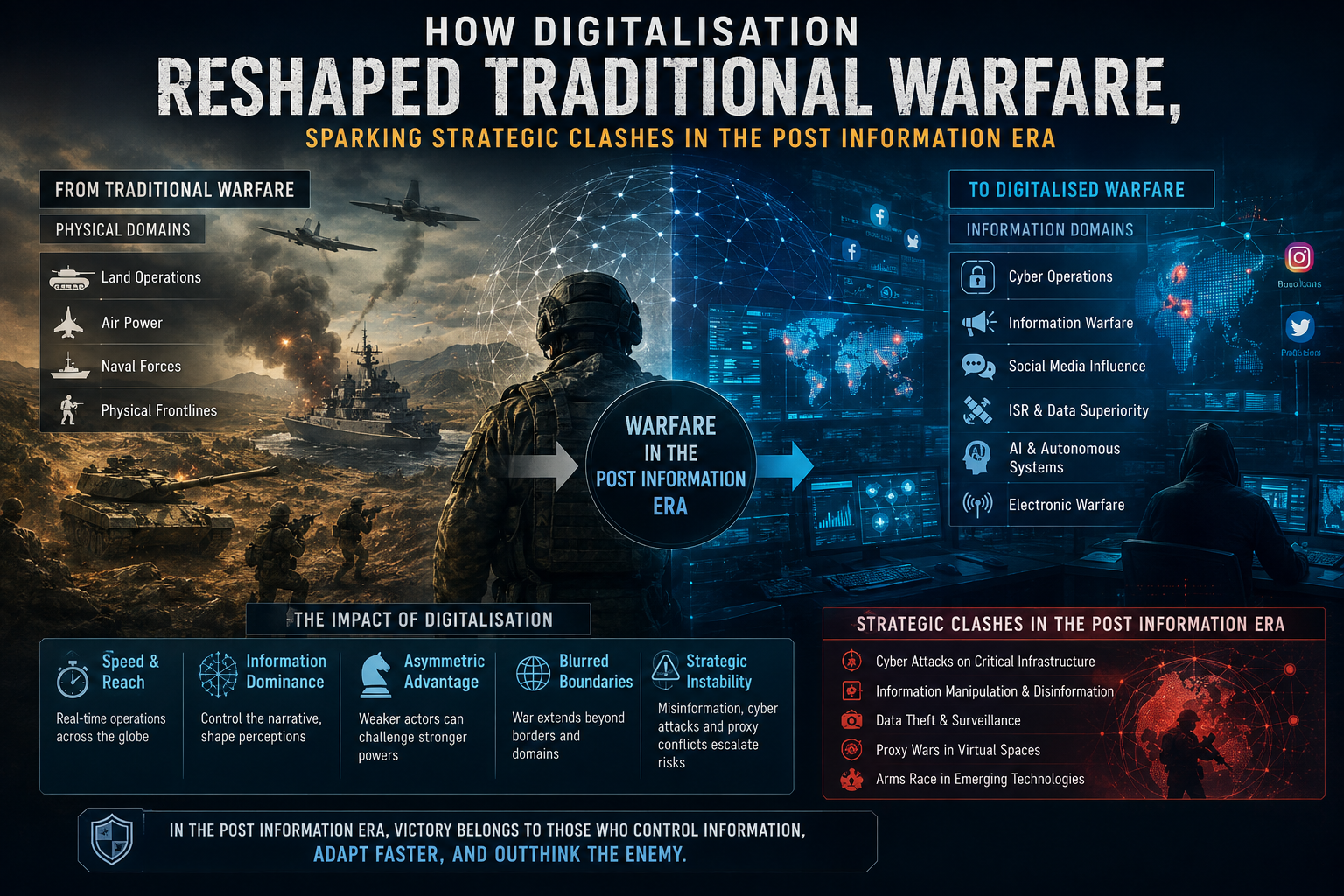
For most of the twentieth century, war was understood in fairly concrete terms. Armies clashed over territory, victory was measured in ground held and casualties inflicted, and the side with greater mass — more tanks, more divisions, more industrial capacity — usually had the advantage. This was the world Clausewitz described, a world of friction, attrition, and physical force applied at scale. That world has not disappeared, but it has been quietly rewired. Over the past two decades, digitalisation has changed not just the tools of war but the underlying logic by which power, strategy, and even truth itself are contested. The result is a strategic environment that some scholars now call the post-information era, in which the old questions of who has more soldiers or more shells have been joined, and sometimes overtaken, by questions of who sees the battlefield most clearly, who controls the narrative fastest, and who can keep their networks alive under attack.
The most visible change is the shift from physical mass toward information dominance as a strategic resource in its own right. In earlier eras, intelligence and reconnaissance supported military operations; today, in many conflicts, they are close to being the operation. Satellites, drones, and networked sensors have compressed what analysts call the sensor-to-shooter loop — the time between spotting a target and destroying it — from hours or days down to minutes. The war in Ukraine has made this almost banal: a farmer’s field, a road junction, or a column of vehicles can become a precisely targeted location within moments of a drone feed or commercial satellite image reaching an artillery unit. What used to require extensive reconnaissance-in-force now happens through a laptop and a data link. This is not simply a faster version of old warfare; it is a different kind of warfare, one in which the side with superior situational awareness can inflict disproportionate damage even without numerical superiority.
This shift has also transformed how militaries organise themselves. Traditional command structures were hierarchical almost by necessity, because information moved slowly and had to be filtered upward before decisions could be filtered back down. Digital networks have made it possible — and often preferable — to distribute a common operational picture across many nodes simultaneously, allowing lower-echelon units to act on shared, real-time information rather than waiting for orders to trickle down a chain of command. This is sometimes described as mission command taken to its logical extreme, or as network-centric warfare, a concept associated with the American theorists Arthur Cebrowski and John Garstka, who argued in the late 1990s that future combat power would come less from massed firepower and more from the ability of forces to share information and act coherently as a network. Their thesis has been largely validated by recent conflicts, but it has also revealed a corresponding vulnerability: a networked force is only as strong as its network. Jam the signal, spoof the GPS, or sever the data link, and a technologically sophisticated unit can suddenly find itself operating blind, no better equipped than its analogue predecessors and sometimes worse, because it has come to depend on capabilities it can no longer access.
Perhaps the most consequential effect of digitalisation, though, is the way it has dissolved the old distinction between front and rear, and between wartime and peacetime. In classical warfare, the battlefield was a place — a line on a map separating friendly and hostile territory. Today, a server farm in a neutral country, an undersea fibre-optic cable, or a piece of critical infrastructure thousands of kilometres from any declared conflict zone can be as strategically significant as a fortified hilltop. Cyber operations allow states to degrade an adversary’s power grid, banking system, or military logistics without a single soldier crossing a border. This has given rise to what strategists call hybrid or grey-zone warfare: a sustained pattern of disinformation campaigns, cyber intrusions, and economic coercion designed to weaken an adversary’s cohesion while staying carefully below the threshold that would trigger a conventional military response. The effect is to make the boundary between war and peace less a clean line and more a spectrum, along which states can inflict real damage while maintaining plausible deniability and avoiding the political and legal costs of open conflict.
This brings us to what might be the defining feature of the post-information era: the fact that the contest is no longer simply about possessing information, but about controlling what people believe to be true. During the Gulf War era, information dominance meant having better satellite imagery and radar coverage than your opponent. That advantage still matters, but it is no longer sufficient, because the proliferation of smartphones, social media, and increasingly convincing synthetic media has turned the human mind itself into a contested domain. Deepfakes, AI-generated propaganda, and coordinated disinformation campaigns can shape public opinion, undermine trust in institutions, and even influence military and political decision-making without a shot being fired. NATO’s Allied Command Transformation has done substantial work on what it terms cognitive warfare, treating perception and belief as a domain to be defended and attacked much like land, sea, air, space, and cyber. This represents a genuine theoretical departure from earlier eras: propaganda has always existed, but never before has it been possible to generate convincing, individualised, and instantaneous disinformation at scale, nor has it been so difficult for ordinary citizens, or even trained analysts, to distinguish authentic footage from fabricated content.
Digitalisation has also lowered the barriers to disruptive military capability in ways that unsettle older assumptions about deterrence. Deterrence theory was built largely around the calculus of nuclear and conventional force: a state with overwhelming military capacity could deter aggression because the costs of attacking it would be unbearable. But a mid-sized state, or even a non-state actor, equipped with commercially available drones, encrypted communications, and the ability to mobilise international opinion through social media, can now impose meaningful costs on a materially superior adversary. The drone war fought over Nagorno-Karabakh in 2020, in which relatively inexpensive loitering munitions destroyed expensive armoured vehicles, is often cited as an early demonstration of this asymmetry. Strategists have responded by developing frameworks for cross-domain deterrence, arguing that in a digitised environment, deterrence can no longer be calculated within a single domain in isolation. A cyberattack might need to be deterred by the threat of conventional retaliation, or a disinformation campaign might need to be countered through economic sanctions, because the old escalation ladders — clear, sequential steps from diplomatic pressure to conventional war to nuclear brinkmanship — no longer map cleanly onto a world where effects can be generated across multiple domains simultaneously and often anonymously.
Underlying all of this is a tension that remains theoretically unresolved, and which may be the most important question digitalisation poses for the future of conflict. On one hand, digital technology promises greater precision and control: more accurate targeting, fewer civilian casualties, faster and better-informed decisions. On the other hand, it introduces new forms of unpredictability and diffusion. Cyber effects can cascade in ways their originators never intended, spreading well beyond their designated targets. Information operations, once released, escape the control of the actor who launched them and take on lives of their own across global networks. Autonomous and semi-autonomous systems, increasingly relied upon to compress decision-making timelines, can behave in ways their human operators did not fully anticipate. Whether digitalised warfare ultimately trends toward more discriminating, controlled violence, or toward a more chaotic and boundary-less form of conflict in which effects spiral beyond anyone’s intent, is a question that current theory has not settled, and probably cannot settle in the abstract. The answer likely depends on which domain, which actor, and which conflict one is examining.
What is clear is that the old framework of warfare as a contest of physical mass, resolved through direct confrontation on a defined battlefield, no longer captures what is actually happening in contemporary conflict. Digitalisation has not replaced traditional warfare so much as layered a new strategic architecture on top of it — one built around information speed, network resilience, cognitive influence, and asymmetric access — and in doing so, it has forced strategists to rethink concepts as fundamental as deterrence, escalation, and the very boundary between war and peace.
One Unit to One Nation Lost: How the 1950s One Unit Scheme Foreshadowed 1971, and Whether History Is Repeating Itself