
 There’s a moment in every game of chess where one player keeps making a move that looks, on the surface, like a mistake — and yet they keep making it, turn after turn, year after year, no matter how many times the opponent punishes it. At some point you have to stop assuming they haven’t noticed the punishment. You have to start asking what they’re actually playing for.
That’s roughly where I’ve landed on China and Iranian oil.
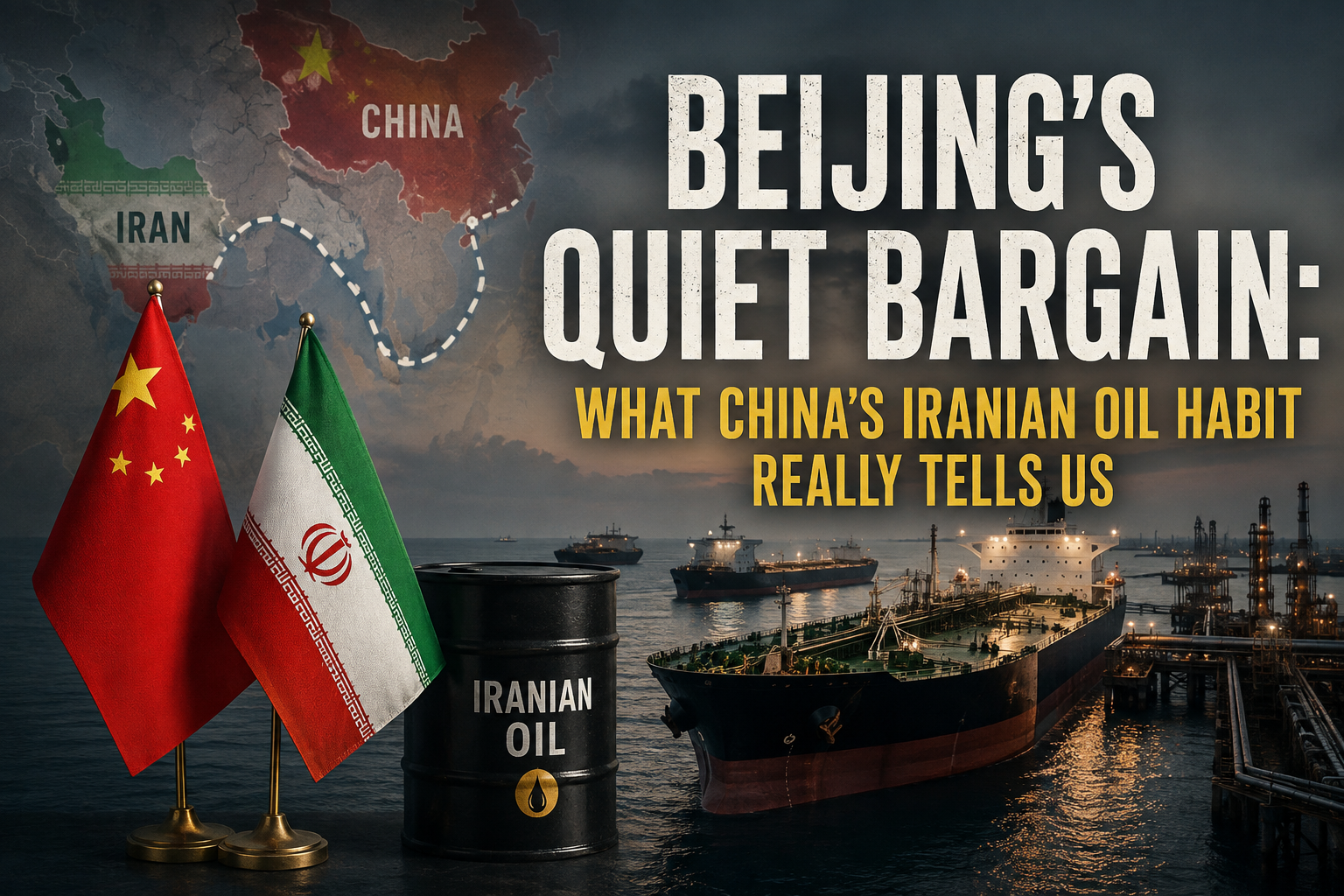
For the better part of a decade, Beijing has run a peculiar kind of open secret. Officially, China’s state oil giants — Sinopec, PetroChina, the companies that actually show up in customs data — haven’t touched Iranian crude since Washington reimposed sanctions in 2018. Officially, not a single barrel of Iranian oil crosses into China. You can check the customs statistics yourself; they’ll tell you so, cleanly, with a straight face.
Unofficially, somewhere between half a million and nearly two million barrels a day of Iranian crude has been flowing into Chinese ports for years, dressed up in Malaysian or Indonesian paperwork, paid for in yuan through a loop of intermediaries that would make a money launderer blush, unloaded mostly by small independent refineries in Shandong province that everyone in the industry calls “teapots” — a nickname that undersells just how much oil actually moves through them.
This is not a secret in any meaningful sense. Ship-tracking firms like Kpler and Vortexa publish the numbers. The US Treasury Department names specific refineries, specific tankers, specific shell companies in press release after press release. Congress has entire research briefs cataloguing the scheme. And yet the flow doesn’t stop. It dips when Washington tightens the screws — Chinese intake reportedly fell as low as roughly half a million barrels a day this August after the US reimposed its blockade on Iranian shipping in mid-July — and then it creeps back up the moment enforcement attention drifts elsewhere. In March of last year, by some estimates, it hit an all-time high of nearly 1.8 million barrels a day.
So here is the question I actually want to sit with, because I think the easy answers being offered on both sides are wrong, or at least incomplete: why does China keep doing this?
Is it cold, practical energy security — a country of 1.4 billion people simply securing the cheapest barrels it can find, the way any importer would? Is it quiet defiance, a deliberate middle finger to American hegemony dressed up in bureaucratic plausible deniability? Or is it something colder still — a hedge, a strategic asset being banked for a future confrontation, purchased today at a discount precisely because Washington is distracted elsewhere?
I think it’s all three. I think that’s the actual, uncomfortable answer, and I think most commentary on this topic picks one explanation because it’s rhetorically cleaner, when the honest picture is a blend that shifts depending on which part of the Chinese state apparatus you’re looking at.
Start with the boring explanation, because it’s mostly right
Let’s not overcomplicate this at the outset. China is the world’s largest crude oil importer. It buys from Saudi Arabia, Russia, Iraq, the UAE, Brazil, Angola, the United States itself when the politics allow it. Energy security for China isn’t an abstraction — it’s the single most consistent thread running through Chinese foreign and economic policy since at least the early 2000s, arguably since Deng Xiaoping’s reforms first made industrial growth the party’s core legitimacy claim.
Iranian oil, sanctioned or not, has one overwhelming appeal: it’s cheap. Discounted, sometimes dramatically, precisely because Tehran has so few other buyers willing to touch it. For refiners squeezed on margin — and Shandong’s independent teapots operate on notoriously thin ones — that discount isn’t a nice-to-have. It can be the difference between profitability and closure. Energy analysts have pointed out that a full halt in Iranian imports would likely have limited impact on China’s overall energy security given the country’s substantial inventories and diversified supplier base, but “limited impact on aggregate security” and “no cost at all to individual refiners” are two very different things. The teapots aren’t running a national security calculation. They’re running a spreadsheet, and Iranian barrels make that spreadsheet work.
So on one level, this is exactly what it looks like: unglamorous commercial opportunism. A country needs oil, someone is selling oil cheap, the oil moves. If you stripped away every geopolitical overlay, you’d still expect to see roughly this behavior from a profit-maximizing, resource-hungry economy operating next to a distressed seller.
But that explanation, while true, is also too convenient. It’s the explanation that lets everyone — Chinese officials, independent refiners, even Western commentators looking for a value-neutral story — avoid the harder question of intent. Because energy security doesn’t require the elaborate concealment apparatus we’re actually looking at. If this were purely commercial, purely deniable in the way normal trade is deniable, you wouldn’t need the fake Malaysian certificates of origin. You wouldn’t need yuan settlement specifically structured to avoid the dollar-clearing system that would expose the transaction. You wouldn’t need “dark fleet” tankers switching off their transponders in the Strait of Hormuz. You wouldn’t need Shandong Port Group publicly announcing, as it did last year, that it would refuse to dock US-sanctioned vessels — a symbolic gesture of compliance that conveniently didn’t stop the oil from arriving through other ports and other ships.
That’s not the behavior of a country that thinks it’s doing something ordinary. That’s the behavior of a country that knows exactly what it’s doing and has decided the risk is worth managing rather than avoiding.
The defiance argument, and why it’s more interesting than it sounds
Which brings us to the second explanation, the one that gets the most airtime in hawkish American commentary: China buys Iranian oil because it wants to. Because every barrel that moves despite US sanctions is a small, cumulative demonstration that Washington’s economic weapons have limits — and demonstrating that, again and again, quietly, is itself a strategic good for Beijing independent of the energy value.
I don’t think this is paranoid. I think it’s basically correct, though it needs to be stated more precisely than “China hates America and wants to show it.”
Consider the pattern. The current wave of American pressure began when Trump returned to office and launched what his administration explicitly called a “maximum pressure” campaign against Iran — the same phrase, deliberately, that was used in his first term. Since then, Treasury has rolled out sanctions round after round: on individual teapot refineries, on shipping networks, on the tankers themselves, on the shadow-banking channels that move the money. By some counts there have been well over a dozen distinct sanctions actions against elements of the Iran-China oil trade in this administration alone, arriving at a clip of nearly one a month through 2026.
And the flows have not stopped. They’ve fluctuated — dipping sharply after the July blockade, recovering, dipping again — but the long-run trend across every administration since 2018, Trump’s first, Biden’s, and now Trump’s second, has been the same: sanctions create friction, not cessation. China’s imports hit record highs under maximum sanctions pressure in 2018. They hit new record highs again in 2023. They surged to an all-time high in March 2025, in the teeth of an active US-China trade war, with Kpler data showing Iranian oil accounted for something like 13 percent of China’s entire crude intake that month.
If sanctions genuinely worked as intended, you’d expect the trend line to bend downward as enforcement sophistication increased. Instead you see the opposite: China’s capacity to absorb Iranian barrels while formally denying it has arguably gotten more resilient over time, not less, even as the US has gotten more granular in its targeting — moving from broad country-level sanctions to naming individual ships, individual port terminals, individual pipeline connections.
That resilience isn’t an accident. It reflects deliberate institutional design. The reliance on small, semi-independent teapot refiners rather than the state majors is not incidental — it’s the load-bearing structure of the whole arrangement. Teapots are numerous, individually low-value, mostly unexposed to the US dollar financial system, and politically expendable. When Washington sanctions one — as it did with Shandong Shengxing, or more recently with the larger Hengli Petrochemical refinery in Dalian — the trade doesn’t stop. It reroutes. Another teapot picks up the volume. The overall flow barely dips.
This is, functionally, a sacrificial architecture. Beijing has built — or at minimum, has permitted to be built and has declined to dismantle — a system explicitly designed to absorb US sanctions pressure at the margins, refinery by refinery, tanker by tanker, while insulating the core of China’s financial and energy system from real damage. That’s not passive opportunism. That’s strategic design, even if no single Politburo meeting ever authorized it as such. It emerges from the incentive structure Beijing has created and refuses to correct.
So yes — I think there’s a real element of Beijing treating each surviving barrel as a small proof of concept: that American economic coercion, however loudly threatened, has practical limits when the target economy is large enough, financially sophisticated enough, and willing to tolerate enough friction at the periphery. Every million barrels that gets through despite sanctions is a data point in an argument China is quietly making to itself, and to every other country watching how this plays out — most obviously, the countries watching to see whether Washington’s sanctions leverage over China itself, on Taiwan, on technology, on anything else, is as absolute as it’s sometimes portrayed.
But “defiance” alone doesn’t explain the shape of the behavior
Here’s where I part ways with the purely confrontational reading, though. If this were principally about demonstrating defiance, you’d expect China to be louder about it. You’d expect state media to celebrate the volumes. You’d expect Sinopec and PetroChina, the national champions, to be the ones doing the buying — visibly, proudly, the way they briefly did in 2018 when Sinopec told reporters flatly that its Iran contracts were binding and it intended to honor them regardless of sanctions.
That’s not what’s happening now. The state majors have stayed out entirely since 2019. The buying has been pushed down, deliberately, to the least prestigious, least visible tier of China’s refining sector — the teapots, the entities with no international listing, no major foreign banking relationships, no reputational stake in how the West perceives them. That’s not the behavior of a state proudly flexing. That’s the behavior of a state that wants the economic benefit without the diplomatic bill, and has engineered its domestic industry specifically to achieve that separation.
This is the “hedge” explanation, and I think it’s actually the most important of the three, even though it gets the least attention because it’s the least dramatic.
China is not trying to pick a fight over Iranian oil. It is trying to avoid one, while still extracting the value. The entire architecture — the relabeling, the currency workaround, the teapot buffer, the studied ambiguity in official statements — exists to let Beijing have it both ways: cheap energy and deniability, commercial benefit and diplomatic distance. When Beijing says, as it regularly does, that it “rejects unilateral sanctions” and prefers “resolution through diplomatic and political means,” that’s not really a defense of Iran. Notice how thin that statement actually is. It doesn’t say China supports Iran’s nuclear program, or Iran’s regional posture, or the Iranian government’s conduct in any specific way. It’s a generic, low-cost objection to the legal category of unilateral sanctions — a category China has every reason to object to on principle, since it is itself a frequent target of unilateral American sanctions on entirely unrelated matters, from Xinjiang to Huawei to semiconductor export controls.
In other words: China’s stated objection to Iran sanctions is not really about Iran. It’s a restatement of Beijing’s much broader, much older grievance about the US using its financial and legal system to project power extraterritorially — the same grievance underlying China’s efforts to build yuan-settlement systems, alternative payment rails, and de-dollarized trade corridors more generally. The Iranian oil trade is, in that sense, less a foreign policy commitment to Tehran than a live-fire training exercise for exactly the kind of sanctions-evasion infrastructure China anticipates it may need for itself one day, in a Taiwan contingency or some other future confrontation where Washington reaches for the same economic weapons currently being aimed at Iran.
That’s the hedge. Not a hedge on oil prices. A hedge on financial sovereignty.
Is Beijing’s public stance principled, or self-serving?
The user’s question asks directly whether China’s “we reject unilateral sanctions” line is principled or self-serving, and I want to resist the temptation to just say “obviously self-serving” and move on, because I think the honest answer is messier and more revealing than that.
There is a genuine, coherent policy position underneath China’s rhetoric, and it predates the Iran situation by decades. China has consistently — across the Cuba embargo, across sanctions on Russia, across sanctions on North Korea in earlier eras, across basically every instance where the US or a Western coalition has imposed sanctions outside a UN Security Council resolution — taken the position that only UN-authorized multilateral sanctions carry real legitimacy, and that unilateral sanctions imposed by a single state (even a superpower) represent an illegitimate extension of domestic law into international affairs. That’s not a position invented for Iran. It’s close to axiomatic in Chinese foreign policy doctrine, and it flows from a deeper and genuinely-held Chinese preoccupation with sovereignty and non-interference that traces back to the “Five Principles of Peaceful Coexistence” from the 1950s.
So there’s a real intellectual tradition here, not a fig leaf invented last Tuesday.
But — and this is the crucial but — a principle that consistently happens to align with your commercial and strategic interests is not thereby proven insincere, but it is fair to be skeptical of how much weight it’s actually carrying in the decision. China does not apply this “we reject unilateral sanctions” logic evenly. Beijing has been perfectly willing to impose its own unilateral trade restrictions and informal boycotts — against Australian wine and barley after Canberra called for a COVID-19 origins inquiry, against South Korean businesses during the THAAD missile-defense dispute, against Lithuanian exports after Vilnius allowed a Taiwanese representative office to open under that name. If the principle were really “unilateral coercive economic measures are illegitimate, full stop,” you’d expect it to constrain Chinese behavior too. It doesn’t. The principle, in practice, functions selectively: as a shield when Beijing is the target of unilateral pressure, and largely dormant when Beijing itself is the one applying it.
That selectivity is the tell. It’s not proof of pure cynicism — genuinely held principles can coexist with selective application, that’s true of most countries and most people, honestly — but it does mean we shouldn’t take China’s “rejects unilateral sanctions” framing as a disinterested legal position. It’s a principle deployed where useful, which makes it, at minimum, heavily instrumentalized even if it isn’t wholly invented.
What this reveals about the limits of American economic power
Step back from China specifically for a second, because I think the real story here is bigger than the bilateral US-China-Iran triangle. This is a live case study in the diminishing marginal returns of unilateral American financial coercion when the target has scale.
Sanctions work best against small, financially exposed, internationally dependent economies — the kind that need dollar clearing, need access to SWIFT, need Western capital markets, and therefore have no real alternative but to comply. Iran itself, in isolation, is a reasonably good example of sanctions “working” in the narrow sense: its oil exports and government revenue have been meaningfully constrained for years, its currency has been battered, its economy genuinely strained.
But sanctions on Iran were never actually just about Iran, not in this case. They depend entirely on cutting off Iran’s buyers, and China is not a small, financially exposed economy. China is the second-largest economy on Earth, holds enormous foreign reserves, runs its own alternative payment infrastructure that’s growing more capable every year, and — crucially — is simply too large and too economically important to the United States and its allies for Washington to impose the kind of blanket, immediate, economy-wide sanctions that might actually force compliance the way they did with, say, Iran itself, or North Korea, or Cuba. Every option on the table against China carries enormous self-inflicted cost: sanctioning a major Chinese bank risks financial contagion; the current administration has explicitly stopped short of designating the larger banks precisely because that risk is judged too destabilizing. Tariff and trade wars are already straining the relationship without resolving the underlying oil trade.
So what Washington is left with is a strategy of attrition at the margins — sanctioning individual teapots, individual tankers, individual shell companies, hoping cumulative friction eventually outweighs the profit motive. And the data increasingly suggests that this approach imposes cost without imposing compliance. It’s expensive theater for the individual entities sanctioned, genuinely disruptive for them, but structurally incapable of closing the macro-level flow so long as China’s overall economy stays insulated and Beijing keeps the state majors clear of direct exposure.
That’s not a uniquely Chinese lesson. It’s a lesson about the architecture of American financial power more broadly: it is extraordinarily effective against economies small enough to be starved, and much less effective against economies large enough to absorb the pain at the edges while declining to change behavior at the core. If I were advising policymakers rather than just opining, I’d say this is the single most important strategic takeaway buried in this story — more important, honestly, than the oil itself. Every year this pattern persists is another year in which the playbook for how a large, resourceful state can partially neutralize American sanctions gets more refined, more replicable, and more available to anyone else who finds themselves on Washington’s target list.
So which is it — security, defiance, or hedge?
I said at the top I think it’s all three, and I want to be specific about how they fit together rather than leaving that as a cop-out.
Energy security is the baseline motive and the one that would exist even in a world with no geopolitical tension at all — cheap oil is cheap oil, and Chinese refiners will buy it. Defiance is the emergent byproduct: not necessarily the primary intent behind any single transaction, but an effect Beijing has clearly noticed, values, and has made no serious effort to eliminate, because letting Washington’s sanctions regime look porous serves a broader signaling purpose China finds useful. And the hedge — the financial-sovereignty training exercise — is, I’d argue, the most strategically load-bearing of the three, even though it’s the quietest, because it’s the one explanation that accounts for the specific architecture of the trade: the deliberate use of disposable teapots instead of national champions, the yuan settlement, the relabeling, the calculated ambiguity of official statements that never quite defend Iran but always quite clearly reject the legal instrument being used against it.
None of these three motives require the others to be false. A government can want cheap energy, enjoy watching a rival’s coercive tools look blunt, and simultaneously be rehearsing its own sanctions-resistance infrastructure for a future crisis — all through the same set of oil tankers.
What I don’t buy is the version of this story, popular in some Western commentary, that treats China’s behavior as either pure venal profiteering with no strategic dimension, or as a grand ideological alliance with Tehran against the West. It’s neither. China doesn’t particularly love the Iranian regime — Beijing’s relationship with Tehran is transactional almost to the point of coldness, and China has been notably unwilling to offer Iran the kind of overt diplomatic or military backing it extends to, say, Russia. This isn’t solidarity. It’s opportunity, managed carefully to avoid becoming liability, wrapped in just enough principled-sounding rhetoric to give Beijing rhetorical cover without requiring it to actually stand behind Iran in any way that would cost China something real.
The uncomfortable conclusion
If there’s a single thread that ties this together, it’s that China has figured out something the United States is still working through: that in a genuinely multipolar economic order, sanctions compliance is no longer a binary. It’s a spectrum, and a sufficiently large, sufficiently insulated economy can occupy a permanent middle ground — extracting most of the benefit of noncompliance while paying only a fraction of the cost, indefinitely, so long as it’s willing to sacrifice the periphery of its own industry to protect the core.
That’s not a morally satisfying answer, and it’s certainly not the answer either side of this debate wants. It doesn’t let you say China is a rogue actor recklessly funding a sanctioned regime out of ideological sympathy, and it doesn’t let you say China is just an innocent commercial actor buying cheap oil like anyone else would. It’s both, filtered through a state that has become extremely good at building plausible deniability into its economic architecture from the ground up — good enough that eight years of escalating, increasingly granular American sanctions have bent the flow of Iranian oil into China without ever actually breaking it.
I think that’s the real story here, more than any single data point about barrels per day or which refinery got sanctioned this month. The China-Iran oil trade isn’t really a story about oil. It’s a stress test — for American financial power, for the coherence of China’s stated principles, and for how much longer unilateral sanctions can be relied on as a tool of first resort against anyone with the scale to simply absorb the hit. Judging by the trend lines, we’re closer to an answer than either government would probably like to admit.