
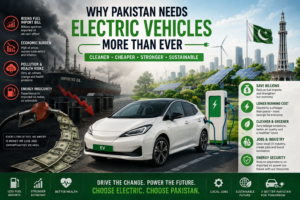
Every winter, Lahore disappears. Not literally — the buildings, the roads, the eleven million people are all still there — but the sky closes in, visibility drops to a few hundred metres, and the city’s outline dissolves into a grey-brown haze that clings to lungs and window ledges alike. In 2025, Pakistan was ranked the most polluted country on Earth, with fine particulate levels nearly fourteen times higher than World Health Organisation guidelines. Lahore alone has spent stretches of recent winters registering Air Quality Index readings above 500 — a number so far into “hazardous” territory that the standard scales barely account for it.
That single image — a great South Asian city choking on its own air — is as good a starting point as any for understanding why electric vehicles (EVs) have moved from a niche environmental talking point to a genuine economic and public health necessity in Pakistan. This isn’t a story about following a global trend or chasing Tesla-style prestige. It’s a story about a country bleeding foreign exchange to pay for imported oil, breathing air that is quietly shortening its citizens’ lives, and sitting on an opportunity to leapfrog into a cleaner, cheaper, more self-reliant transport future — if it can get the policy and infrastructure right.
This explainer walks through the case for EVs in Pakistan from every angle that matters: the economics, the environment, public health, energy security, industrial opportunity, and the very real obstacles standing in the way. By the end, the picture should be clear — not a rosy sales pitch, but an honest account of why the shift matters and what it will actually take.
1. The Oil Import Bill: A Bleeding Wound in the Economy
Start with the number that explains almost everything else: Pakistan’s petroleum import bill hit roughly $16.86 billion in fiscal year 2025-26, overshooting even the International Monetary Fund’s own projection of $15.28 billion, as global crude prices spiked amid Middle East tensions. For a country whose total annual imports hover in the range of $55-60 billion, that means well over a quarter of everything Pakistan buys from abroad is fuel — petrol, diesel, and crude for refining.
This is not a one-off spike. It’s structural. Pakistan produces only a fraction of the oil it consumes domestically — roughly 20 per cent of national demand is met locally, with the rest imported at whatever price the global market dictates that month. When tensions flare in the Middle East, when the Strait of Hormuz becomes a flashpoint, when OPEC+ tightens supply, Pakistan has no cushion. The country simply pays more, and that money — precious foreign exchange that could go toward development, debt repayment, or industrial investment — flows straight out of the economy.
The knock-on effects are familiar to anyone who has lived through Pakistan’s recurring balance-of-payments crises. A larger fuel import bill widens the current account deficit. A wider deficit puts pressure on the rupee. A weaker rupee makes imports — including fuel — even more expensive, creating a vicious cycle. It also feeds inflation directly: transport costs are baked into the price of nearly everything, from vegetables trucked in from Punjab’s farms to cement bags moving to construction sites. When diesel prices rise, so does the cost of living for everyone, not just vehicle owners.
This is precisely why the government’s own planners have started talking about EVs not as an environmental nice-to-have but as a balance-of-payments strategy. In April 2026, Prime Minister Shehbaz Sharif chaired a high-level review on electric mobility where officials projected that converting 30 percent of the country’s vehicle fleet to electric within five years could save approximately $4.5 billion annually in fuel import costs. That is a staggering figure — roughly a quarter of the entire annual oil import bill — recovered simply by shifting a third of vehicles from petrol and diesel to electricity, much of which can be generated domestically.
It’s worth pausing on why that $4.5 billion figure matters so much in the current moment. Pakistan has spent much of the past several years negotiating IMF programs, managing a fragile foreign reserve position, and trying to avoid default. Every dollar not spent on imported fuel is a dollar that strengthens the external account without requiring painful austerity, new taxes, or additional borrowing. In a country where foreign exchange reserves can swing the entire economic narrative — confidence in the currency, ratings agency assessments, the cost of servicing external debt — an EV transition functions as a quiet, structural fix rather than a one-time patch.
2. The Air Pakistanis Breathe
If the economic case is about money leaving the country, the health case is about lives being cut short inside it. Pakistan’s air pollution crisis is not a seasonal inconvenience; it is a public health emergency measured in years of life lost.
Lahore’s story is the most visible. The city’s annual average PM2.5 concentration — the fine particulate matter that penetrates deep into lungs and bloodstream — was around 89 micrograms per cubic metre in 2025, nearly eighteen times the WHO’s annual guideline of 5 micrograms per cubic metre. During peak winter smog episodes, hourly readings have exceeded 500 AQI, a level classified as “hazardous,” at which even healthy individuals are advised to avoid outdoor activity entirely. Schools have closed. Flights have been delayed by poor visibility. Hospitals report seasonal spikes in respiratory admissions, eye irritation, and cardiovascular complaints.
But Lahore is not an outlier so much as the most extreme example of a nationwide pattern. Karachi, Faisalabad, Multan, Peshawar, and Gujranwala all regularly post air quality readings that would trigger public health advisories in most of the world. Nationally, Pakistan’s average PM2.5 concentration in 2025 was around 67 micrograms per cubic metre — still nearly fourteen times the WHO guideline — earning the country the unwelcome distinction of the world’s most polluted nation that year.
Where does this pollution come from? Research on Lahore’s air specifically attributes roughly 40 to 45 per cent of pollution to vehicle emissions, with industrial activity contributing another 30 per cent or so, and the remainder split between crop-residue burning, brick kilns, construction dust, and biomass burning. Vehicle emissions are singled out as the dominant source of nitrogen dioxide and carbon monoxide in the city’s air — pollutants directly tied to internal combustion engines. In other words: nearly half of the toxic haze that blankets Pakistan’s largest city every winter is, quite literally, exhaust.
This matters enormously for the EV argument, because it means transport is not a peripheral contributor to Pakistan’s smog crisis — it is close to the single largest one. A meaningful shift toward electric vehicles would not solve air pollution on its own (industrial emissions, stubble burning, and brick kilns all need separate interventions), but it would remove the largest single slice of the problem, and it would do so in the exact urban corridors — Lahore, Karachi, the GT Road belt — where population density means the health payoff is greatest.
The human cost of inaction is not abstract. Long-term exposure to PM2.5 at the levels Pakistani cities register is associated with elevated risk of stroke, heart disease, lung cancer, and both chronic and acute respiratory illness, with children, the elderly, and outdoor workers bearing a disproportionate share of the burden. Public health researchers studying Pakistan’s air pollution crisis have described respiratory and cardiovascular admissions climbing sharply during smog season, alongside impacts that are harder to quantify but very real — missed school days, lost workdays, and a general erosion of quality of life for anyone who has to step outside during “the fifth season,” as Punjab’s smog months have come to be known locally.
3. Energy Security and the Case for Electrons Over Barrels
There’s a subtler argument here too, one about strategic vulnerability. Oil is a commodity Pakistan cannot produce enough of domestically and cannot control the price of internationally. Every time a tanker is threatened near the Strait of Hormuz, every time OPEC+ adjusts output quotas, every time a regional conflict flares, Pakistan’s economy absorbs the shock secondhand, with no seat at the table and no ability to hedge meaningfully against the volatility.
Electricity is different. It doesn’t have to be imported at all — or at least, not in the same all-or-nothing way. Pakistan’s grid draws on a genuine domestic energy mix: hydropower from the Indus system, a growing share of solar and wind, nuclear capacity, and — yes — a significant chunk of imported fuel-fired generation too. But the country’s electricity generation mix already includes a substantial and growing renewable component, with official estimates putting the grid at around 40 per cent renewable currently and projecting growth toward 60 per cent renewable by 2030 as hydropower, solar, and wind capacity expand. Every kilowatt-hour generated domestically, rather than every litre of fuel imported and burned, is a kilowatt-hour insulated from geopolitical shocks thousands of miles away.
There is also a basic efficiency argument that’s easy to overlook. New Energy Vehicles are dramatically more energy-efficient than their combustion counterparts — Pakistani policy documents note that electric vehicles require roughly 65 per cent less energy to operate than equivalent petrol or diesel vehicles, once you account for the inherent inefficiency of internal combustion (much of the energy in a litre of petrol is lost as heat, not converted into motion). That efficiency gap means that even accounting for the electricity needed to charge a growing EV fleet, the net energy burden on the country is lower than continuing to import and burn liquid fuel at current rates.
Put simply: shifting transport energy demand from imported barrels to domestically generated (and increasingly renewable) electrons is one of the few concrete, achievable ways for Pakistan to reduce its exposure to a volatile global oil market it has no control over.
4. Where the Real Opportunity Lies: Two- and Three-Wheelers
Any conversation about EVs in the West conjures images of sleek electric sedans and SUVs. That’s largely the wrong picture for Pakistan. The country’s vehicle fleet is overwhelmingly dominated by motorcycles and rickshaws — the humble 70cc and 125cc bikes that ferry office workers, students, and delivery riders through every city and town, and the auto-rickshaws (and increasingly, loader rickshaws) that form the backbone of short-distance freight and passenger transport. Motorcycles alone account for the vast majority of registered vehicles in Pakistan, numbering in the tens of millions.
This is precisely where Pakistan’s EV policy has, sensibly, chosen to concentrate its early efforts — and where the biggest wins are available fastest. Electric motorcycles and rickshaws are cheaper to convert to electric propulsion than four-wheelers, require smaller and less expensive batteries, and serve exactly the income bracket that feels fuel price increases most acutely. A delivery rider or a rickshaw driver spends a meaningful share of daily earnings on petrol; switching to electric can cut that operating cost dramatically, since electricity per kilometre is far cheaper than petrol per kilometre even at Pakistan’s relatively high power tariffs.
The government’s approach reflects this. Under the New Energy Vehicle (NEV) Policy 2025–30, which is set to replace the earlier Automotive Industry Development and Export Policy once its incentives lapse in mid-2026, Pakistan is explicitly targeting the two- and three-wheeler segment as the fastest path to scale. By March 2025, authorities had already issued 58 certificates for local assembly and manufacturing of electric two- and three-wheelers, alongside two licenses for local four-wheeler EV assembly — and domestic production capacity for electric two- and three-wheelers had already risen to roughly 2 million vehicles per year.
Subsidy programs have followed. Under proposed and rolling-out schemes such as the Pakistan Accelerated Vehicle Electrification (PAVE) program, direct subsidies of up to roughly Rs. 80,000 have been floated for electric motorcycle purchases, with specific quotas reserved for women, delivery riders, and small business owners — an acknowledgment that the people who stand to benefit most from cheaper running costs are often those with the least capital to make the upfront switch. Separately, the new NEV policy framework includes tax and toll exemptions: vehicles registered under the scheme in Islamabad, for instance, are proposed to be exempt from registration fees and annual token taxes, lowering both the upfront and ongoing cost of ownership.
This bottom-up approach — starting with bikes and rickshaws rather than premium cars — is arguably Pakistan’s smartest EV strategy, because it targets the vehicles that are (a) the most numerous, (b) the biggest contributors to urban air pollution per rupee of subsidy spent, and (c) used by the population segment most sensitive to fuel costs. A Tesla in Islamabad’s diplomatic enclave does very little for Pakistan’s air quality or its trade balance. Two million electric motorcycles replacing petrol bikes in Lahore, Karachi, Faisalabad, and Gujranwala would do a great deal of both.
5. The Policy Landscape: What Pakistan Has Actually Committed To
It’s worth laying out where policy currently stands, because Pakistan’s EV push is no longer just an aspiration on paper — it has some real institutional momentum behind it, even if implementation has historically lagged targets.
The original National Electric Vehicle Policy, launched in 2019–2020, set ambitious adoption targets that were, by the government’s own later admission, largely unmet. That experience shaped the design of the successor framework: the New Energy Vehicle Policy 2025–30, still finalising as of mid-2026, which aims for 30 per cent of new vehicle sales to be electric or “new energy” vehicles by 2030, and separately for around 2.2 million electric vehicles to be on Pakistani roads by that same year.
In parallel, the Ministry of Industries and Production has been reviewing a new automotive and auto-parts policy meant to replace the expiring AIDEP 2021–26 framework, explicitly built around four pillars: EV adoption, local manufacturing capacity, export growth, and job creation — alongside the climate commitments Pakistan has made internationally. Officials involved in these reviews have been direct about the logic: expanding EV usage is expected to reduce environmental pollution while significantly lowering dependence on imported fossil fuels, with local manufacturing seen as a way to create skilled jobs and attract investment, not just import finished electric vehicles from China.
On the infrastructure side, provincial and federal regulators have begun addressing some of the more mundane but essential plumbing of an EV transition. New rules now permit multiple power connections for EV charging stations at a single site, allow installation of additional transformers to support charging load, and — in a small but telling development — the first inter-provincial EV registration was processed in Lahore in 2026, with excise departments beginning to receive and process similar applications elsewhere, suggesting the bureaucratic machinery for EV ownership is slowly catching up to the vehicles themselves.
None of this means the transition is assured. Pakistan’s EV Policy 2019 missed its own targets rather badly, and there’s ample reason for healthy scepticism about whether 2025–30 targets will fare any better without sustained political will, financing, and — critically — the infrastructure buildout discussed below. But the direction of travel, and the seriousness with which the issue is now being treated at the Prime Minister’s Office level, marks a real shift from EVs being a fringe environmental talking point to a mainstream economic policy priority.
6. The Manufacturing and Jobs Angle
There is an industrial policy dimension to this story that deserves more attention than it typically gets. Pakistan’s automotive sector has, for decades, been built around assembling (rather than truly manufacturing) vehicles designed elsewhere — a low-value-add position in the global auto supply chain that has left the country dependent on imported parts, technology licensing from Japanese and, more recently, Chinese manufacturers, and a domestic market long criticised for producing outdated, overpriced cars protected by high tariff walls.
EVs represent a genuine opportunity to reset that dynamic. Because the electric vehicle supply chain is younger and less entrenched globally than the century-old combustion-engine ecosystem, there is more room for a country like Pakistan to build real domestic capability — battery assembly, motor and controller manufacturing, charging infrastructure — rather than simply screwing together parts shipped in from abroad. Policymakers reviewing the new automotive framework have specifically flagged local manufacturing capacity, technology transfer, and component localisation as central goals, not afterthoughts. Industry stakeholders have consistently pushed for policies that support this kind of technology transfer rather than a purely import-based EV rollout.
There’s early evidence this is happening at the two- and three-wheeler level, where dozens of local manufacturers already hold assembly licenses and domestic capacity has scaled into the millions of units annually. New four-wheeler entrants are also beginning to appear in the Pakistani market — compact electric SUVs and other new-energy models from Chinese brands establishing early footholds — signalling that the four-wheeler segment, while smaller, is not being ignored either.
The jobs argument follows naturally. A domestic EV manufacturing base — batteries, motors, chargers, assembly — creates skilled employment in a way that pure vehicle imports do not. Officials reviewing the policy have explicitly tied EV localization to thousands of skilled jobs, foreign investment, and a stronger position for Pakistan within global automotive value chains, alongside the export potential of a country positioned relatively close to major EV component supply chains in China and increasingly interested in South-South trade relationships (Pakistan’s outreach to Chinese manufacturers and trade fairs on this front has been active through 2026).
7. The Honest Obstacles
None of this works as a simple, uncomplicated success story, and a genuinely useful explainer has to be honest about the real barriers standing between Pakistan and a meaningful EV transition.
Grid capacity and reliability. Pakistan’s power sector has its own well-documented troubles — circular debt that runs into the trillions of rupees, transmission losses, and periodic load-shedding in parts of the country. Adding millions of EVs to charge off this grid is not a trivial ask. It requires investment in generation capacity, transmission upgrades, and — ideally — a charging pattern that leans on off-peak hours and renewable generation rather than straining an already stressed system further. The 40-to-60-per cent renewable trajectory mentioned earlier is encouraging, but it needs to be matched with genuine capacity additions, not just percentage targets on paper.
Charging infrastructure. Outside a handful of urban pilot projects, Pakistan’s public charging network remains thin. For four-wheelers especially, range anxiety and charging access are real deterrents for middle-class buyers who might otherwise consider an EV. Two- and three-wheelers are somewhat more forgiving here, since many can be charged from a standard home outlet overnight, which is one more reason the current policy focus on bikes and rickshaws makes practical sense — it sidesteps the infrastructure chicken-and-egg problem that plagues four-wheeler adoption.
Affordability and financing. Pakistan is a price-sensitive market where even conventional car ownership is out of reach for a large share of the population, and EVs — despite falling battery costs globally — still typically carry a higher upfront price than comparable combustion vehicles, even after subsidies. Financing schemes, leasing models, and battery-swap arrangements (increasingly popular in markets like India and parts of Southeast Asia for two-wheelers) will likely need to expand considerably for the mass-market adoption the policy envisions to actually materialize.
Policy consistency and implementation. Pakistan’s original 2019 EV policy missed its targets, and policymakers themselves have acknowledged this. Tariff protections for the conventional automotive sector remain extensive by regional standards, and the same policy documents driving the current EV push note that these distortions need to come down for the transition to work. Political and bureaucratic follow-through — sustained subsidy funding, timely charging infrastructure rollout, tariff reform — will determine whether the 2025–30 targets fare better than their predecessor, or simply become another set of missed benchmarks.
Import dependence on batteries and components. Somewhat ironically, a transition meant to reduce import dependence could, if not managed carefully, simply shift that dependence from imported oil to imported lithium-ion batteries and EV components — at least until domestic manufacturing capacity, discussed above, matures enough to reduce that reliance. Getting genuine localization right, rather than settling for CKD (“completely knocked down”) assembly of foreign-made kits, will be the difference between a real industrial win and a cosmetic one.
These are not reasons to abandon the push — they’re the reasons the push has to be managed competently, with realistic sequencing (bikes and rickshaws first, four-wheelers as infrastructure matures), sustained financing, and grid investment running in parallel rather than as an afterthought.
8. Climate Commitments and Pakistan’s Global Position
There’s a broader dimension to this conversation that’s easy to lose in the day-to-day economics: Pakistan’s own climate vulnerability, and the international commitments it has made in response to it.
Pakistan is routinely ranked among the countries most exposed to the physical effects of climate change, despite contributing a tiny fraction of global greenhouse gas emissions historically. The 2022 floods, which submerged roughly a third of the country and displaced millions, are the most visible recent example of a pattern climate scientists expect to intensify: erratic monsoons, accelerated glacial melt in the north feeding both flash floods and long-term water insecurity, and heatwaves that regularly push major cities past dangerous thresholds. This is the backdrop against which Pakistan negotiates internationally, and it gives the country a somewhat unusual moral standing — a nation that emits little but suffers disproportionately, asking wealthier, higher-emitting nations for both climate finance and technology support.
That standing comes with an expectation, fair or not, that Pakistan will also do its part domestically, and transport electrification is one of the more visible, measurable ways to demonstrate that. Officials reviewing the new automotive and NEV policy frameworks have explicitly tied EV adoption to the country’s climate commitments, alongside the more immediate economic and health arguments. It’s a useful reminder that the EV push isn’t happening in a domestic vacuum — it’s also part of how Pakistan positions itself in international climate negotiations, trade discussions, and the search for concessional financing tied to green development.
There’s a practical financing angle here too. International climate funds, green bonds, and multilateral development bank financing increasingly favour projects with demonstrable emissions reductions attached. A credible, well-implemented EV transition — backed by real adoption numbers rather than just policy documents — strengthens Pakistan’s case for accessing exactly this kind of financing, at a moment when the country’s access to conventional commercial borrowing is constrained by its debt profile and credit rating. In other words, taking transport electrification seriously isn’t just good climate citizenship; it’s also a plausible route to cheaper capital.
9. Lessons From Elsewhere: What Pakistan Can Borrow
Pakistan is not attempting this transition in isolation, and it doesn’t need to reinvent every wheel. A few regional and global comparisons are instructive.
India’s experience with electric two- and three-wheelers offers perhaps the closest parallel, given similar vehicle-fleet composition, price sensitivity, and grid challenges. India’s subsidy schemes for electric vehicles, combined with state-level incentives and the rapid growth of battery-swapping networks for delivery riders and rickshaw operators, pushed electric two- and three-wheelers from a niche curiosity to a meaningful share of new sales within a few years in some states. The lesson for Pakistan is less about the specific subsidy mechanics and more about sequencing: India, too, focused early adoption efforts on the vehicle categories where running-cost savings were most immediate and infrastructure demands lowest, before tackling the harder four-wheeler segment.
China’s experience is instructive in a different way — less about subsidy design and more about the sheer scale of industrial commitment. China’s EV manufacturing base didn’t emerge from consumer demand alone; it was built deliberately through sustained state investment in battery supply chains, charging infrastructure, and manufacturing capacity over roughly a decade and a half, to the point where Chinese firms now dominate global battery production and EV exports. Pakistan’s growing engagement with Chinese manufacturers — reflected in licensing arrangements, assembly partnerships, and diplomatic engagement around regional trade fairs — suggests an implicit recognition that Pakistan’s own transition will likely be built in partnership with, and using technology and components from, this existing Chinese supply chain, rather than from scratch domestically. That’s a pragmatic choice, though it does tie the pace of Pakistan’s EV rollout partly to the terms of that relationship.
Bangladesh and Nepal offer smaller but relevant examples too, particularly around three-wheeler electrification, where both countries have seen rapid organic uptake of electric auto-rickshaws even without particularly generous formal subsidy programs, driven simply by the operating-cost math working out favourably for drivers. This suggests that once the upfront price gap narrows enough — through subsidies, financing, or falling battery costs — adoption in this vehicle segment can move faster than top-down planning alone would predict, because the economic incentive for individual drivers is so direct and immediate.
The common thread across these examples is that successful transitions tend to start narrow and concrete — a specific vehicle category, a specific city, a specific subsidy mechanism — and expand once the model proves out, rather than attempting a simultaneous, nationwide, all-vehicle-category rollout from day one. Pakistan’s current emphasis on two- and three-wheelers, with four-wheelers treated as a longer-term ambition, fits this pattern reasonably well.
10. What Success Would Actually Look Like
It’s worth being concrete about what a genuinely successful transition would look like in practice, rather than leaving the goals as abstract percentages in a policy document.
Success would mean charging infrastructure that keeps pace with, rather than trailing behind, vehicle adoption — so that buying an electric motorcycle or rickshaw in a mid-sized city like Sialkot or Multan is no more logistically complicated than buying a petrol one is today. It would mean financing products, whether through banks, microfinance institutions, or manufacturer-backed leasing schemes, that make the upfront cost gap between an electric and petrol motorcycle a non-issue for the delivery riders and rickshaw drivers the policy is explicitly trying to reach. It would mean grid investment that treats EV charging load as a planning input from the start, ideally paired with continued growth in renewable generation, so that the environmental gains of electrification aren’t quietly offset by additional fuel-fired power generation to meet new demand.
It would also mean tariff and industrial policy that genuinely rewards local value addition — battery assembly, motor winding, controller manufacturing — rather than settling for a Pakistan that simply imports finished electric motorcycles from abroad and calls it “assembly.” And it would mean sustained political attention across multiple budget cycles and, likely, more than one change of government, since the original 2019 policy’s shortfall was as much about follow-through fading over time as it was about any single design flaw.
None of this is exotic or unachievable — every element listed above has already been attempted successfully somewhere in the world, often in countries with fewer resources and less urgent air-quality and balance-of-payments pressure than Pakistan currently faces. What’s required now is less about inventing new solutions and more about the harder, less glamorous work of consistent execution: keeping subsidy budgets funded year after year, keeping charging infrastructure rollout on schedule, and keeping the tariff reforms that make local manufacturing viable from being quietly reversed under pressure from entrenched interests in the conventional automotive sector.
11. Putting It All Together
Step back, and the case for EVs in Pakistan isn’t really one argument — it’s several separate, mutually reinforcing arguments that happen to point in the same direction.
The economic argument says: stop bleeding $16-17 billion a year on an oil import bill that a volatile global market controls, and Pakistan does not. The projected $4.5 billion in annual fuel-import savings from a 30-percent EV fleet conversion isn’t a marginal improvement — it’s a meaningful structural fix to a chronic balance-of-payments weakness.
The public health argument says: nearly half of the toxic air choking Lahore and other major cities comes from vehicle exhaust, in a country now ranked the most polluted on the planet, and shifting that transport energy source to electricity is one of the few concrete levers available to bring PM2.5 levels down from multiples of the WHO guideline toward something survivable.
The energy security argument says: electrons generated domestically, increasingly from hydropower, solar, and wind, are inherently less vulnerable to the kind of geopolitical shocks — a tanker seized near Hormuz, a spike in Dubai benchmark crude — that regularly rattle Pakistan’s economy through no fault of its own.
The industrial argument says: Pakistan’s automotive sector has spent decades stuck in low-value assembly of other countries’ designs, and the EV transition — still young enough globally that supply chains aren’t fully locked in — offers a genuine, if narrow, window to build real domestic manufacturing capability, skilled jobs, and export potential rather than repeating the same import-dependent pattern with a different kind of vehicle.
And the social equity argument, often overlooked, says: the people who benefit most immediately from cheaper-to-run electric two- and three-wheelers are precisely the delivery riders, rickshaw drivers, and lower-income commuters for whom every rupee of fuel cost matters — which is exactly why current policy design, with its subsidy quotas for women, delivery workers, and small business owners, is aimed where it is.
None of this guarantees success. Pakistan has a track record of ambitious policy documents that outrun actual implementation, and the 2019 EV policy’s unmet targets are a cautionary tale sitting right there in the same government reports that lay out the new 2030 goals. Grid capacity, charging infrastructure, financing access, and genuine (not just nominal) local manufacturing all have to be built out simultaneously, not sequentially, for the transition to hit anywhere close to its targets.
But the underlying logic is sound in a way that few policy debates in Pakistan actually are. This isn’t a case where economic interest and environmental necessity pull in opposite directions, forcing an uncomfortable trade-off. Here, they point the same way. Every electric motorcycle that replaces a petrol one saves its rider money, keeps a few more dollars of foreign exchange inside the country, and takes one more tailpipe out of Lahore’s winter smog. At a moment when Pakistan is simultaneously fighting to stabilize its currency, protect its foreign reserves, and do something — anything — about air that has become measurably dangerous to breathe, that kind of alignment between what’s economically necessary and what’s environmentally right doesn’t come along often. Pakistan would be hard-pressed to find a bigger lever to pull.
Understanding International Relations: How the World Really Works
Realism in International Politics: Power, Security, and the Struggle for Survival
US–Israel–Iran War: A New Geopolitical Order in the Making? Implications for Pakistan and the World
Rise of Artificial Intelligence and Global Job Markets
Climate Change and Extreme Weather Events
⚔️ Middle East Conflicts and Their Global Impact
Global Inflation and the Cost of Living Crisis: Why Prices Are Rising Worldwide
Digital Censorship and Freedom of Speech: Are Governments Tightening Control Over Online Platforms?
Strait of Hormuz Crisis: Can the World Survive Another Oil Shock?
Operation Epic Fury: A Comprehensive Look at the 2026 U.S.–Israel Military Campaign Against Iran
Strategic Importance of Gwadar Port in Regional Geopolitics
Balance of Power in International Relations: Meaning, History, and Modern Relevance
What is Geopolitics? – Explained Simply
Nature and Importance of International Relations
Middle Eastern Politics Explained Through International Relations Theory
Liberalism in International Relations: Cooperation, Institutions, and Mutual Benefit