
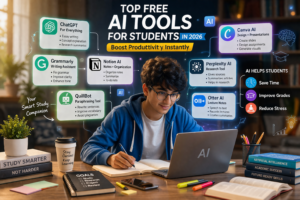
Introduction: The AI Revolution in Education
Artificial Intelligence is no longer a futuristic concept—it is an essential part of modern education. From simplifying research to enhancing creativity, AI has become a powerful companion for students across the globe. In 2026, academic success is no longer determined solely by hard work but also by how smartly students leverage technology.
Imagine completing assignments faster, understanding complex topics effortlessly, and organizing your academic life with precision. This is the reality AI offers. Today’s students are not just learners; they are digital innovators who rely on intelligent tools to stay ahead in a competitive academic environment.
Students who use AI are:
- Studying faster
- Writing better
- Learning smarter
In this comprehensive guide, we’ll explore the best free AI tools for students in 2026 that can transform your academic journey. Whether you’re in school, college, or university, these tools will help you maximize productivity, improve grades, and reduce stress.
Why AI Is Essential for Students in 2026
The educational landscape has evolved significantly over the past decade. Traditional learning methods are now complemented by intelligent technologies that enhance efficiency and accessibility. AI empowers students by offering personalised learning experiences, automating repetitive tasks, and providing instant access to information.
Key Benefits of AI in Education
Artificial Intelligence enables students to:
- Save time on research and assignments
- Improve writing and communication skills
- Enhance creativity and innovation
- Organise academic responsibilities efficiently
- Understand complex concepts quickly
- Access personalised learning support
In a world driven by data and innovation, students who embrace AI gain a competitive advantage. These tools not only support academic success but also prepare learners for future careers in an increasingly digital economy.
1. ChatGPT – The Ultimate All-in-One Study Companion
When it comes to versatility, ChatGPT stands at the forefront of AI-powered education. It serves as a virtual tutor, writing assistant, research guide, and brainstorming partner—all in one platform.
How Students Can Use ChatGPT
Students rely on ChatGPT for:
- Essay writing and editing
- Concept explanations
- Research summaries
- Homework assistance
- Brainstorming ideas
- Language learning
- Coding support
Whether you need help understanding calculus, summarising a research paper, or drafting an essay, ChatGPT provides clear and structured responses within seconds.
Key Benefits
- Saves time on assignments
- Simplifies complex subjects
- Enhances creativity and critical thinking
- Provides personalised academic assistance
Best For: All-in-one academic support and productivity.
2. Grammarly – Perfect Your Writing Instantly
Clear and error-free writing is essential for academic success. Grammarly is an AI-powered writing assistant that helps students refine their work by correcting grammar, enhancing clarity, and improving tone.
Features That Benefit Students
- Grammar and spelling corrections
- Tone and clarity improvements
- Vocabulary enhancement
- Plagiarism detection
- Real-time writing suggestions
From essays and research papers to emails and scholarship applications, Grammarly ensures that your writing remains professional and polished.
Why Students Love Grammarly
It acts like a personal editor, guiding students toward better communication and academic excellence.
Best For: Assignments, essays, and professional correspondence.
3. Notion AI – Smart Organisation for Academic Success
Staying organised is one of the biggest challenges students face. Notion AI transforms productivity by combining note-taking, task management, and content generation into a single, intuitive platform.
How Notion AI Helps Students
- Organises lecture notes
- Creates study plans and schedules
- Summarises academic content
- Generates to-do lists
- Manages research projects
- Tracks assignments and deadlines
With its clean interface and powerful automation, Notion AI serves as a digital academic hub.
Key Advantages
- Improves time management
- Enhances productivity
- Keeps academic resources in one place
Best For: Productivity, organisation, and project management.
4. QuillBot – Enhance Academic Writing with Ease
Paraphrasing is a critical academic skill, especially when working on research papers and essays. QuillBot helps students rewrite sentences while preserving their original meaning.
Features of QuillBot
- AI-powered paraphrasing
- Grammar checking
- Summarization tools
- Citation assistance
- Vocabulary enhancement
QuillBot is particularly useful for students who want to improve clarity and avoid unintentional plagiarism.
Benefits for Students
- Improves writing quality
- Enhances readability
- Saves time during revisions
Best For: Academic writing and research support.
5. Canva – Create Stunning Presentations and Visuals
Visual communication plays a vital role in modern education. Canva empowers students to create professional designs without requiring advanced graphic design skills.
How Canva AI Supports Students
- Creates presentations and slides
- Designs infographics and posters
- Generates visual content for projects
- Produces resumes and portfolios
- Enhances social media content
With its AI-powered design suggestions and customizable templates, Canva makes creativity accessible to everyone.
Why Students Prefer Canva
- User-friendly interface
- Thousands of free templates
- Professional-quality designs
Best For: Presentations, visual assignments, and creative projects.
6. Perplexity AI – Smarter Research with Reliable Sources
Conducting research can be time-consuming and overwhelming. Perplexity AI simplifies the process by providing accurate answers along with credible sources.
Key Features
- Instant research summaries
- Source citations and references
- Real-time information retrieval
- Academic insights and explanations
Unlike traditional search engines, Perplexity AI offers concise and reliable results, making it an ideal research companion.
Advantages for Students
- Saves research time
- Improves academic accuracy
- Enhances critical thinking
Best For: Research papers, essays, and academic projects.
7. Otter.ai – Transform Lectures into Smart Notes
Taking notes during lectures can be challenging, especially when trying to keep up with fast-paced discussions. Otter.ai solves this problem by converting spoken words into accurate, searchable text.
How Otter.ai Helps Students
- Records lectures in real time
- Transcribes audio into text
- Highlights key points
- Generates summaries
- Enables collaborative note-sharing
This tool ensures that students never miss important information.
Key Benefits
- Improves comprehension
- Saves time on note-taking
- Enhances study efficiency
Best For: Lecture recordings and class notes.
How AI Helps Students Succeed Academically
Artificial Intelligence is transforming education by making learning more efficient, personalised, and accessible. Students who embrace AI gain an edge in both academic and professional settings.
1. Saves Time
AI automates repetitive tasks such as proofreading, summarising, and organising notes, allowing students to focus on learning.
2. Improves Academic Performance
With instant feedback and guidance, students produce higher-quality assignments and perform better in exams.
3. Enhances Creativity
AI tools encourage innovation by assisting with brainstorming, design, and content creation.
4. Simplifies Complex Subjects
AI explains difficult concepts in easy-to-understand language, making learning more accessible.
5. Reduces Stress
By streamlining workloads and improving efficiency, AI minimizes academic pressure.
6. Encourages Independent Learning
Students can learn at their own pace with personalized support from AI-powered platforms.
Ethical Use of AI in Education
While AI offers numerous benefits, responsible usage is essential. Students must ensure that they use these tools to enhance learning rather than replace genuine effort.
Best Practices for Ethical AI Use
- Use AI for guidance, not copying.
- Always verify information from reliable sources.
- Avoid plagiarism by citing references properly.
- Maintain academic integrity.
- Use AI to learn and improve skills.
Remember:
AI should be your assistant—not your substitute.
How to Choose the Right AI Tool as a Student
Selecting the best AI tool depends on your academic needs and goals. Here’s a simple guide:
| Purpose | Recommended Tool |
|---|---|
| Essay Writing | ChatGPT, Grammarly |
| Research | Perplexity AI |
| Note-Taking | Otter.ai, Notion AI |
| Paraphrasing | QuillBot |
| Presentations | Canva |
| Productivity | Notion AI |
By integrating the right tools into your workflow, you can optimize your academic performance.
The Future of AI in Education
The role of AI in education will continue to expand in the coming years. By 2030, intelligent systems are expected to provide personalised learning paths, virtual tutors, and immersive educational experiences through augmented and virtual reality.
Future trends include:
- AI-powered virtual classrooms
- Personalised learning algorithms
- Smart tutoring systems
- Automated assessments
- Global accessibility to quality education
Students who adopt AI today will be better prepared for tomorrow’s careers.
Frequently Asked Questions (FAQs)
1. What are the best free AI tools for students in 2026?
The top tools include ChatGPT, Grammarly, Notion AI, QuillBot, Canva, Perplexity AI, and Otter.ai.
2. Are AI tools safe for academic use?
Yes, when used responsibly and ethically. Students should always verify information and avoid plagiarism.
3. Can AI improve academic performance?
Absolutely. AI enhances productivity, accuracy, and understanding, leading to better academic outcomes.
4. Do students need technical skills to use AI tools?
No. Most AI tools are user-friendly and designed for beginners.
5. Are these AI tools completely free?
Most offer free versions with optional premium upgrades.
6. Can AI replace traditional learning?
No. AI complements education but cannot replace critical thinking, creativity, and human interaction.
7. Which AI tool is best for research?
Perplexity AI and ChatGPT are excellent choices for academic research and analysis.
8. Is using AI considered cheating?
Not when used ethically. AI should support learning, not replace original work.
Conclusion: Embrace AI to Excel in the Digital Age
Artificial Intelligence is redefining education, empowering students to learn faster, work smarter, and achieve more. The tools highlighted in this guide are not just technological innovations—they are gateways to academic excellence and future success.
By integrating AI into your daily routine, you can:
- Enhance productivity
- Improve academic performance
- Unlock creativity
- Prepare for a technology-driven future
The students of today are the leaders of tomorrow. Those who embrace AI will not only excel academically but also thrive in the digital world.
So, start exploring these tools today—because the future of learning has already begun.
THE CRISES OF GLOBAL GOVERNANCE?
HYDROCARBONS IN THE EASTERN MEDITERRANEAN?
What is ECONOMIC GLOBAL FRAGMENTATION?
The Rise of a Multipolar World: Is US dominance ending?
Rise of Regional trade blocs and Protectionism.
US–Israel–Iran War: A New Geopolitical Order in the Making? Implications for Pakistan and the World
Rise of Artificial Intelligence and Global Job Markets
Climate Change and Extreme Weather Events
Middle East Conflicts and Their Global Impact
Global Inflation and the Cost of Living Crisis: Why Prices Are Rising Worldwide
Digital Censorship and Freedom of Speech: Are Governments Tightening Control Over Online Platforms?
Strait of Hormuz Crisis: Can the World Survive Another Oil Shock?
Strait of Hormuz: The Geopolitical Lifeline in the Iran War Crisis
Operation Epic Fury: A Comprehensive Look at the 2026 U.S.–Israel Military Campaign Against Iran
Strategic Importance of Gwadar Port in Regional Geopolitics
Balance of Power in International Relations: Meaning, History, and Modern Relevance
What is Geopolitics? – Explained Simply
Nature and Importance of International Relations
Middle Eastern Politics Explained Through International Relations Theory
Liberalism in International Relations: Cooperation, Institutions, and Mutual Benefit
Realism in International Politics: Power, Security, and the Struggle for Survival
What Is International Relations and Why It Matters in Today’s World