
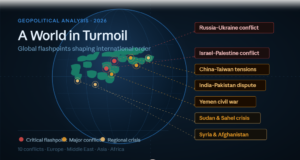
A Global Overview of Conflicts, Their Causes, and International Consequences
Preface
This document is not written for diplomats alone. It is written for anyone who has ever watched the news and felt overwhelmed — not because they lacked intelligence, but because nobody ever sat down and explained things clearly. That is what this piece attempts to do. It takes the most significant conflicts of our time and unpacks them: where they came from, why they matter, and what they mean for the rest of the world — including people who live thousands of miles away from any battlefield.
Introduction: A World in Turmoil
We live in an age of extraordinary contradiction. On one hand, humanity has never been more connected. We trade across oceans, communicate across continents in seconds, and share ideas with people we will never meet. The phrase “global village” gets used so often it has almost lost its meaning. But beneath all that connectivity, the world is also deeply fractured — by political ambitions, historical grievances, territorial disputes, and the relentless competition for power and resources.
What makes today’s conflicts particularly dangerous is that they refuse to stay contained. A war in Eastern Europe pushes up grain prices in West Africa. Tensions in the Persian Gulf make fuel more expensive in Southeast Asia. Political instability in the Taiwan Strait sends shockwaves through global technology markets. These are not separate crises — they are threads in the same unravelling fabric.
As 2026 unfolds, the international landscape looks increasingly unsettled. Great power competition has returned with a confidence not seen since the Cold War. Nationalism is on the rise in countries across every continent. International institutions — designed after World War II to prevent exactly this kind of disorder — are struggling to keep pace with events that move faster than diplomacy can manage.
The order built after 1945 was a noble experiment: the idea that nations could resolve their differences through dialogue, law, and cooperation rather than war. That experiment has not entirely failed, but it is under enormous strain. The United Nations frequently finds itself paralysed by divisions among its most powerful members. Major powers openly accuse each other of hypocrisy. Alliances are shifting in ways that would have seemed unthinkable a decade ago.
What is perhaps most tragic about all of this is who pays the price. Not the politicians. Not the generals. Not the arms dealers. It is ordinary people — families in bombed-out cities, children growing up in refugee camps, farmers watching their harvests collapse because a distant conflict disrupted the supply chain for fertiliser. The human cost of geopolitical instability is measured in lives, not just statistics.
Understanding these conflicts is no longer a niche interest. It matters for students trying to make sense of the world they are inheriting. It matters for researchers, journalists, business people, and policymakers. And it matters for ordinary citizens who vote, who consume, who engage in the civic life of their countries. Because these crises shape trade, energy security, migration, climate negotiations, and domestic politics in ways that touch everyone.
What follows is an honest attempt to explain the ten most significant geopolitical flashpoints of our time.
1. The Russia–Ukraine Conflict
Classification: Critical — Global Escalation Risk
There are some conflicts that rearrange the furniture of the entire world. The Russia–Ukraine war is one of them.
The full-scale Russian invasion of Ukraine in February 2022 was not, as some observers initially assumed, a short-term military operation with a quick political resolution. It became a prolonged, grinding war that has fundamentally altered European security, strained international institutions, and drawn the world’s major powers into opposing camps more sharply than at any point since the Cold War.
To understand the war, you have to understand the decades that preceded it. Ukraine and Russia share deep historical, cultural, and linguistic ties — ties that have been interpreted very differently on each side. Russia, particularly under President Vladimir Putin, came to see Ukraine as part of a historical and cultural sphere that belonged, in some essential way, within Moscow’s orbit. Ukraine, meanwhile, was moving in a different direction. After the Soviet Union collapsed in 1991, Ukrainians developed their own national identity, their own democratic politics, and their own aspirations — including the hope of joining Western institutions like the European Union and NATO.
That trajectory put the two countries on a collision course. For Moscow, NATO expanding eastward toward Russia’s borders was not merely inconvenient — it was, in the Kremlin’s framing, an existential threat. Russia had made these objections clearly for years. The West, for its part, argued that sovereign nations had the right to choose their own alliances.
The first open rupture came in 2014, when Russia annexed Crimea following political upheaval in Kyiv. It was a move that shocked the international community and triggered Western sanctions. Armed conflict also broke out in eastern Ukraine between Ukrainian forces and Russian-backed separatists, killing thousands over the following years. But even that violence was, in retrospect, a prelude.
When Russian forces crossed the border in full in February 2022, the scale of the assault made clear that this was not a limited operation. Cities across Ukraine were targeted. Millions of civilians fled. The destruction of infrastructure — power stations, hospitals, bridges — was systematic. The human cost, on both sides, has been enormous.
The global consequences have matched the scale of the conflict. Europe suddenly confronted its deep dependency on Russian natural gas, triggering an energy crisis that drove up household bills and forced governments to scramble for alternative supplies. Food prices surged worldwide, because Ukraine and Russia together account for a significant share of global wheat and sunflower oil exports — supplies that developing countries in Africa and the Middle East depend on to feed their populations.
Politically, the war produced some unexpected results. NATO, which had been described by some observers as “brain dead” just years earlier, found new purpose and unity. Countries that had maintained studied neutrality — Finland and Sweden being the most notable — reconsidered their positions entirely. Defence spending rose across Europe with a seriousness that earlier generations of politicians had resisted.
At the same time, the conflict exposed deep divisions in the broader international community. While Western countries rallied behind Ukraine, many nations in the Global South — including large ones like India, Brazil, and South Africa — maintained positions of neutrality or ambiguity, unwilling to align themselves with either camp. This division reflects something important: the world is no longer neatly organised around Western-led institutions and norms. A more multipolar, more fragmented international order is taking shape, and the Ukraine war has accelerated that transition.
What the end of this conflict looks like remains genuinely uncertain. Peace negotiations have stalled at multiple points. The territorial, political, and moral questions at the heart of the war have not become easier to resolve. But the war has already changed the world — and whatever comes next will have to reckon with that change.
2. The Israel–Palestine Conflict
Classification: Critical — Global Escalation Risk
There are few conflicts that generate as much emotion, as much political heat, and as much genuine disagreement among well-meaning people as the conflict between Israelis and Palestinians. It has been called intractable so many times that the word has lost some of its weight. But intractable it remains — and understanding why requires looking honestly at a history that is complicated, painful, and contested at almost every point.
The origins stretch back more than a century. In the late 19th and early 20th centuries, two nationalist movements were making competing claims to the same land. The Zionist movement, responding to centuries of Jewish persecution in Europe, sought to establish a Jewish homeland in what was then Ottoman and later British-controlled Palestine. Arab Palestinians, who formed the majority of the population, had their own national aspirations and saw incoming Jewish migration as a displacement of their people and their future.
The creation of the State of Israel in 1948 fulfilled the dream of one people and became the defining catastrophe — the Nakba — for another. Hundreds of thousands of Palestinians were displaced. Neighbouring Arab states went to war. The conflict that emerged from that moment has never been fully resolved, and the wounds of 1948 remain politically alive today.
At the core of the dispute are questions that have defied every attempt at a lasting solution: Who governs Jerusalem, a city of profound spiritual importance to Jews, Muslims, and Christians alike? Where does a Palestinian state begin and end? What happens to Israeli settlements built in the occupied West Bank over decades? What are the rights of Palestinian refugees and their descendants? And, underlying everything else, how can two peoples who share the same land find security, dignity, and recognition at the same time?
Gaza has become the most visible symbol of the conflict’s human cost. The strip is one of the most densely populated places on earth, and it has been under blockade and subjected to repeated military operations. Civilians — including enormous numbers of children — have lived through cycles of destruction, rebuilding, and destruction again. The suffering is real, documented, and immense.
What makes the conflict so difficult to resolve is precisely that it operates on multiple levels simultaneously. It is a territorial dispute, yes. But it is also a conflict about identity, about historical memory, about religion, about survival. Israelis, as a collective, carry the memory of the Holocaust and millennia of persecution; security is not an abstract concept for them. Palestinians carry the experience of occupation, displacement, and the denial of statehood; justice is not an abstract concept for them either.
The international community has been unable to bridge these realities. Western governments have generally emphasised Israel’s right to defend itself while calling for restraint. Governments across the Arab world and the broader Global South have spoken more forcefully about Palestinian rights and self-determination. International law is invoked by everyone and accepted in full by no one. Peace negotiations have collapsed repeatedly — at Camp David, at Annapolis, at countless summits — leaving behind deep scepticism that any process can actually deliver a solution.
What persists is the human reality: generations of Palestinians and Israelis who have grown up knowing nothing but conflict, and who deserve, on both sides, to live without fear.
3. China–Taiwan Tensions
Classification: Critical — Global Escalation Risk
If there is one flashpoint that keeps security analysts awake at night more than any other, it is probably Taiwan. Not because conflict is certain — it is not — but because the potential consequences of conflict there would be so catastrophic, so far-reaching, that the risk cannot be treated as remote even if it remains unresolved.
Taiwan’s situation is genuinely unusual in global politics. It functions as a fully independent democratic state with its own government, military, economy, and increasingly distinct national identity. But it has never formally declared independence, and the international community — including the United States — officially acknowledges the Chinese position that Taiwan is part of China while stopping short of endorsing it. It is a delicate fiction that has maintained an uneasy peace for decades.
China’s position has never been ambiguous. Beijing views Taiwan as a breakaway province that must eventually reunify with the mainland — and has explicitly refused to rule out the use of force to achieve that outcome. From Beijing’s perspective, Taiwan is not just a territorial matter; it is a question of national dignity and historical completion, the unfinished business of the Chinese civil war. Allowing Taiwan to formalise its independence would be, in Beijing’s view, an intolerable humiliation.
Taiwan, meanwhile, has evolved. Its democracy has deepened, its civil society has grown, and public identification as Taiwanese — rather than Chinese — has risen sharply, particularly among younger generations. Many Taiwanese people see their democratic system not as something to negotiate away but as something worth defending.
The strategic dimensions go beyond questions of identity. Taiwan sits at the heart of the global semiconductor industry. Taiwan Semiconductor Manufacturing Company (TSMC) alone produces a significant share of the world’s most advanced microchips — the components that go into everything from smartphones and cars to military systems and artificial intelligence infrastructure. If Taiwan’s semiconductor capacity were disrupted by conflict, the consequences for the global economy would be severe and immediate.
Military activity in the Taiwan Strait has intensified in recent years. China has conducted increasingly large military exercises near Taiwan, including simulated blockades. The United States continues to sell arms to Taiwan and to send naval vessels through the strait in what Washington describes as freedom of navigation operations. The risk of miscalculation — of an incident that spirals beyond anyone’s intentions — is real.
Managing this tension requires navigating between the genuine strategic interests of a rising China, a democratic Taiwan that does not wish to surrender its way of life, and a United States that sees itself as a guarantor of stability in the Indo-Pacific. There is no obvious resolution, and nationalism on all sides makes compromise politically costly. The world watches and hopes that decades of deterrence continue to hold.
4. The India–Pakistan Dispute
Classification: Major — High-Stakes Regional Dispute
The relationship between India and Pakistan is one of history’s great tragedies — two nations born together in one of history’s most violent partitions, and unable, for more than seven decades, to find a stable peace.
When British India was divided in 1947 into independent India and Pakistan, the process was rushed, chaotic, and accompanied by mass displacement and communal violence on a scale that left deep wounds in both societies. Millions of people moved across new borders, and hundreds of thousands were killed in the sectarian violence that accompanied partition. The experience of that moment — the fear, the loss, the displacement — became foundational to the national psyches of both countries.
Kashmir became the central unresolved question almost immediately. The territory, a Muslim-majority region ruled by a Hindu maharaja, did not have its fate determined in 1947. Both India and Pakistan moved to claim it. War broke out almost immediately, and the first of what would become multiple India-Pakistan wars was fought over the region. A ceasefire line — later called the Line of Control — was drawn, leaving each country in control of part of Kashmir. Both claim the whole.
What makes this dispute uniquely dangerous is the nuclear dimension. Both India and Pakistan developed nuclear weapons — India tested in 1974, Pakistan in 1998 — and neither has renounced first use. This means that any serious military escalation between the two countries carries a risk of nuclear exchange, with consequences that would extend far beyond the subcontinent. South Asia is home to nearly two billion people. A nuclear exchange there would not be a regional catastrophe — it would be a global one.
Tensions between the two countries fluctuate with events. Terrorist attacks, particularly ones where evidence — or suspicion — points across the border, have repeatedly brought the two sides to the brink. The political environment in both countries, where leaders are often rewarded domestically for taking hard lines, makes de-escalation politically difficult even when cooler heads recognise its necessity.
For ordinary people in Kashmir especially, the conflict is not an abstract geopolitical dispute — it is the fabric of daily life. Heavy militarisation, restrictions on movement, periods of communication blackouts, and the constant presence of security forces have shaped the lives of generations in the region.
The international community has long encouraged dialogue between the two countries, with limited results. Deep historical grievances, political incentives on both sides to maintain tension rather than resolve it, and the ever-present nuclear shadow make this one of the world’s most stubbornly persistent disputes.
5. The Yemen Civil War
Classification: Humanitarian — Severe Civilian Crisis
The Yemen civil war does not always make the front page. There are no superpower capitals directly involved, no dramatic moments that capture global attention in the way that some other conflicts do. And yet, by almost any measure of human suffering, Yemen deserves to be described as one of the worst humanitarian catastrophes of the modern era.
The conflict began in 2014 when Houthi rebels — a Zaidi Shia movement from northern Yemen — swept into the capital, Sana’a, exploiting political discontent and governmental weakness to seize control. The internationally recognised Yemeni government was pushed out. What followed drew in the entire region.
Saudi Arabia, watching an Iran-linked movement consolidate control on its southern border, intervened militarily in 2015, leading a coalition of Arab states in an air campaign intended to restore the Yemeni government. Iran has provided support to the Houthis — though the exact nature and extent of that support has been a matter of dispute — transforming what might have been a domestic political crisis into a proxy conflict for the Saudi-Iranian rivalry that runs through so much of the Middle East’s political geography.
The humanitarian consequences have been devastating. Years of fighting, blockade, and economic collapse have left millions of Yemenis on the edge of famine. Healthcare infrastructure has been destroyed. Water systems have been damaged. Disease — cholera in particular — has spread through populations with no adequate medical care. Children have died of hunger in a country that was already one of the poorest in the Arab world before the war began.
Beyond the human tragedy, Yemen matters strategically because of its geography. The Bab el-Mandeb Strait, through which a significant portion of global shipping passes on its way between Asia and Europe via the Suez Canal, sits at Yemen’s southern tip. Houthi attacks on commercial vessels in the Red Sea — which intensified significantly in late 2023 and into 2024 and 2025 — demonstrated vividly how instability in Yemen can translate directly into disruption for global trade.
Peace efforts have come and gone. Ceasefires have been agreed and then broken. Diplomatic processes have been launched and stalled. The underlying political questions — who governs Yemen, how power is shared, what role external powers play — remain unresolved. And the people of Yemen continue to wait.
6. The Syria Conflict
Classification: Humanitarian — Severe Civilian Crisis
The Syrian conflict began with peaceful protest and evolved into one of the most complex, bloody, and internationally entangled wars of the 21st century. In 2011, inspired by the Arab Spring uprisings spreading across the region, Syrians took to the streets demanding political reform and an end to the authoritarian rule of President Bashar al-Assad. The government’s response was brutal. Peaceful demonstrators were met with violence. The brutality radicalised the opposition and militarised what had begun as a civic movement.
What followed was a descent into a multi-layered conflict that drew in an extraordinary cast of actors. The Syrian government — backed by Russia and Iran — fought to survive. Various rebel factions, backed by different external sponsors including Turkey, Gulf states, and Western governments, fought against it. ISIS emerged from the chaos to seize vast territories and declare a caliphate, drawing military intervention from a US-led coalition. Kurdish forces, fighting ISIS with American support, carved out their own area of control in the northeast, creating further complexity in an already impossible situation.
Every major power used Syria as a stage for pursuing its own interests. Russia demonstrated the reach of its military power and preserved a strategically important client. Iran expanded its regional influence and secured a land corridor to Hezbollah in Lebanon. Turkey focused on preventing Kurdish autonomy near its borders. The United States fought ISIS while being deeply uncertain about what kind of Syria it wanted to emerge from the conflict.
The civilians caught in all of this had no say in any of it. By the time the most intense fighting subsided, more than half of Syria’s pre-war population had been displaced — either internally or as refugees abroad. Millions fled to Turkey, Lebanon, Jordan, and Europe. The refugee flows that reached European shores triggered political crises across the continent, fuelling debates about immigration and national identity that reshaped European politics for years.
Syria today is not at peace — it is at an exhausted standstill. The country remains fragmented. Economic conditions are devastating. International sanctions have choked whatever economic activity survived the war. Reconstruction is nowhere in sight. Assad maintained his hold on much of the country but rules over a broken state. And the people who fled — many of them professionals, educators, engineers — remain scattered, uncertain whether they will ever be able to return to what was once their home.
7. The Sudan Crisis
Classification: Regional — Significant Regional Impact
Sudan’s story over the past several years is in some ways a story about hope destroyed. In 2019, after decades of authoritarian rule under Omar al-Bashir, a popular uprising succeeded in removing him from power. There was a real moment of possibility — a sense that Sudan might genuinely be able to transition toward democratic governance. That possibility has, for now, been crushed.
The transition faltered almost immediately. A civilian-military partnership that was meant to guide Sudan toward elections became the arena for a power struggle between competing military factions. In 2023, that power struggle exploded into open conflict. Fighting between the Sudanese Armed Forces and the Rapid Support Forces — a powerful paramilitary organisation with its roots in the Janjaweed militias that had previously terrorised Darfur — brought violence to Khartoum itself. A capital city that Sudanese people had hoped would become a symbol of democratic renewal instead became a battleground.
The consequences for civilians have been catastrophic. Millions have been displaced. Food insecurity has deepened dramatically. Healthcare has collapsed. Reports of atrocities — killings, sexual violence, targeted attacks on civilians — have emerged from multiple parts of the country. Sudan, already one of the world’s most fragile states, has been pushed further toward the edge.
The crisis matters regionally because Sudan sits at a geopolitical crossroads — bordered by seven countries, located between the Sahel and East Africa, with the Nile running through it. Instability in Sudan sends shockwaves through its neighbourhood. Refugee flows into Chad, Egypt, Ethiopia, and South Sudan add pressure to countries already dealing with their own crises. The international community has struggled to find a way to intervene constructively, hampered by divisions between external actors who have competing interests in Sudan’s political future.
What Sudan’s crisis illustrates, starkly, is how fragile political transitions can be when the institutions needed to manage them are weak, when military actors have their own interests to protect, and when the international community’s attention is divided among too many simultaneous emergencies.
8. The Armenia–Azerbaijan Conflict
Classification: Regional — Significant Regional Impact
The conflict over Nagorno-Karabakh is, in one sense, a local dispute between two small countries in the South Caucasus. In another sense, it is a window into some of the deepest patterns in modern geopolitics — how ethnic grievances outlast the empires that created them, how energy geography shapes great power interests, and how military power can rapidly redraw maps that decades of diplomacy could not.
Nagorno-Karabakh is a mountainous enclave internationally recognised as part of Azerbaijan but populated largely by ethnic Armenians. When the Soviet Union collapsed, the ethnic Armenian population sought to break away and align with Armenia. War broke out in the early 1990s, leaving Armenia in control of the enclave and surrounding territories. More than a million Azerbaijanis were displaced. A ceasefire froze the conflict without resolving it.
For nearly three decades, the situation simmered. Then, in 2020, Azerbaijan launched a military offensive and, over six weeks of fighting backed by modern drone warfare and Turkish support, retook much of the territory it had lost. A Russian-brokered ceasefire stopped the fighting. In 2023, another Azerbaijani offensive led to the collapse of the last Armenian-controlled areas, and the ethnic Armenian population of Nagorno-Karabakh — nearly all of them — fled to Armenia in one of the most rapid and complete population displacements in recent history.
The geopolitical stakes beyond the immediate conflict are significant. The South Caucasus is a critical corridor for energy pipelines carrying Caspian oil and gas to European markets. Russia, Turkey, Iran, and Western powers all have interests in the region’s political alignment. Russia’s role as a mediator — while also fighting a war in Ukraine — has raised questions about the limits of its influence. Turkey’s strong backing of Azerbaijan has demonstrated how Ankara projects power in its near neighbourhood.
For Armenians, the loss of Nagorno-Karabakh is experienced as a national trauma, the culmination of a long history of displacement and loss. For Azerbaijanis, the restoration of territorial control is a moment of national triumph. How these two neighbours — who must ultimately share a region — find a workable relationship remains to be seen.
9. Afghanistan’s Ongoing Instability
Classification: Humanitarian — Severe Civilian Crisis
Afghanistan has been described, not without some truth, as a graveyard of empires. For two decades, American and NATO forces fought in the country, attempting to build a state that could govern itself securely and respect the rights of its people. When those forces withdrew in August 2021, the Taliban returned to power in a matter of days, and everything that had been built — or at least, much of what had appeared to be built — collapsed almost immediately.
The speed of the government’s fall revealed something that many people had suspected for years: that the Afghan state built under foreign patronage had shallow roots, that its military was dependent on external support in ways that had never been properly addressed, and that decades of effort had not produced the sustainable institutions that policymakers had hoped for.
The Taliban governance that followed has produced its own set of tragedies. Women and girls have been progressively excluded from public life — barred first from secondary and then university education, restricted in their ability to work, and denied many of the freedoms they had gained over the previous two decades. The international community’s response — sanctions, frozen assets, diplomatic isolation — has been driven by moral outrage at these policies, but has also worsened the economic conditions that ordinary Afghans depend on for survival.
The humanitarian picture is grim. Millions of Afghans are dependent on international aid for basic food and healthcare. The economy has contracted severely. Unemployment is widespread. The professionals — doctors, engineers, teachers — who can get out are getting out, depleting the human capital that Afghanistan would need for any real recovery.
Security concerns persist as well. Extremist groups remain active in the country. Neighbouring states — Pakistan, Iran, China, Central Asian republics — worry about the spillover effects of instability: terrorism, drugs, refugees. Afghanistan’s instability is not contained within its own borders.
What Afghanistan leaves behind is a set of difficult questions about foreign intervention, nation-building, and the limits of what external military and financial power can actually achieve. Those questions do not have easy answers. But for ordinary Afghans living through the consequences, the time for abstract debate has passed.
10. The Sahel Region Conflicts
Classification: Regional — Significant Regional Impact
Stretching across the southern edge of the Sahara Desert, the Sahel region — a belt of countries including Mali, Burkina Faso, Niger, and their neighbours — has become one of the world’s most acutely dangerous zones of instability, and one of the least discussed.
The problems here are not simple, and they do not have simple solutions. The Sahel faces a convergence of crises that reinforce each other in ways that make any single intervention insufficient. Poverty is widespread and structural. Governance has been weak for decades, with state authority often barely reaching beyond capital cities. Extremist groups linked to ISIS and al-Qaeda have exploited this weakness, establishing themselves in rural areas, recruiting from populations that feel abandoned by their governments, and carrying out attacks that have killed tens of thousands of civilians.
In recent years, military coups have toppled elected governments in Mali, Burkina Faso, and Niger in quick succession. The juntas that took power positioned themselves as strong alternatives to civilian governments that had failed to address insecurity — and found real popular support among people who were exhausted by violence and willing to try something different. These coups have also been accompanied by a strategic realignment: the expulsion of French forces that had been fighting jihadists in the region for years, and the invitation in some cases of Russian-linked Wagner Group fighters.
Climate change makes everything worse. The Sahel is one of the regions most acutely affected by rising temperatures and shifting rainfall patterns. Droughts and desertification are reducing the land available for farming and grazing, intensifying competition between communities over resources that were already scarce. Conflicts over land and water that were once localised are becoming more frequent and more deadly. People who cannot survive where they are leave — adding to migration flows that eventually reach Mediterranean shores and generate political controversy in European capitals far removed from the causes of that movement.
What the Sahel illustrates is that security problems cannot be solved by military means alone. The conditions that allow extremism to flourish — poverty, exclusion, weak governance, climate stress — require responses that are political, economic, and long-term. External powers that have engaged in the region militarily, including France, the United States, and increasingly Russia, have each pursued their own strategic interests, often without building the local institutions that genuine stability would require.
Why These Conflicts Matter Globally
It is tempting to view these crises as problems that belong to someone else — to governments, to military planners, to international organisations. That would be a mistake.
Wars disrupt the global economy in ways that reach into ordinary households everywhere. When conflict threatens oil production or disrupts shipping routes, fuel prices rise. When agricultural exporters are at war, food prices climb — and the burden falls most heavily on the poorest people, in the poorest countries, who spend the largest share of their income on food. When financial markets are rattled by geopolitical uncertainty, investments falter, growth slows, and jobs disappear.
Politically, conflicts reshape the world’s architecture. Countries form new alliances, sever old ones, and shift foreign policy strategies in response to changing security environments. Defence budgets expand — often, as history shows, at the expense of health, education, and social investment. International norms about sovereignty, human rights, and the use of force are tested and, sometimes, broken in ways that make the next violation easier to justify.
The humanitarian consequences need no translation. Every refugee who leaves their home is a person who had something worth staying for, until they did not. Every child who grows up in a displacement camp is a child whose potential is being shaped by conditions they did not choose. These are not abstract casualties. They are people.
The Role of Global Powers and International Organisations
The international institutions created after World War II — the United Nations, the International Criminal Court, regional bodies like the African Union and the European Union, and financial institutions like the World Bank and the IMF — were built on a conviction: that collective action, rules, and shared norms could prevent the worst.
That conviction has not been proven wrong, exactly. But it has been seriously tested. The UN Security Council, where the five permanent members each hold a veto, has been deadlocked repeatedly when conflicts involved those members’ interests — as has been the case repeatedly in Ukraine, Syria, and elsewhere. The ICC has struggled with questions of selective justice and enforcement. Regional bodies have had moments of genuine effectiveness, but also moments of paralysis.
Major powers meanwhile have shaped conflicts through arms sales, economic pressure, military advisors, and the credible or not-so-credible threat of intervention. In doing so, they have often turned local disputes into arenas for global competition — with consequences for the people living through those disputes that those powers are rarely held accountable for.
The challenge facing international institutions today is not only preventing wars. It is maintaining the credibility to play a meaningful role in a world where trust between major powers is at a low point, where the norms of the post-war order are being openly contested, and where the Global South is increasingly asserting its own perspectives on what fairness, justice, and international responsibility should look like.
Economic and Humanitarian Consequences
The economic consequences of modern conflict extend far beyond the countries directly involved. Global markets are deeply sensitive to geopolitical uncertainty. Commodity prices spike, trade routes are disrupted, and supply chains that have been built over decades on the assumption of stability suddenly prove fragile.
The inflation that spread through the global economy in 2022 and 2023 had multiple causes, but the Russia-Ukraine war was among the most significant — disrupting grain and energy supplies in ways that raised costs for consumers across every continent. The Houthi attacks on Red Sea shipping in 2023 and 2024 added to those pressures, forcing shipping companies onto longer routes with higher costs, which ultimately appeared in the price of goods on shelves.
Food insecurity has become a defining feature of the current geopolitical moment. The World Food Programme has spoken repeatedly about the compounding effects of conflict, climate change, and economic disruption on hunger. When a war breaks out in a major agricultural producing region, the people who suffer most are those who were already struggling — in the poorest countries, in the most vulnerable communities.
The humanitarian consequences are, if anything, even harder to quantify than the economic ones. What does it mean, in human terms, when a family spends years in a refugee camp? What is the cost — not in money but in human potential — of millions of children missing years of education? What happens to communities that lose their doctors, their engineers, their teachers to displacement or death? These are the real costs of conflict, and they do not appear in GDP calculations.
The Future of Global Stability
Looking ahead, there is neither reason for despair nor room for complacency.
The tools that could reduce global instability are not mysterious. Diplomacy, when undertaken seriously and with genuine willingness to compromise, has resolved conflicts that once seemed intractable. Economic development, when it reaches the people who need it most, reduces the desperation that extremist movements exploit. Strong institutions — courts, civil services, free presses — create the conditions in which political disputes can be managed without violence. International cooperation on shared challenges, above all climate change, can address the environmental pressures that are increasingly driving conflict.
But all of this requires political will, and political will is in short supply. New challenges are emerging that existing institutions were not designed to handle. Cyber warfare blurs the line between peace and conflict. Artificial intelligence is changing the nature of military competition in ways that existing arms control frameworks do not address. Disinformation campaigns — some state-sponsored, some not — are corroding the shared reality that democratic politics depends on. Competition over critical resources — minerals needed for clean energy technology, water in increasingly drought-prone regions — is intensifying.
Whether the world finds its way toward greater cooperation or deeper fragmentation will depend on choices made by leaders — and by citizens. Those choices will be made in the context of these conflicts, these pressures, and these stakes. Getting them right will require, at minimum, understanding what is actually happening in the world.
Conclusion
The conflicts shaping the world in 2026 are not isolated events. They are interconnected — shaped by the same forces of nationalism, great power competition, resource scarcity, climate stress, and historical grievance, even when they play out in very different corners of the globe.
From Eastern Europe to the Middle East, from the Taiwan Strait to the Sahel, ordinary people are living through crises that have their roots in decisions made by leaders, in failures of institutions, and in the accumulated weight of history. Those people deserve more than to be treated as statistics or abstractions in someone else’s geopolitical analysis.
Understanding these conflicts is the beginning of something, not the end. It is the beginning of asking better questions about foreign policy, about international responsibility, about what kind of world we want to live in and what we are willing to do to build it. Informed citizens make different demands of their leaders. Informed societies make different choices.
In an age where instability can travel across borders within hours — in the form of rising prices, refugee flows, political contagion, or the threat of weapons that know no borders — remaining informed is not a luxury. It is a form of responsibility.
This document was written for educational and research purposes. The conflicts described are ongoing and complex; this overview is intended as an introduction, not a comprehensive analysis.