
📌 Table of Contents
- Introduction: A New Era of Rivalry
- The Original Cold War vs the New Cold War
- Why the US–China Rivalry is Fundamentally Different
- The Semiconductor Wars: Battle for Silicon Supremacy
- Artificial Intelligence Race: Who Controls the Future?
- Trade Wars and Economic Sanctions
- Technology as a Tool of Geopolitical Power
- Impact on the International System
- Winners and Losers in the New Cold War
- What Does This Mean for Pakistan?
- Future Scenarios: What Lies Ahead
- Conclusion: A War Without Bullets
- FAQs
1. Introduction: A New Era of Rivalry
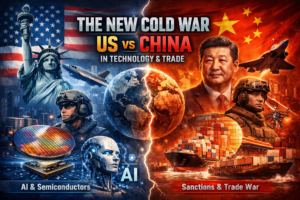
The global order is undergoing a profound transformation. What once appeared to be an era of economic interdependence and globalisation is now increasingly shaped by rivalry, suspicion, and strategic competition. At the centre of this transformation lies the intensifying confrontation between the United States and China—often described as the New Cold War.
However, unlike the 20th-century Cold War, this is not a battle of ideologies alone. It is a contest rooted in technological supremacy, economic influence, and control over global supply chains. Instead of nuclear arsenals and proxy wars, the tools of conflict today include semiconductors, artificial intelligence, trade restrictions, and digital infrastructure.
This new rivalry is subtle yet far-reaching. It affects not only the two superpowers but also reshapes global markets, alliances, and the future trajectory of developing countries like Pakistan.
2. The Original Cold War vs the New Cold War
To understand the present, it is essential to revisit the past. The original Cold War between the United States and the Soviet Union was largely defined by ideological confrontation—capitalism versus communism. It created a sharply divided world, with limited economic interaction between the two blocs.
In contrast, the New Cold War is unfolding within a deeply interconnected global economy. The United States and China are not isolated adversaries; they are deeply intertwined through trade, investment, and supply chains.
The earlier Cold War relied heavily on military deterrence and geopolitical alliances. Today’s rivalry is less visible but arguably more pervasive. It operates through economic pressure, technological competition, and strategic decoupling.
The most critical distinction lies in this paradox:
👉 The old Cold War separated economies.
👉 The new Cold War is taking place within a shared economic system.
This makes the current conflict more complex, as confrontation carries significant global economic costs.
3. Why the US–China Rivalry is Fundamentally Different
The United States and China share one of the most complex relationships in modern history. On one hand, China serves as a global manufacturing powerhouse, supplying goods to markets worldwide. On the other hand, the United States remains the epicentre of innovation, particularly in advanced technologies.
This creates a unique dynamic:
👉 They are both indispensable partners and strategic competitors.
This duality intensifies the stakes. Any attempt at complete decoupling would disrupt global trade, increase costs, and destabilise markets. Yet, continued dependence creates vulnerabilities, particularly in sectors tied to national security.
As a result, both nations are pursuing a strategy of “selective decoupling”—reducing dependence in critical areas while maintaining broader economic ties.
4. The Semiconductor Wars: Battle for Silicon Supremacy
At the heart of the New Cold War lies a tiny but powerful component: the semiconductor.
Semiconductors are the foundation of modern technology. From smartphones and artificial intelligence systems to advanced military hardware, nearly every technological innovation depends on these chips.
Control over semiconductor production is therefore synonymous with control over the future.
The Strategic Importance
Semiconductors determine:
- Economic competitiveness
- Military capabilities
- Technological leadership
Recognising this, the United States has taken aggressive steps to limit China’s access to advanced chip technologies. Export controls, restrictions on semiconductor manufacturing equipment, and pressure on allied nations have become key tools of policy.
China, in response, has embarked on an ambitious campaign to achieve technological self-reliance. Massive state investments, domestic innovation programs, and strategic partnerships are all aimed at reducing dependence on foreign technology.
The Global Consequences
This confrontation has led to:
- Fragmentation of global supply chains
- Rising production costs
- Delays in technological development
The semiconductor war is not just about chips—it is about who controls the digital backbone of the global economy.
5. Artificial Intelligence Race: Who Controls the Future?
If semiconductors are the foundation, artificial intelligence is the future.
AI is rapidly transforming industries, economies, and military strategies. It is no longer just a technological tool—it is a strategic asset.
The United States leads in AI innovation, supported by world-class universities, private sector investment, and a culture of research and development. Meanwhile, China leverages its vast population and data ecosystem to accelerate AI deployment at scale.
Competing Advantages
- The U.S. excels in innovation and foundational research
- China leads in application, scale, and state-driven implementation
But the real competition goes beyond technological advancement.
👉 The true battle is about who sets global standards, ethics, and governance frameworks for AI.
The winner of this race will not only dominate economically but will also shape how societies function in the digital age.
6. Trade Wars and Economic Sanctions
The rivalry between the United States and China has increasingly taken the form of economic confrontation.
Trade wars—once considered temporary disputes—have evolved into long-term strategic tools. Tariffs, export restrictions, and sanctions are now used to influence behaviour and limit technological advancement.
For the United States, the goal is to slow China’s rise in critical sectors. For China, the objective is to reduce vulnerability and expand global influence.
Broader Impacts
- Decline in global trade efficiency
- Rise in protectionist policies
- Increased uncertainty in international markets
This shift signals a move away from cooperative globalisation toward competitive economic nationalism.
7. Technology as a Tool of Geopolitical Power
Technology has become the central pillar of modern geopolitical power.
In the past, dominance was measured through military strength and territorial control. Today, it is increasingly defined by:
- Digital infrastructure
- Cyber capabilities
- Control over emerging technologies
From 5G networks to quantum computing, nations are competing to establish technological superiority. This shift represents a fundamental transformation:
👉 Power is no longer just about weapons—it is about who controls the systems that power the world.
8. Impact on the International System
The New Cold War is reshaping the international system in several key ways.
8.1 A Divided Technological World
The global system risks splitting into two competing ecosystems:
- A U.S.-led technological order
- A China-led alternative
8.2 Decline of Multilateralism
Global cooperation is weakening as countries prioritise national interests over collective solutions.
8.3 Emergence of Strategic Alignments
Countries are aligning themselves based on economic and technological interests rather than ideology.
8.4 Persistent Uncertainty
Markets and governments alike must navigate an increasingly unpredictable environment shaped by geopolitical risks.
9. Winners and Losers in the New Cold War
Winners
Tech Industries
Technology companies benefit from increased government investment and strategic importance.
Allied Nations
Countries aligned with major powers gain access to investment, technology, and trade opportunities.
Losers
Developing Countries
Many nations are forced to navigate complex geopolitical pressures and may struggle to remain neutral.
Global Economy
Fragmentation reduces efficiency, increases costs, and slows overall growth.
Consumers
Higher production costs translate into more expensive goods and fewer choices.
10. What Does This Mean for Pakistan?
Pakistan finds itself at a critical juncture in this evolving global landscape.
Opportunities
- Attract investment as companies diversify supply chains
- Leverage its geographic position as a regional hub
Risks
- Pressure to align with either the U.S. or China
- Reduced access to diversified markets
The China Factor
Pakistan’s close relationship with China offers significant advantages, including infrastructure development and economic cooperation. However, it also creates risks related to overdependence and limited strategic flexibility.
The Way Forward
Pakistan must adopt a balanced approach by:
- Maintaining strategic neutrality
- Investing in technological education and innovation
- Expanding trade partnerships beyond a single bloc
11. Future Scenarios: What Lies Ahead
Scenario 1: Full Technological Decoupling
The world splits into two separate technological ecosystems, increasing rivalry and reducing global integration.
Scenario 2: Managed Competition
Both powers compete but maintain limited cooperation to avoid global disruption.
Scenario 3: Escalation
Economic tensions spill over into military or security conflicts, destabilising global order.
12. Conclusion: A War Without Bullets
The New Cold War is not fought on traditional battlefields. It unfolds in data centres, research labs, and global markets.
It is a conflict defined by innovation, influence, and interdependence.
For countries like Pakistan, the challenge is not merely to survive this transition—but to strategically position themselves within it.
The future will not be shaped solely by power—but by how nations adapt to this rapidly changing landscape.
❓ FAQs
1. What is the New Cold War?
A strategic rivalry between the United States and China focused on technology, trade, and global influence.
2. How is it different from the original Cold War?
It is driven by economic and technological competition rather than purely ideological conflict.
3. Why are semiconductors important?
They are essential for modern technologies and critical for economic and military power.
4. What role does AI play?
AI is central to future global dominance, influencing both economies and security systems.
5. What should Pakistan do?
Maintain balanced foreign relations, invest in technology, and diversify economic partnerships.
IS THE WORLD HEADING TOWARDS WORLD WAR 3? A REALISTIC GEOPOLITICAL PERSPECTIVE