
 📌 Table of Contents
- Introduction: A World Breaking Apart
- What is Global Economic Fragmentation?
- The Rise of Regionalisation: From Global to Local Blocs
- Key Drivers Behind Deglobalization
- The New Economic Blocs: US, China, and EU Spheres
- Impact on the International System
- Who Benefits and Who Loses
- Supply Chain Shifts: The New Economic Geography
- What Does This Mean for Pakistan?
- Future Scenarios: What Happens Next?
- Conclusion: Evolution or Collapse of Globalisation?
- FAQs
1. Introduction: A World Breaking Apart
For decades, globalisation was seen as an unstoppable force—integrating economies, reducing trade barriers, and connecting markets across continents. But today, that narrative is rapidly changing.
From trade wars to geopolitical rivalries, the world is witnessing a slow but decisive shift toward economic fragmentation—a process often described as “deglobalization.”
The idea of a single, interconnected global economy is being replaced by competing regional blocs, each driven by strategic interests rather than efficiency.
This raises a fundamental question:
👉 Are we witnessing the end of globalisation—or just its transformation?
2. What is Global Economic Fragmentation?
Global economic fragmentation refers to the breakdown of integrated global trade systems into smaller, regional or political blocs.
Instead of global interdependence, countries are now prioritising:
- National security over economic efficiency
- Regional alliances over global integration
- Political trust in market openness
This shift is not accidental—it is strategic.
3. The Rise of Regionalisation: From Global to Local Blocs
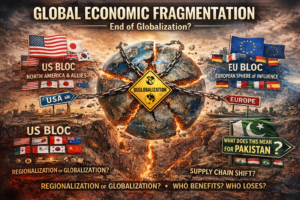
The world economy is increasingly reorganising into three major spheres of influence:
1. US-Led Bloc
- North America and key allies
- Focus on friend-shoring and secure supply chains
2. China-Centric Bloc
- Asia, Africa, Belt and Road partners
- Infrastructure-led economic integration
3. European Union Sphere
- Regulatory power and internal cohesion
- Emphasis on strategic autonomy
This emerging structure resembles a multipolar economic order, where global cooperation is limited and regional competition dominates.
4. Key Drivers Behind Deglobalization
4.1 Geopolitical Rivalries
The growing competition between the United States and China is the primary catalyst.
Trade wars, sanctions, and export controls have fractured global markets.
4.2 Supply Chain Vulnerabilities
Events like COVID-19 exposed the risks of overdependence on global supply chains.
Countries now aim to:
- Reshore industries
- Diversify suppliers
- Build resilience
4.3 National Security Concerns
Technology and trade are no longer separate from security.
Semiconductors, AI, and energy are treated as strategic assets.
4.4 Rise of Economic Nationalism
Governments are prioritising domestic industries through:
- Subsidies
- Tariffs
- Industrial policies
This marks a shift away from free-market globalisation.
5. The New Economic Blocs: US, China, and EU Spheres
5.1 US Economic Sphere
The U.S. is building alliances based on:
- Technology partnerships
- Defense cooperation
- Trade agreements
Its strategy is “de-risking, not decoupling.”
5.2 China’s Expanding Influence
China is leveraging:
- Infrastructure investments
- Trade connectivity
- Resource diplomacy
Its model is state-led globalisation.
5.3 European Union’s Strategic Autonomy
The EU is attempting to:
- Reduce dependence on both the U.S. and China
- Build independent supply chains
- Strengthen internal markets
6. Impact on the International System
Global economic fragmentation is reshaping the international system in profound ways:
6.1 End of Hyper-Globalisation
The era of unrestricted global trade is fading.
6.2 Emergence of Multipolarity
Power is now distributed among multiple economic centres.
6.3 Weakening of Global Institutions
Organisations like the WTO face declining influence.
6.4 Rise of Geoeconomics
Economic tools are now used as weapons:
- Sanctions
- Trade restrictions
- Technology bans
7. Who Benefits and Who Loses
Winners
1. Regional Powers
Countries with strong regional influence gain importance.
2. Strategic Industries
Sectors like defence, semiconductors, and energy benefit from government support.
3. Resource-Rich Nations
Demand for local sourcing increases its value.
Losers
1. Export-Dependent Economies
Countries reliant on global trade face disruptions.
2. Small Economies
Lack bargaining power in regional blocs.
3. Consumers
Higher costs due to inefficiencies and trade barriers.
8. Supply Chain Shifts: The New Economic Geography
Supply chains are no longer global—they are becoming regional and strategic.
Key trends include:
- Nearshoring: Moving production closer to home
- Friend-shoring: Trading with trusted allies
- Decoupling: Reducing dependence on rivals
This leads to a new economic map where geography matters more than ever.
9. What Does This Mean for Pakistan?
For Pakistan, global economic fragmentation presents both opportunities and risks.
9.1 Opportunity: Strategic Positioning
Pakistan can leverage its location:
- Gateway between Asia, the Middle East, and Central Asia
- Potential hub for regional trade
9.2 Risk: Choosing Sides
Pakistan’s close ties with China could limit:
- Access to Western markets
- Economic diversification
9.3 Supply Chain Integration
Pakistan has the potential to:
- Attract manufacturing relocation
- Develop export industries
But this requires:
- Policy reforms
- Infrastructure development
- Political stability
9.4 Missed Opportunities
Without strategic planning, Pakistan risks being:
👉 A bystander rather than a participant in the new economic order
10. What Happens Next? (Future Scenarios)
Scenario 1: Full Deglobalization
- Trade blocs become isolated
- Global cooperation declines
- Economic inefficiencies increase
Scenario 2: Controlled Fragmentation
- Regional blocs dominate
- Limited global cooperation continues
Scenario 3: Re-globalisation 2.0
- New rules for trade emerge
- Technology enables integration
- Balanced globalization returns
11. Conclusion: Evolution or Collapse of Globalisation?
Globalisation is not ending—it is evolving.
The world is moving from:
👉 Efficiency → Security
👉 Global → Regional
👉 Cooperation → Competition
This transformation will define the future of:
- Trade
- Technology
- Global power
For Pakistan and other developing nations, the challenge is clear:
👉 Adapt to the new order—or be left behind.
FAQs
1. What is deglobalization?
It is the process of reducing global economic integration and shifting toward regional systems.
2. Why is globalisation declining?
Due to geopolitical tensions, supply chain risks, and national security concerns.
3. What are economic blocs?
Groups of countries aligned economically and politically, such as the US, China, and the EU spheres.
4. How does this affect global trade?
Trade becomes more regional, less efficient, and more politically driven.
5. What should Pakistan do?
Diversify trade, invest in industry, and maintain balanced foreign relations.