
Introduction
In October 2014, a young game developer named Zoë Quinn woke up to find her home address, phone number, and personal photographs circulating across forums and message boards, attached to a wave of messages telling her to kill herself. She had not committed a crime. She had made a small, free video game. What followed — a campaign that would come to be known as Gamergate — introduced much of the public to a pair of tactics that had, until then, mostly lived in the shadows of hacker forums and gaming subcultures: doxxing and swatting. A decade later, these tactics are neither niche nor rare. They are a standard part of the toolkit used to punish women who write, play, govern, stream, or simply speak in public.
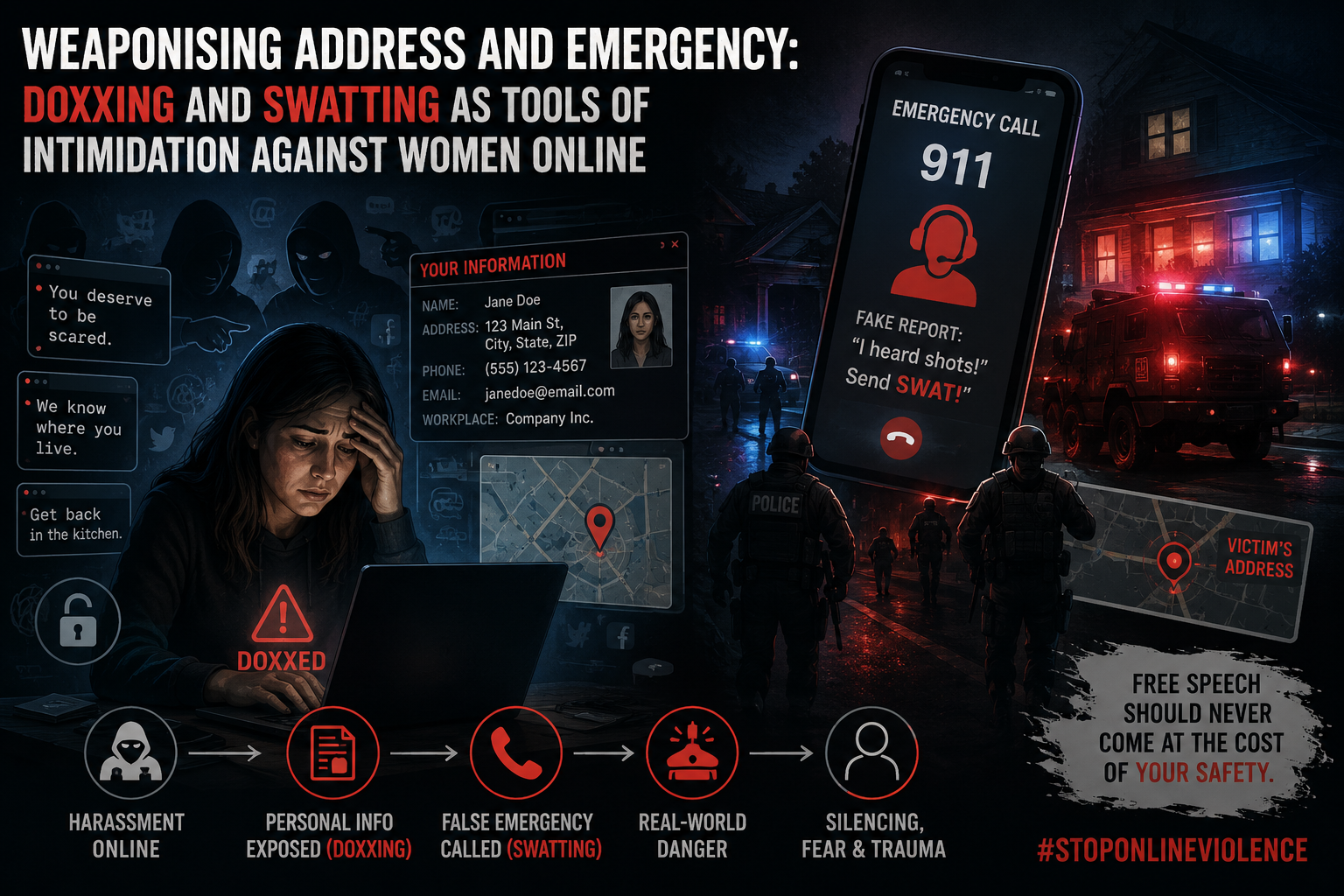
This analysis examines doxxing and swatting as mechanisms of gendered intimidation, focusing on four groups that have been disproportionately targeted: journalists, video game developers and players, elected officials, and livestreamers. The throughline connecting these otherwise different professions is visibility. Each involves a woman occupying public or semi-public space — a byline, a leaderboard, a voting record, a live camera feed — and each has become a site where anonymous or semi-anonymous actors attempt to convert that visibility into vulnerability. Doxxing exposes the woman’s physical self to potential harm; swatting attempts to make that harm materialize instantly, using the state’s own emergency apparatus as the weapon. Together they represent an evolution in how online misogyny operates: not merely as insult or harassment confined to a screen, but as a bridge connecting digital hostility to the physical world.
This is not a technical guide to either practice, nor an argument about any specific unresolved case. It is an attempt to understand the shape of the phenomenon — why these particular tactics emerged, why they target women with such consistency, what psychological and social function they serve for perpetrators, how platforms and institutions have responded, and what the accumulated evidence suggests about prevention.
Defining the Tactics
Doxxing (from “dropping documents”) is the deliberate publication of private identifying information about a person without their consent, with the implicit or explicit goal of enabling others to locate, harass, or harm them. It can include home addresses, phone numbers, workplace details, family members’ names, financial information, daily routines, or images of a person’s residence. What separates doxxing from ordinary information-sharing is intent and context: the information is compiled and released specifically because the target has attracted hostility, and its release is understood by everyone involved — poster and audience alike — as an invitation to escalate.
Swatting is doxxing’s violent extension. It involves placing a false emergency report — typically a fabricated hostage situation, shooting, or bomb threat — to a target’s address, with the deliberate aim of provoking a heavily armed police response, often a SWAT team, at that location. The term captures both the tactic’s mechanism (exploiting the “swat” response) and its dark humor among perpetrators, who often treat the resulting chaos as entertainment to be watched, sometimes live, on streaming platforms. Swatting requires doxxing as a precondition: an attacker cannot send police to an address they do not have. In this sense, the two tactics are not separate phenomena but sequential stages of the same escalatory logic — expose, then endanger.
Both practices depend on an asymmetry that is central to understanding why they proliferate: the perpetrator can remain anonymous, low-cost, and physically distant, while the harm delivered to the target is immediate, embodied, and largely irreversible. A doxxed address cannot be un-published once it has propagated across dozens of screenshots and mirrors. A swatting call cannot be un-dispatched once officers are already at the door with weapons drawn.
Why Women Are Disproportionately Targeted
It would be inaccurate to claim that only women experience doxxing and swatting; men, particularly in gaming and streaming communities, are also frequent targets, often as retaliation in disputes unrelated to gender. But research and journalistic documentation consistently show that when the underlying motive is punitive — when the goal is not simple rivalry but the desire to silence, humiliate, or “put a woman in her place” — the campaigns tend to be more sustained, more sexualized, more likely to include threats of rape alongside threats of death, and more likely to invoke the target’s gender explicitly as the reason she deserves punishment.
Several dynamics explain this pattern. First, women who enter spaces historically coded as male — competitive gaming, political office, tech journalism, cybersecurity — are perceived by some segment of that space’s existing population as trespassers rather than participants. Their presence itself is treated as a provocation, independent of anything they say or do. A negative game review written by a woman can generate a doxxing campaign in a way that the same review written by a man typically does not, because the underlying grievance is not really about the review.
Second, doxxing and swatting are, at their core, methods of reasserting control through the threat of embodied vulnerability, and women are acculturated — correctly, given rates of gender-based violence — to experience the exposure of their home address as a distinctly gendered threat. An attacker does not need to specify what might happen when strangers know where a woman sleeps; the ambient cultural knowledge of stalking, domestic violence, and sexual assault does the specifying for him. This makes doxxing a uniquely efficient intimidation tool against women: it requires no further threat to be legible as one.
Third, these campaigns frequently function as a form of networked, participatory punishment. A single instigator posts identifying information; hundreds or thousands of others then pile on with messages, calls, and threats, each individual contribution small enough to feel deniable but the aggregate effect devastating. This crowd-sourced model of harassment specifically exploits the fact that misogynistic communities online are large, are motivated by shared grievance narratives, and can be mobilized quickly around a target once she has been identified and framed as an enemy.
Case Studies
Gamergate and the Gaming Industry
Gamergate remains the most extensively documented case of coordinated doxxing and swatting used against women, and it illustrates the pattern in near-complete form. What began as accusations about a personal relationship metastasized into a movement ostensibly about “ethics in games journalism” but functionally organized around targeting women in and around the gaming industry — developers, critics, and cultural commentators. Multiple women, including Quinn, cultural critic Anita Sarkeesian, and developer Brianna Wu, were doxxed repeatedly, had to leave their homes due to specific and credible threats, and in some cases were subjects of swatting attempts. Sarkeesian canceled a university speaking engagement after a threat invoking a real mass shooting was sent to the venue; Wu left her home after receiving a message that included her address alongside a graphic threat.
What made Gamergate significant beyond the individual harm it caused was its demonstration of infrastructure: dedicated forum threads for compiling personal information, shared spreadsheets, and coordination across multiple platforms designed to route around any single platform’s moderation efforts. When one forum banned Gamergate-related organizing, participants migrated to another, taking their compiled dossiers with them. This modular, platform-agnostic organizing became a template that later harassment campaigns — including political ones — would reuse.
Journalism
Women journalists, particularly those covering politics, technology, or extremism, face doxxing and swatting as a fairly routine occupational hazard, distinct from the ordinary hostility journalists of any gender might expect. Reporters who cover far-right movements, misinformation, or online radicalization are especially likely to be targeted, seemingly because their reporting threatens to expose or delegitimize communities that then retaliate using the same tools they use against other targets. Multiple journalists have documented receiving swatting calls at their homes after publishing critical stories, timed to arrive within hours of a story’s publication — a pattern that leaves little ambiguity about motive.
The effect on journalism itself is a form of censorship that does not require any government action. A reporter who has been swatted once faces a rational, justified fear that continuing a particular line of coverage will produce a repeat. Editors report that some women reporters decline assignments on extremism or online misogyny specifically because of this risk, which means the intimidation succeeds in shaping coverage even when no single article is ever retracted.
Politics
Women in elected office — particularly those who are also young, of color, or otherwise visible as symbolically significant — have become frequent targets of both doxxing and swatting. Sitting members of Congress have had their home addresses posted online alongside violent rhetoric; some have experienced swatting calls at their residences, prompting armed police responses in the middle of the night. Local officials, including school board members and city council representatives in smaller jurisdictions with far less security infrastructure than federal officials, have reported similar experiences, often for the first time in their lives, after taking positions on politically charged local issues such as curriculum, pandemic policy, or zoning.
The political dimension adds a layer of consequence beyond the personal: when doxxing and swatting are used against elected women, the intended audience is not just the target but every other woman watching who might consider running for office. Multiple women who have left public life or declined to seek reelection have cited harassment, including doxxing, as a contributing factor, which represents a direct erosion of political representation attributable to online intimidation tactics.
Streaming and Content Creation
Livestreaming introduces a technical wrinkle that makes swatting particularly cruel: it can be broadcast in real time to an audience, some of whom may have orchestrated it specifically to watch. Women streamers on platforms built around live video have been swatted while broadcasting, meaning armed officers burst into rooms while a camera is running and an audience is watching — sometimes an audience the attacker has explicitly directed to tune in for the moment of the raid. This turns a woman’s own means of livelihood and self-expression into the delivery mechanism for her own public humiliation and endangerment.
Women streamers, particularly those who play competitively or who publicly discuss experiences of harassment, report high rates of doxxing attempts, on-stream threats, and coordinated brigading — waves of hostile viewers arriving simultaneously to overwhelm chat with abuse. The parasocial intimacy inherent to streaming, where audiences feel a sense of personal relationship with a creator they have never met, appears to intensify entitlement-driven aggression when that creator does something perceived as a betrayal, such as blocking a viewer, discussing feminism, or simply having an off night.
The Mechanics of Escalation
Doxxing and swatting rarely emerge from nothing; they typically follow a recognizable escalatory arc. A woman does something — publishes a story, makes a comment, wins a match, takes a policy position — that a segment of an online community interprets as offensive or threatening to its interests. Hostile commentary begins, often framed initially as legitimate criticism. When the target does not retreat, respond apologetically, or disappear, the campaign intensifies: criticism becomes insult, insult becomes threat, and a subset of participants begins actively searching for identifying information, treating the search itself as a form of investigative sport. Old forum posts, leaked databases, public records, real estate listings, and reverse image searches on background details in photographs are all common sourcing methods; none require sophisticated technical skill, which is part of why the tactic has spread so widely.
Once compiled, information is posted — sometimes on the original platform, more often on secondary forums specifically because those forums have laxer moderation and are known within the community as the appropriate venue for “next steps.” From there, the campaign can bifurcate: some participants use the information to send direct threats or contact the target’s employer, family, or neighbors; others may escalate to swatting, treating the emergency call as the logical capstone of the harassment campaign — the moment where online hostility is finally, physically, delivered.
Understanding this arc matters because it identifies multiple points of possible intervention that are earlier and less costly than a police response: platform moderation at the “hostile commentary” stage, rapid takedown of compiled personal information at the “doxxing” stage, and community norms that make clear the search-and-compile behavior itself is unacceptable rather than a permissible extension of criticism.
Platform Dynamics and Institutional Response
Social media and gaming platforms occupy an uncomfortable position in this ecosystem. Doxxing typically violates the explicit terms of service of every major platform, and yet enforcement has historically been inconsistent, slow, and heavily dependent on the target’s own ability to document and report violations — an especially cruel burden to place on someone already under active attack. Compiled dossiers frequently exist across multiple platforms simultaneously, meaning that even swift action by one company does nothing to remove the information from forums, image boards, or messaging apps outside its jurisdiction.
Part of the difficulty is structural. Platforms are generally organized to moderate individual pieces of content rather than campaigns, and a distributed harassment operation is specifically designed to defeat content-level moderation: no single post may contain enough information to constitute a violation on its own, even though the aggregate, cross-referenced picture assembled by a determined audience does. Some platforms have introduced dedicated policies and reporting flows for coordinated harassment and doxxing in the years following Gamergate, along with faster escalation paths for threats involving physical safety, but researchers and advocates continue to document significant gaps, particularly for smaller platforms and messaging apps that host the “planning” phase of these campaigns away from public view.
Law enforcement’s role is similarly uneven. Swatting is a criminal act in most jurisdictions, and high-profile cases have resulted in real prosecutions and, in cases where swatting led to a death, serious prison sentences. But the anonymity tools used by perpetrators — VPNs, spoofed caller ID, voice-changing software, and international jurisdiction-hopping — make investigation resource-intensive, and departments vary widely in their familiarity with the tactic and their willingness to treat a hoax call as a serious felony rather than a prank. Some police departments have adopted swatting-specific protocols, including flagging addresses that have previously been targeted so dispatchers can approach a call with appropriate caution, but this remains far from universal, and a first-time target has essentially no protection against the initial armed response.
Psychological and Social Function for Perpetrators
It would be a mistake to treat every doxxer or swatter as ideologically identical. Motives range from targeted misogynistic grudges to indiscriminate thrill-seeking, and some perpetrators are barely more than teenagers seeking status within a subculture that rewards escalation with attention and approval. But several recurring dynamics appear across cases.
For some, the act functions as a demonstration of capability and dominance to a peer audience — proof that the perpetrator can locate and endanger someone, offered up for community approval on forums where such “wins” are celebrated. For others, the framing is explicitly punitive: the target is understood, within the internal logic of the harassment community, to have transgressed against the group and to deserve consequences the group itself cannot legally impose but can approximate by weaponizing the state’s own emergency response against her. This latter framing is particularly evident in cases where the swatting call explicitly references the target’s public statements, timed to arrive shortly after she has spoken, written, or streamed something the perpetrator found objectionable.
The anonymity and physical distance inherent to these acts appears to matter enormously in enabling participation. A person calling in a fake hostage situation from another state, or another country, experiences none of the immediate feedback — the fear on a target’s face, the visible presence of armed officers — that might otherwise trigger empathy or hesitation. This distance, combined with the gamified, spectator-friendly framing many harassment communities apply to these acts, allows participants to experience real, sometimes lethal, violence against another person as a form of entertainment rather than as the assault it functionally is.
Consequences for Targets
The harm caused by doxxing and swatting extends well beyond the acute incident. Targets commonly report having to relocate, sometimes multiple times, incurring significant financial cost and disruption to work and family life. Many install home security systems, alter daily routines, limit their children’s school pickup schedules, or ask neighbors to watch for suspicious activity — a permanent, low-grade vigilance that persists long after any specific threat has faded from public attention. Psychologically, targets frequently describe symptoms consistent with sustained traumatic stress: hypervigilance, intrusive thoughts about the incident, anxiety triggered by unexpected knocks at the door or unfamiliar vehicles near their homes, and a persistent, well-founded sense that their physical safety is no longer fully within their control.
Professionally, the chilling effect is significant and measurable in indirect ways: women journalists declining certain beats, women game developers leaving public-facing roles or the industry altogether, women streamers reducing personal disclosure or building teams specifically to handle harassment triage, and women considering political candidacy weighing the near-certainty of this kind of exposure against the value of running. None of these decisions show up in any single incident report, but in aggregate they represent a meaningful narrowing of whose voices remain visible in public discourse.
There is also a distinctly gendered secondary harm worth naming: the frequent public skepticism directed at women who report having been doxxed or swatted, ranging from outright accusations of fabrication to milder suggestions that they are exaggerating for sympathy or attention. This skepticism, itself sometimes organized and amplified by the same harassment communities responsible for the original attack, compounds the initial harm by adding public doubt to private fear.
Legal and Policy Landscape
Legal responses to swatting have hardened over the past decade, particularly following cases in which the armed response led to a fatality. Federal and state prosecutors in the United States have pursued swatting cases under a range of statutes — false report laws, wire fraud, conspiracy, and in fatal cases, manslaughter or related homicide charges — and sentencing in the most serious cases has extended into years of imprisonment. Some jurisdictions have passed swatting-specific statutes that increase penalties when the hoax call results in injury or death, or when it targets a person because of a protected characteristic.
Doxxing occupies a messier legal space, in part because much of the underlying information is technically public record, scattered across sources that are each individually legal to access. The harm arises specifically from compilation and malicious redistribution, which existing privacy and harassment law does not always capture cleanly. Some jurisdictions have introduced or strengthened statutes specifically criminalizing the publication of private information with intent to cause harm, but enforcement remains inconsistent, and cross-border cases — extremely common given the international nature of these harassment communities — face significant jurisdictional obstacles.
Civil remedies exist in some cases, including harassment-based lawsuits and restraining orders, but these tend to be slow, expensive, and often ineffective against anonymous or pseudonymous perpetrators operating from overseas, which limits their practical usefulness for the majority of targets.
What Reduces Harm
Evidence and advocacy work point toward a layered approach, since no single intervention addresses the full arc from hostile commentary to armed police response.
At the platform level, faster and more proactive detection of coordinated doxxing campaigns — rather than relying solely on individual user reports — combined with genuine cross-platform information sharing about active harassment operations, would close some of the gaps that currently let compiled dossiers persist and circulate even after individual posts are removed.
At the law enforcement level, standardized swatting protocols that allow addresses with a documented harassment history to be flagged for cautious, verified response, along with dedicated training for dispatchers and officers on recognizing hoax patterns, can reduce the likelihood that a false report escalates into physical harm even when the call itself cannot be prevented.
At the legal level, clearer statutory language specifically addressing malicious doxxing — distinguishing it from legitimate public-interest disclosure — combined with international cooperation frameworks for cross-border harassment cases, would address some of the enforcement gaps that currently let perpetrators act with practical impunity.
At the individual and organizational level, employers of frequently targeted women — newsrooms, campaign offices, streaming platforms — have increasingly adopted proactive security measures: address protection services, coordinated incident response plans, and staff training on what to do the moment a doxxing attempt is detected, before it can escalate to swatting. Advocacy organizations focused on online harassment have also developed rapid-response resources to help targets navigate the practical steps of securing their information and documenting threats for potential legal action.
None of these measures, individually or collectively, fully eliminates the risk. The underlying dynamic — that visibility itself invites punishment, and that punishment can be delivered anonymously and at a physical remove — is deeply embedded in how these online spaces currently function. But the layered approach at least raises the cost and difficulty of executing these campaigns, which is likely the most realistic near-term goal.
Conclusion
Doxxing and swatting represent a particular escalation in the broader story of online misogyny: the point at which digital hostility stops being purely rhetorical and becomes a mechanism for delivering physical risk to a woman’s body and home. What makes these tactics distinctly effective as tools of gendered intimidation is not technical sophistication — both rely on comparatively simple information-gathering and a phone call — but their exploitation of an existing cultural understanding that women’s physical vulnerability is real, and that the mere exposure of a home address carries an implicit threat that requires no further elaboration.
The women targeted by these campaigns are journalists exposing uncomfortable truths, developers and players occupying spaces some believe should remain exclusively male, elected officials attempting to represent constituents on contested issues, and streamers building careers in a medium that leaves them uniquely exposed in real time. What unites them is simply that they were visible, and that visibility was treated by someone, somewhere, as sufficient justification for an attempt to make them afraid in their own homes.
Addressing this problem seriously requires treating doxxing and swatting not as isolated pranks or individual criminal acts disconnected from broader patterns, but as a coherent tactic within a larger system of online misogyny — one that platforms, law enforcement, legislators, and employers each have a distinct and necessary role in disrupting. The alternative is a slow, cumulative narrowing of whose voices remain willing to stay visible in public life, measured not in any single dramatic incident but in the quiet accumulation of women who decided the risk was no longer worth it.
A note on sensitive content: this analysis discusses threats of violence and harassment in a factual, educational context. If you or someone you know is experiencing targeted harassment, doxxing, or swatting, organizations such as the Cyber Civil Rights Initiative and PEN America’s Online Harassment Field Manual offer practical guidance and support resources.