
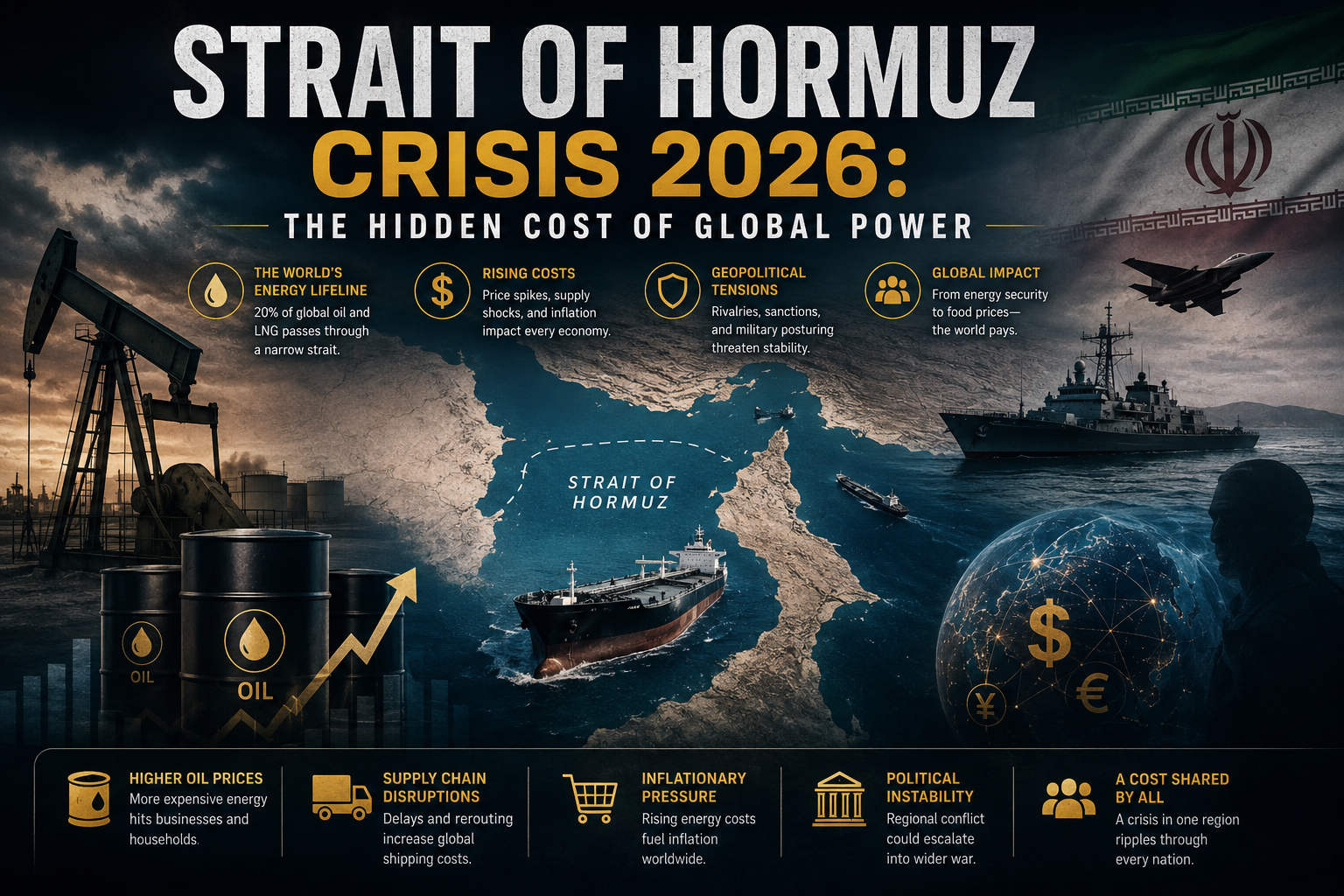
 This essay draws on public reporting and analysis of the 2026 Iran conflict and the associated Strait of Hormuz shipping crisis, synthesizing the sequence of events, economic consequences, and diplomatic aftermath into a single narrative account.
Introduction: A Narrow Passage, an Enormous Stake
There is a particular kind of geography that punishes the world disproportionately to its size. The Strait of Hormuz is the textbook case. At its narrowest point, the water separating Iran from Oman measures barely twenty-one miles across — a distance a fast ferry could cross before most people finish their morning coffee. And yet, for six months beginning in early 2026, this sliver of sea became the single most consequential piece of geography on Earth, a place where decisions made by a handful of governments could move oil prices, freight insurance rates, and inflation forecasts on every continent simultaneously.
It is tempting, from a safe distance, to describe the Strait of Hormuz crisis as a regional dispute that spilled outward. That framing understates what actually happened. What unfolded was closer to a live demonstration of how thin the buffer really is between a regional military conflict and a full-blown global economic shock — and how a country with a battered conventional military can still hold much of the world’s energy supply hostage simply because of where it happens to sit on a map. This essay traces the roots of the crisis, walks through its four distinct phases, examines the economic toll it inflicted, and considers what the affair reveals about the fragility of chokepoint-dependent globalization.
Part One: The Long Fuse — How the Crisis Began
To understand why a war erupted in early 2026, it helps to look back at what didn’t happen in the years before it. Diplomatic efforts to revive or replace the Iran nuclear framework had been sputtering for years, and by late 2025 talks in Geneva had effectively collapsed without a workable substitute. That collapse did not occur in a vacuum. It came on the heels of a twelve-day air conflict between Iran and Israel in 2025 that ended without a decisive resolution — a ceasefire that froze hostilities in place rather than settling the underlying dispute over Iran’s nuclear program and its network of regional proxies.
In hindsight, that unresolved 2025 conflict reads like a warning shot that went unheeded. Both Israel and the United States had signaled, repeatedly and publicly, that Iran’s continued enrichment activity and its missile production capacity were unacceptable long-term realities. Iran, for its part, had spent years hardening its most sensitive military and nuclear infrastructure specifically against exactly this kind of strike — burying facilities, dispersing production, and investing heavily in underground missile complexes with rail systems designed to allow weapons to be moved and launched even after conventional bombing campaigns.
When the second round of negotiations collapsed in Geneva without producing an alternative framework, the diplomatic runway effectively ran out. What followed was not a slow escalation but an abrupt and overwhelming one.
On February 28, 2026, the United States and Israel launched a coordinated military campaign — codenamed Operation Epic Fury by the U.S. and Operation Roaring Lion by Israel — against more than nine hundred targets scattered across Iranian territory. The target list included nuclear enrichment sites, missile production facilities, air defense networks, and military command infrastructure. According to U.S. Central Command, over a thousand sites were struck within the first twenty-four hours alone, employing a mix of stealth bombers, fighter aircraft, electronic warfare planes, and airborne command platforms.
The single most consequential element of that opening strike, however, was not a piece of infrastructure. It was a person. Iran’s Supreme Leader, Ali Khamenei, was killed in the initial wave of attacks, along with a substantial number of senior military and government officials. This was not incidental collateral damage; it was, by most assessments, a deliberate decapitation strike aimed at the top of Iran’s political and religious hierarchy simultaneously.
The strategic logic behind targeting Khamenei directly is worth pausing on, because it changed the entire character of what followed. Wars fought against a state with an intact command structure tend to follow a recognizable, if brutal, logic: military pressure builds until a government calculates that further resistance costs more than concession, and negotiations proceed from there. Killing the Supreme Leader in the opening hours removed that structure before the war had even properly begun. Iran did not enter this conflict as the same actor it had been a day earlier. Whoever inherited command authority in Tehran was doing so in the middle of an active bombing campaign, without the benefit of a stable transition, and with an obvious incentive to demonstrate strength rather than flexibility. In practical terms, this meant the war lost, almost immediately, any easy off-ramp. There was no one left standing on the Iranian side of the table with both the authority and the political security to negotiate an early surrender, even if enough of Iran’s leadership had wanted one.
Part Two: Four Phases, One War
Analysts who have since tried to make sense of the conflict’s shape have generally settled on a four-phase framework: the opening strikes and their immediate aftermath, a brief and ultimately unstable ceasefire, a period of mutual blockade and direct confrontation in the Gulf, and finally the uneasy corridor negotiations that define the current, still-unresolved moment.
Phase One: The Opening Strikes
The initial hours and days of Operation Epic Fury were defined by overwhelming asymmetry in the air. The United States and Israel struck deep into Iranian territory with comparatively little resistance from an Iranian air defense network that had already been degraded in earlier rounds of conflict. Naval targets were hit hard as well; over the following weeks, Iran’s conventional navy was described by multiple assessments as effectively neutralized, with well over a hundred vessels — including submarines and dedicated mine-laying ships — damaged or destroyed, and key port infrastructure, including facilities near Bandar Abbas, struck directly.
Iran’s retaliation was immediate and geographically wide. Within forty-eight hours, the conflict’s footprint had extended well beyond the two primary combatants, with missile and drone strikes reaching Bahrain, Jordan, Kuwait, Qatar, Saudi Arabia, the United Arab Emirates, and Iraq. By some accounts, Iran had launched several hundred ballistic missiles and roughly two thousand drones within the first four days of the war — a staggering rate of expenditure against a prewar arsenal estimated in the low thousands.
It was during this opening phase that Iran’s Revolutionary Guard Corps made the decision that would come to define the rest of the crisis: rather than attempting to contest American and Israeli air superiority directly, Iran declared the Strait of Hormuz a de facto combat zone and began targeting merchant shipping. This was the moment a military conflict, however brutal, became something else — an economic siege with global reach, executed not through conventional battlefield victories but through control of a body of water that much of the planet’s energy supply had to pass through.
Phase Two: The Fragile Ceasefire
By late spring, exhaustion and diplomatic pressure produced a ceasefire, though “ceasefire” turns out to be a generous word for what actually held. A temporary halt to hostilities was announced, intended to run roughly two weeks, with the stated goal of creating space for a negotiated end to the broader conflict and, critically, for the U.S. Navy to begin the extraordinarily difficult work of clearing mines that Iranian forces had placed throughout the Strait.
Even the clearing of those mines illustrated how much lasting damage had already been done. Pentagon officials told Congress that fully demining the Strait could take as long as six months — an estimate that itself depended on hostilities actually ending, since mine-clearing operations are not something a navy can safely conduct while still under threat of attack. The ceasefire, in other words, was less a resolution than an acknowledgment that both sides needed a pause to assess what came next.
That pause did not hold cleanly. When the ceasefire’s initial window ended in late April, President Trump extended it rhetorically while simultaneously continuing the naval blockade the United States had imposed on vessels traveling to and from Iranian ports — a signal that “ceasefire” and “normalcy” were not the same thing. Iran, meanwhile, continued seizing tankers it accused of violating its own preferred protocols; two vessels attempting what Iranian forces characterized as covert departures from the Strait were intercepted and forced into Iranian waters for inspection. A planned ceasefire meeting in Islamabad collapsed entirely when Iranian representatives simply failed to appear. Within days, U.S. naval forces had seized several tankers of their own, sanctioned under the terms of the ongoing blockade.
This second phase makes clear something important about the crisis as a whole: a ceasefire between two state militaries does not automatically produce safety for the thousands of civilian vessels caught in between. Even as the two principal combatants edged toward de-escalation, commercial shipping remained a pressure point that both sides continued to use, seize, and threaten.
Phase Three: Mutual Blockade and Peak Confrontation
The uneasy ceasefire gave way, by summer, to what amounts to the crisis’s most dangerous phase — a period of mutual blockade in which both the economic siege and the military confrontation intensified simultaneously. Attacks on shipping off the coast of Oman in late June, and again in July, prompted retaliatory American airstrikes on each occasion, establishing a grim rhythm: an attack on a vessel, followed by a strike in response, followed by the strong likelihood of another attack on a vessel not long after.
By the middle of July, the volume of attacks from both sides had reached the highest point of the entire war. This is worth sitting with, because it complicates a natural assumption — that a conflict tends to wind down the longer it goes on, as both sides tire and casualties mount. Instead, the Hormuz conflict escalated well past its opening weeks, suggesting that neither side had found, by midsummer, an acceptable path toward de-escalation that didn’t look like unilateral surrender. Iran continued to rely on the asymmetric toolkit that had defined its strategy from the outset: naval mines, drones, and fast attack boats used not to win a conventional engagement against American or Israeli forces, but to sustain uncertainty in global energy markets for as long as possible. It was, in effect, a strategy built around imposing cost rather than achieving victory in any traditional sense.
Phase Four: The Corridor Negotiations
The turning point toward the current, more stable — if still unresolved — phase came in August, when President Trump declared that the mines placed throughout the Strait had been removed or destroyed. That announcement created the political space for a genuine diplomatic breakthrough between Iran and Oman, one of the few regional actors that had maintained credibility with both sides throughout the conflict.
The resulting proposal established a temporary shipping corridor through the Strait, split into two distinct routes. A southern route would run through Omani waters and remain open to free navigation without restriction. A northern route would pass through Iranian waters, but ships using it would need prior Iranian approval — though notably, without tolls being charged, a detail that suggests Iran was seeking to preserve a degree of control and prestige over the passage without turning the arrangement into an obvious extraction scheme that would have drawn immediate and heavier international backlash.
The diplomatic language surrounding the corridor agreement was notably careful on both sides. Iran’s foreign minister described the arrangement as proof that persistent diplomacy could still coexist with regional stability — a framing clearly designed to project resilience rather than concession. Oman’s foreign minister, playing the role of the trusted intermediary, characterized the mood as hopeful while being explicit that a truly permanent solution remained pending. Neither statement claimed victory. Neither pretended the underlying dispute had been resolved. What both statements agreed on, implicitly, was that a workable interim arrangement was preferable to continued open conflict in the Strait.
It’s worth noting the broader diplomatic backdrop against which this corridor agreement emerged. NATO’s summit in Ankara issued a formal call for Iran to fully respect freedom of navigation — language that, on its face, reads as an unremarkable statement of principle. What makes it notable is what it avoided: any direct reference to the strikes that triggered the entire crisis in the first place. That omission was almost certainly deliberate, a piece of diplomatic choreography meant to hold together an alliance whose members did not uniformly agree on the wisdom, legality, or necessity of Operation Epic Fury, while still allowing NATO to take a public position on the navigation issue that virtually every member state’s economy had a direct stake in.
Part Three: Counting the Cost
It is one thing to describe a crisis in terms of phases and diplomacy. It is another to reckon with what it actually cost, in barrels, in dollars, and in disrupted lives spread across the global shipping industry.
The Strait of Hormuz is not simply one chokepoint among many; it is arguably the single most important one in the global energy system. In an ordinary year, something on the order of a fifth of all the oil the world consumes passes through this twenty-one-mile gap, along with nearly a quarter of all seaborne crude trade. That concentration of flow through such a narrow and geographically vulnerable passage is precisely what gave Iran’s asymmetric strategy its leverage. A country that could not contest American or Israeli air superiority could still, through mines and fast attack boats alone, threaten to choke off a meaningful share of the planet’s energy supply.
At the crisis’s most acute point, the disruption to oil flows reached an estimated fourteen million barrels a day — a staggering figure by any historical comparison. Brent crude, the global benchmark, spiked toward ninety dollars a barrel in response. The World Bank characterized the resulting shock as among the largest oil market disruptions in recorded history, a description that should not be read as hyperbole given the scale of the barrels involved and the abruptness with which the disruption occurred.
The shipping industry absorbed the shock in the most direct way available to it: avoidance. More than one hundred and fifty freight vessels either rerouted around the danger zone entirely or paused their transits altogether rather than risk sailing through waters where mines, drones, and fast attack boats posed an active and unpredictable threat. Each of those rerouted or paused voyages represents a cascade of secondary costs — delayed deliveries, spiking insurance premiums for any vessel still willing to attempt the passage, and a general repricing of risk across global shipping and logistics that likely persisted well beyond the specific weeks when ships were actually being attacked.
It is worth pausing to consider what an economic shock of this size actually means in practical terms, beyond the headline barrel counts and price spikes. Oil price shocks of this magnitude tend to work their way through economies unevenly but broadly: higher fuel costs raise the price of transporting virtually every physical good, which shows up eventually in consumer prices across categories that have nothing obviously to do with oil. Energy-importing nations, particularly in Asia — which received the overwhelming majority of crude that transited the Strait before the crisis — faced an acute and immediate vulnerability, given how directly their industrial output and consumer economies depend on a predictable flow of affordable energy. Meanwhile, the disruption created windfall conditions for producers with alternative export routes or spare capacity, illustrating one of the crueler ironies of chokepoint crises: they tend to redistribute wealth and hardship in ways that have little to do with which countries actually caused the disruption in the first place.
Part Four: The Larger Lesson — Geography as Leverage
If there is a single idea that the Strait of Hormuz crisis illustrates more clearly than any policy paper could, it is this: whoever controls a geographic chokepoint holds leverage wildly disproportionate to their conventional military strength. Iran, throughout this conflict, was on the losing end of nearly every direct military engagement with the United States and Israel. Its air defenses were degraded early. Its conventional navy was, by most credible accounts, effectively destroyed within weeks. Its most senior political and religious leadership was killed in the opening hours of the war. By any traditional measure of military outcomes, this was a lopsided conflict.
And yet Iran spent six months holding meaningful portions of the global energy market hostage anyway, using nothing more sophisticated than naval mines, drones, and small fast attack boats. This is the asymmetric chokepoint strategy in its purest form: rather than attempting to match a stronger adversary’s firepower, a weaker actor identifies the single point in a system where a comparatively small application of force produces a wildly outsized effect, and then applies pressure there, relentlessly, for as long as it can sustain the effort.
This lesson will not be lost on other states that happen to control their own maritime chokepoints — the Bab-el-Mandeb Strait between the Red Sea and the Gulf of Aden, the Strait of Malacca connecting the Indian and Pacific Oceans, the Bosphorus controlling access to the Black Sea, the Panama Canal linking the Atlantic and Pacific. Each of these passages represents a similar structural vulnerability: an enormous share of global trade or energy flow forced through a narrow, geographically fixed corridor that a relatively modest military or paramilitary force could threaten to close, even if that same force stood no chance in an open conventional conflict.
There is also a broader lesson here about the limits of overwhelming force as a tool of coercion. The United States and Israel achieved, by most assessments, substantial and rapid tactical success against Iran’s visible military infrastructure. And yet that tactical success did not translate cleanly into the strategic outcome either government presumably wanted, which was something closer to a swift, comprehensive resolution of the underlying dispute over Iran’s nuclear and missile programs, delivered on terms favorable to Washington and Jerusalem. Instead, the war dragged on for months, expanded geographically to touch seven additional countries within its first two days, and ultimately concluded — if “concluded” is even the right word for a situation still described as an “uneasy corridor negotiation” — not with a decisive military victory but with a temporary, negotiated shipping arrangement brokered by a third country.
This gap between tactical military success and strategic political resolution is a recurring pattern in modern conflicts against adversaries who cannot win symmetrically but can impose costs asymmetrically. Iran’s underground missile infrastructure, built with rail systems allowing weapons to be moved and launched from hardened, dispersed locations, proved resilient enough that launches from these facilities were confirmed as operational even after extensive bombing campaigns against more visible targets. Its “mosquito fleet” of small, fast attack craft survived the destruction of its conventional navy and remained a persistent threat to U.S. naval vessels throughout the conflict. In both cases, an adversary facing catastrophic losses in its conventional capabilities retained enough distributed, low-cost capacity to keep imposing meaningful costs on a vastly more powerful opponent — precisely because that capacity didn’t depend on winning any single engagement, only on surviving long enough to keep threatening the chokepoint.
It is also worth considering how this dynamic complicates the traditional calculus of deterrence. Deterrence theory generally assumes that a sufficiently overwhelming show of force will convince an adversary that continued resistance is irrational. But deterrence works best when the adversary has a centralized decision-making structure capable of making that rational calculation and acting on it. Killing Khamenei in the opening hours of the war may have delivered a devastating tactical blow, but it also may have removed the very structure through which a calculated, negotiated de-escalation could have been reached earlier. A fragmented or newly reconstituted leadership, uncertain of its own authority and wary of appearing weak in the eyes of hardliners within its own security apparatus, arguably had every incentive to prolong resistance through the one channel still available to it — the Strait — even after its conventional military options had been exhausted. If that reading is correct, the decapitation strike that began the war may have inadvertently extended it, by eliminating the party best positioned to end it quickly.
Part Five: What the Diplomacy Reveals
The diplomatic maneuvering around the crisis is, in some ways, as instructive as the military campaign itself. Consider the position Oman occupied throughout this crisis. Geographically, Oman sits directly across the Strait’s narrowest point from Iran, giving it an unavoidable stake in any resolution. Politically, Oman managed to maintain enough credibility with both the Iranian government and Western powers to serve as the effective broker of the corridor agreement that eventually stabilized the situation — no small feat in a region where most actors had been pulled, in one way or another, into taking sides.
The structure of the corridor agreement itself reveals a great deal about the incentives on each side by August. Iran’s insistence on maintaining an approval process for the northern route, even without charging tolls, suggests a government still determined to project sovereign control over its territorial waters and to avoid the appearance of having simply capitulated to Western naval pressure — even as its conventional military capacity to actually enforce that control had been devastated. Oman’s southern route, by contrast, offered international shipping the one thing it needed most after six months of uncertainty: a genuinely free and predictable path through the Strait, unencumbered by Iranian approval processes, that insurers and shipping companies could plan around with some confidence.
NATO’s carefully worded statement calling on Iran to respect freedom of navigation, while avoiding any direct reference to Operation Epic Fury, illustrates a different kind of diplomatic tension — the challenge of maintaining alliance cohesion when member states do not uniformly share the same view of a conflict’s legitimacy or necessity. It is one thing for an alliance to agree that a chokepoint disruption threatens shared economic interests; it is quite another for that same alliance to agree on whether the initial military campaign that triggered the crisis was itself justified. NATO’s language threaded that needle by focusing entirely on the navigation issue and saying nothing at all about how the underlying conflict began.
Part Five and a Half: The Human and Institutional Toll Beneath the Statistics
Barrel counts and price spikes are the numbers that make headlines, but they tend to flatten a crisis into something more abstract than it actually was for the people living through it. Behind the figure of fourteen million barrels a day sat thousands of individual mariners — tanker crews, container ship officers, engine room staff — who spent months deciding, voyage by voyage, whether a transit through the Strait was worth the risk to their lives. Maritime unions and shipping federations spent much of the crisis renegotiating hazard pay, war-risk bonuses, and the right of crew members to refuse a specific transit without losing their jobs, an issue that rarely makes it into economic summaries but that shaped the day-to-day experience of the crisis for the people actually sailing through it.
Insurance markets, for their part, went through a version of the same repricing that individual sailors experienced personally. War-risk insurance premiums for vessels transiting the Strait rose to levels that made certain routes economically unviable even for companies willing to accept the physical risk, effectively rerouting cargo through pricing mechanisms rather than through any formal government order. This is worth noting because it means the crisis’s economic footprint extended well beyond the ships that were actually attacked or the barrels that were actually lost; it touched every transaction in which someone had to price in the possibility of an attack that, in the end, might never come for that particular vessel.
Port authorities and logistics networks across the Gulf and beyond it absorbed their own version of the disruption. Ports in the UAE, Saudi Arabia, and Qatar — countries that found themselves targeted by Iranian missile and drone strikes within the war’s first forty-eight hours despite not being primary combatants — had to manage the logistics of continued trade while under intermittent direct threat themselves. This is an underappreciated dimension of chokepoint conflicts: the states most exposed to physical risk are not necessarily the ones whose decisions started the conflict, but rather whoever happens to sit closest to the geography in dispute.
There is also an institutional dimension worth naming. Multilateral bodies whose usual function is slow, deliberative, and consensus-driven found themselves under pressure to respond to a crisis unfolding in near-real time. The World Bank’s willingness to characterize the shock in historically superlative terms — one of the largest oil market disruptions on record — reflects an institution trying to convey urgency through the only vocabulary available to it: comparative economic history. NATO’s carefully hedged Ankara statement reflects a similar institutional strain, an alliance trying to say something meaningful about a crisis directly affecting its members’ economies without committing itself to a position on the legality or wisdom of the war that caused it. Neither institution was built to move at the speed the crisis demanded, and both, in their own ways, showed the limits of what slow-moving multilateral machinery can accomplish once a fast-moving regional conflict starts reshaping global commodity markets within days rather than months.
Part Six: The Unresolved Question
Six months into the crisis, what remains is not a resolution but a pause — a genuinely useful pause, one that has restored a functional shipping corridor and pulled Brent crude back from its most extreme spike, but a pause nonetheless. The corridor arrangement between Iran and Oman is explicitly described, by the parties themselves, as temporary. A durable resolution would require something considerably more robust: a framework that neither side has the practical ability to unilaterally break, whether through a renewed blockade, a fresh round of mine-laying, or a policy shift in Washington or Tehran that reopens hostilities.
Until such a framework exists, the corridor agreement is best understood as a fragile equilibrium rather than a settled peace. It depends on continued restraint from an Iranian government whose internal leadership situation remains, even months after Khamenei’s death, less than fully stable or transparent to outside observers. It depends on continued American willingness to maintain the current posture rather than resuming more aggressive action, whether in response to a fresh Iranian provocation or a shift in the broader political calculus in Washington. And it depends on the continued willingness of shipping companies and insurers to treat the corridor as trustworthy enough to resume something close to normal transit volumes, a judgment that will be made and remade continuously based on whether the corridor actually holds in practice, day after day, tanker after tanker.
Conclusion: A Test Still in Progress
The Strait of Hormuz crisis, six months in, functions as something close to a live experiment in one of the oldest questions in international relations: does economic interdependence actually restrain conflict, or does it simply give conflicts a more precise and devastating set of tools to work with? The optimistic version of interdependence theory holds that when nations’ economies are deeply entangled — when China, India, Japan, and dozens of other economies depend on a steady flow of oil through a chokepoint that a handful of Gulf states control — everyone involved has a powerful incentive to keep that flow moving smoothly, and conflict becomes correspondingly less likely because the costs of disruption are shared so broadly.
What the Hormuz crisis suggests is a less comforting possibility: that deep interdependence does not prevent chokepoint conflicts so much as it raises the stakes of them dramatically once they begin. Iran did not need to defeat the United States or Israel militarily to inflict enormous economic damage on the entire world; it needed only to threaten, credibly and persistently, the one narrow passage that so much of the global economy had quietly agreed to depend on. The very interdependence that was supposed to discourage conflict instead became the mechanism through which a comparatively weak actor extracted six months of global economic pain from a position of profound military disadvantage.
The evidence assembled over these six months does not offer a reassuring answer to the question of whether economic interdependence restrains conflict or merely arms it more precisely. If anything, it points toward the latter. A twenty-one-mile-wide strait, controlled in part by a country that had just lost its Supreme Leader, most of its navy, and a substantial share of its air defense capability, still managed to move the price of oil worldwide, reroute over a hundred and fifty commercial vessels, and force NATO, the World Bank, and finance ministries on every continent to treat a regional war as a matter of immediate and direct economic concern. Whatever the corridor negotiations eventually produce as a permanent arrangement, that underlying lesson about chokepoint vulnerability is unlikely to be forgotten by anyone who watched oil prices during those six months — least of all by other states sitting, as Iran does, astride a narrow passage the rest of the world cannot afford to lose.
create related image for above


Here’s a satellite view of the Strait of Hormuz itself, along with images of oil tankers transiting the Persian Gulf — the vessels most directly affected by the crisis described in the essay. The map shows just how narrow and geographically constrained the passage really is, which is central to why it became such a high-leverage chokepoint despite Iran’s degraded conventional military.