
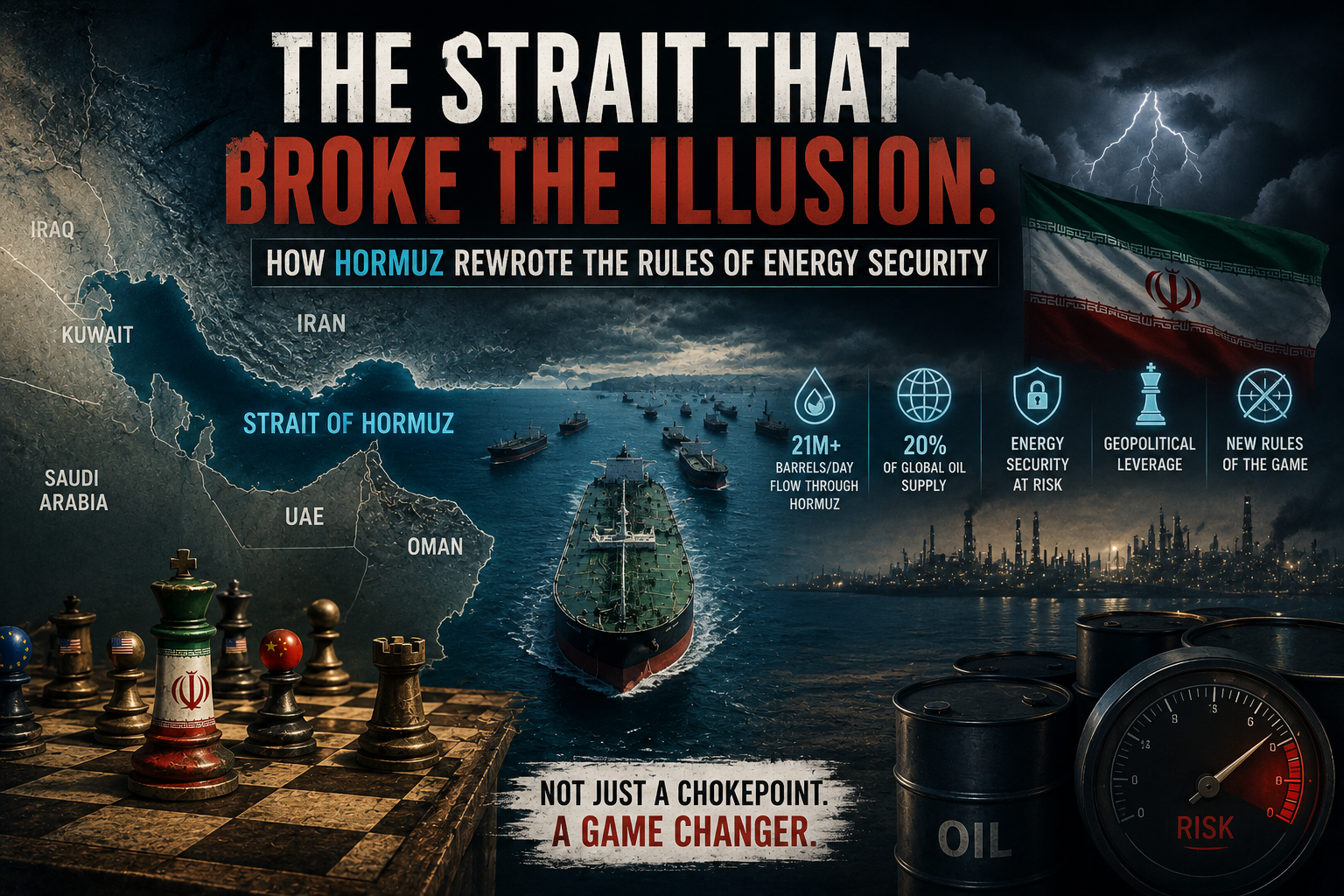
For half a century, the global economy has run on a quiet, mostly unspoken bet: that a 33-kilometre-wide channel of water between Iran and Oman would stay open. Not because anyone guaranteed it, and not because the countries bordering it were reliably stable, but because closing it seemed so catastrophic, so mutually destructive, that no one would actually do it. Analysts called this “the tanker war that never quite happens.” Traders priced it as a tail risk. Governments built strategic reserves as insurance against a disruption they didn’t really expect to need.
That bet has now been called, repeatedly, in 2026 — and the world lost it more than once. Since Israeli and American strikes on Iran began on February 28, the Strait of Hormuz has gone from a chokepoint on a map to the central character in the global economy’s worst year for energy security since the 1970s oil shocks. It has closed. It has partially reopened. It has closed again. Tankers have burned in it. Insurance markets have effectively refused to touch it. And in early July, just as the world was cautiously exhaling after months of diplomacy, the United States struck Iran again over attacks on shipping in the strait, and Tehran hit back, proving that even a signed, “electronically executed” peace framework couldn’t fully close the door on renewed chaos there.
This is not a one-off crisis that the world will shrug off once a ceasefire finally sticks. It is a structural stress test, and the test results are already rewriting how governments, companies, and entire regions think about energy security. The old architecture — cheap oil moved efficiently through a small number of maritime bottlenecks, insured by the assumption that everyone has too much to lose to actually pull the trigger — is being dismantled in real time. What replaces it will look less efficient, more expensive, and considerably more resilient. That trade-off was probably overdue. It’s just a shame it took a war, a decapitation strike, and half a year of price shocks to force the issue.
How bad, exactly, did it get
It’s worth being blunt about scale here, because “energy market volatility” is the kind of phrase that lets people’s eyes glaze over before they register what actually happened. Around one-fifth of the world’s oil, and a similar share of its liquefied natural gas, normally passes through Hormuz — between 17 and 21 million barrels of crude a day, moving through two navigable shipping lanes each only about three kilometres wide at the strait’s narrowest point. When Iran began targeting vessels transiting the strait after the February strikes, the effect wasn’t really a “closure” in the sense of a physical blockade at first — it was something arguably worse for markets, because it made the risk itself uninsurable. As the Brookings Institution put it plainly, Iran’s use of drones, ballistic missiles, and small attack boats against ships in the strait meant insurance became either unavailable or prohibitively expensive, and seafarers simply refused to make the crossing — so the strait was effectively closed even without a formal blockade. Iran kept its own roughly two million barrels a day of exports flowing until the U.S. imposed a direct blockade in mid-April, at which point even that stopped.
The price response was almost instantaneous and historically severe. By the end of March, Brent crude had jumped by roughly 65 percent — about $46 a barrel — in its largest monthly increase ever recorded, with extreme volatility throughout. Analysts were openly discussing triple-digit and even $200 scenarios, and they weren’t being dramatic for headlines. One veteran oil economist told Bloomberg in late March that a prolonged near-closure could push prices to somewhere between $150 and $200 a barrel within weeks, with severe global economic fallout to follow. By May, with the disruption running past ten weeks, one tracker estimated Brent could approach $154 a barrel if the closure extended to twelve weeks, driven by an estimated 5.3 million barrel-a-day shortfall in demand. The IEA’s characterization of the episode wasn’t hedged at all: multiple independent analyses converged on calling it the most severe disruption to global energy flows since the 1970s, and systemic rather than cyclical in nature — meaning this wasn’t a blip the market would simply absorb and move past, but a shock to the underlying architecture of how energy gets from the Gulf to the rest of the world. A separate tracker described the March disruption alone as the largest in the history of the global oil market, with cumulative supply losses exceeding 360 million barrels that month and roughly 440 million barrels projected for April.
The World Bank’s April Commodity Markets Outlook, usually a fairly dry document, was similarly stark, projecting that average Brent prices for 2026 could land somewhere between $95 and $115 a barrel — 10 to 35 percent above baseline — with global oil output expected to fall by 6.9 million barrels a day, or 6.6 percent, year-on-year in the second quarter, the sharpest quarterly decline since the pandemic. Demand didn’t stay static either. Global oil consumption fell by roughly 0.8 million barrels a day year-on-year in March, with a further 1.5 million barrel decline forecast — the beginning of real demand destruction as higher prices worked their way through economies that couldn’t simply absorb the cost.
Wood Mackenzie’s scenario modeling in May captured just how much hinged on whether the war stayed contained. Under its most optimistic “Quick Peace” path, the firm expected Dated Brent to ease back to around $80 a barrel by the end of 2026 and fall further to $65 in 2027 as the market returned to oversupply, with global growth slowing from 3 percent to 2.3 percent and a recession confined to the Middle East. Its “Summer Settlement” scenario, assuming negotiations dragged into late summer with the strait largely closed until September, produced persistent oil and LNG shortages through the third quarter and a shallow global recession in the second half of the year, with growth falling below 2 percent and lasting economic scarring. Its worst case had the strait largely closed through the end of 2026, with recurring tensions triggering repeated cycles of renewed conflict and sustained disruption. Given that the strait did, in fact, see renewed conflict in July, we are living somewhere between the “Summer Settlement” and worst-case tracks — not the optimistic one that policymakers were hoping for back in April.
None of this stayed confined to oil traders and shipping executives. A Kiel Institute policy brief modeled the broader economic contagion and found that a full Hormuz closure would push global energy prices up by roughly 5.4 percent and food prices up by 2.7 percent, with the food-price effect anchored by the bottleneck running from energy through fertilizer costs to agricultural output — and that if Saudi exports were also disrupted, whether through insufficient pipeline capacity or direct attacks on that alternative infrastructure, those effects would roughly double, with welfare losses concentrated most heavily on energy-dependent developing economies in South Asia, sub-Saharan Africa, and the Middle East, and specific projected losses of 2.5 percent for South Korea and comparably severe hits for India. This is the part of the story that gets lost when the coverage is all about Brent futures: a war fought over Iranian nuclear infrastructure and regime survival ended up landing its heaviest economic weight on households in Lagos, Dhaka, and rural India, who had nothing to do with any of it.
The bypass routes were always a patch, not a solution
The instinctive policy response to a chokepoint crisis is to look for a way around the chokepoint, and Gulf states did exactly that — with real, if limited, success. Saudi Arabia’s East-West pipeline (Petroline), which carries crude roughly 750 miles from Abqaiq on the Gulf coast to the Red Sea port of Yanbu, and the UAE’s Habshan–Fujairah pipeline, known as ADCOP, which runs about 248 miles and can handle an estimated 1.5 to 1.8 million barrels a day, both bypass the strait entirely. Analysts initially estimated the two systems combined could offset somewhere between 3.5 and 5.5 million barrels a day of the roughly 20 million barrels a day that normally moved through Hormuz. Saudi Arabia actually outperformed that estimate under pressure: by late March, the kingdom had pushed the East-West pipeline to its full capacity of 7 million barrels a day, redirecting flotillas of tankers to Yanbu on the Red Sea to keep oil moving, preserving roughly 60 percent of its pre-war export volume.
But two things should temper any enthusiasm about pipelines as a real fix. First, the arithmetic still doesn’t close. Even at full stretch, these bypass routes cover a fraction of what Hormuz normally carries, and countries like Kuwait, Iraq, Qatar, and Bahrain remain almost entirely reliant on the strait, with no comparable alternative. Second, and more importantly, the war demonstrated that “bypass” doesn’t mean “safe.” In April, Iran itself attacked the East-West pipeline, cutting its throughput by roughly 700,000 barrels a day, and Iranian drones struck the port of Fujairah, disrupting oil loading operations at the very terminal meant to be the safe alternative. Rerouting Saudi crude to the Red Sea, meanwhile, doesn’t remove risk so much as relocate it: that corridor runs straight past Houthi-controlled waters, and as one analysis dryly noted, Houthi forces have already demonstrated the capacity to target commercial shipping and energy infrastructure there, meaning the Red Sea route doesn’t eliminate conflict exposure, it just exchanges one risk category for another.
This is the uncomfortable truth energy planners are grappling with: in a genuinely multipolar, chronically unstable Middle East, there may not be such a thing as a “safe” export corridor anymore, only a set of routes with different attackers and different odds. Gulf states understand this, which is why the response since spring hasn’t been to declare victory on bypass capacity but to keep building more of it, as fast as possible. The UAE is fast-tracking a second pipeline to Fujairah aimed at doubling its bypass capacity to over 3 million barrels a day by mid-2027, up from the current 1.8 million, with the government describing it as necessary to “meet global demands”. Saudi Arabia is evaluating a further expansion of the East-West line, potentially by another 2 million barrels a day, and Iraq is dusting off long-dormant plans for a Mediterranean corridor through Turkey and Syria on a three-to-five-year horizon. Taken together, Goldman Sachs analysts estimated that regional pipeline capacity could grow to more than 14 million barrels a day by the end of 2028 — over 60 percent of the seven Gulf states’ pre-war export volume of 23 million barrels a day, spread across seven pipelines either under construction or in planning.
That is a genuinely significant shift in regional infrastructure — arguably the most concrete, durable legacy of this entire war, more durable than any ceasefire document. But notice what it actually represents: not a plan to make Hormuz safe again, but a slow, expensive, multi-year hedge against the assumption that it might never be fully reliable again. Gulf producers are no longer building for efficiency. They’re building for redundancy. That’s a real philosophical shift in how the region’s most important export infrastructure gets designed, and it will outlast whatever eventually happens between Washington and Tehran.
LNG exposed a security narrative that wasn’t quite true
If the oil story is about redundancy, the gas story is about the collapse of a comforting myth. For years, the growth of liquefied natural gas trade was framed, correctly in narrow terms, as a security upgrade over pipeline gas: LNG can be redirected mid-voyage, sold on spot markets, diverted to whichever buyer needs it most urgently. That flexibility was real. What 2026 exposed is that flexibility only helps you if the ships carrying it can actually get to open water in the first place. As one Oxford energy analysis put it with admirable bluntness, the closure of Hormuz, by removing around one-fifth of global LNG supply, exposed the fragility of a gas system that had appeared more secure precisely because of the diversification LNG trade was supposed to provide — the crisis undermined any simple equation between LNG and energy security, since maritime flexibility means nothing if the maritime route itself is closed.
The knock-on effects landed hardest in Asia, which draws disproportionately on Gulf LNG and had the least room to substitute. Japan’s crude imports fell 66 percent in April 2026 as supply chains buckled under the combined pressure of disrupted shipping lanes and intensified competition for the LNG cargoes that were still available, and spot prices for gas surged across both Asia and Europe as importers scrambled for emergency procurement. This is where the crisis quietly did something the renewables lobby has wanted to demonstrate for a decade: it made the case for decarbonization not on climate grounds, but on hard-nosed security grounds. One widely circulated comparison found that the record 510 gigawatts of solar and 160 gigawatts of wind capacity added globally in 2025 alone generates an estimated 1,100 terawatt-hours a year — roughly twice the electricity that would have been produced from all the LNG that used to transit Hormuz before the closure. That is a genuinely striking statistic, and it’s the kind of thing that changes boardroom conversations about capital allocation faster than any climate summit communiqué.
But it would be intellectually lazy to treat this as an uncomplicated win for renewables, and to their credit, some of the more serious analysis of the crisis didn’t pretend otherwise. The same report that made the solar-versus-LNG comparison also flagged the structural catch: the clean energy transition doesn’t eliminate chokepoints so much as relocate them — from maritime straits and hydrocarbon reserves to mineral processing facilities and manufacturing supply chains. Swap dependence on the Strait of Hormuz for dependence on a handful of Chinese-controlled rare-earth processing plants or polysilicon factories, and you haven’t solved the chokepoint problem. You’ve just changed its geography and its owner. Anyone treating 2026 as proof that renewables are inherently more “secure” than hydrocarbons is skipping over the fact that the accelerated buildout itself now runs through its own concentrated, geopolitically exposed supply chains — copper, graphite, rare earths, batteries, and photovoltaic cells, all subject to the same kind of remote-supply fragility that fossil fuels demonstrated in the Gulf. There’s also a less romantic explanation for part of the pivot away from LNG: cost. Coal, unglamorous as it is, turned out to be the immediate beneficiary in several Asian markets, since it’s often locally sourced and considered a safer, cheaper option in the short-to-medium term than paying a premium for longer-haul LNG imports — hardly the clean-energy victory lap some analysts wanted to declare.
Watching two countries respond very differently
The most instructive part of this crisis isn’t the aggregate data. It’s the divergence in how individual countries actually coped, because it shows which security strategies were real and which were theoretical.
India is the clearest success story, and it’s worth taking seriously rather than dismissing as government self-congratulation, because the underlying claims are checkable. Prime Minister Modi, speaking at a refinery inauguration in July, described the response as the product of timely assessment, decisive policymaking, effective use of domestic resources, and diplomatic partnerships — allowing India to avoid fuel rationing entirely, keep cooking gas flowing uninterrupted, and shield consumers and farmers from the full brunt of the price shock, with public oil marketing companies absorbing much of the financial hit instead. Strip away the political framing and there’s a genuinely coherent strategy underneath: India didn’t just stockpile and hope. It combined refining expansion, diversified sourcing, strategic reserves, and digital governance into something closer to structural resilience than crisis management, marking a shift from relying on stockpiles alone toward resilience built on diversification, infrastructure, governance, and diplomacy together. A separate Gulf News analysis framed India’s response around the same triad — strategic reserves, diplomacy, and naval reach reshaping the country’s entire energy security calculus — which is precisely the multi-pronged approach that a single-point fix like a strategic reserve or a pipeline can’t deliver on its own.
Contrast that with the more reactive posture visible elsewhere. New Zealand — about as far from the Gulf as a country can be — still felt compelled to stand up an entirely new government body, the Ministerial Economic Security and Supply Chains Group, after crude prices spiked past $100 a barrel, tasked explicitly with assessing the country’s exposure to supply shocks and coordinating whole-of-government planning for market volatility, informed by coordinated emergency oil reserve releases from the International Energy Agency. That’s not resilience; that’s a government realizing mid-crisis that it hadn’t done the resilience work in advance. Multiply that scramble across dozens of governments simultaneously, and you get a rough sketch of just how unevenly prepared the world actually was for a chokepoint disruption that energy security researchers have been warning about for decades.
The China-US split is the quieter, longer story
Buried under the day-to-day price coverage is a slower-moving divergence that will probably matter more once this war fades from headlines: the emergence of two structurally different models of energy security, one built by Washington and one by Beijing, that aren’t really competing so much as running in parallel. American LNG exports have surged specifically to serve allied nations trying to diversify away from geopolitically risky suppliers, which dovetails neatly with Washington’s broader foreign-policy interests. China, meanwhile, is pursuing the opposite strategy: not expanding its footprint as an exporter, but shrinking its exposure as an importer, accelerating domestic energy investment so that its presence as a price-sensitive buyer in the volatile spot LNG market gradually diminishes over time.
The framing of this as a binary US-versus-China energy contest is mostly wrong, and the more careful analyses said so directly: the two strategies are structurally divergent rather than directly opposed — the United States is building export market depth while China is reducing import market exposure, and in a globally bifurcated energy system, both can succeed within their own spheres without one defeating the other. What’s true, though, is that the crisis has compressed a decade of theoretical energy-security planning into a matter of weeks of live operational emergency, and different powers are drawing very different lessons from that compression. The US is doubling down on being the world’s supplier of last resort. China is doubling down on needing nobody. Both are rational responses to the same shock. Neither is really about solving the Hormuz problem itself.
The insurance market closed the strait before the navy tried to reopen it
If there’s one dynamic from this crisis that deserves to reshape how militaries and governments think about chokepoint warfare, it’s this: Iran didn’t need to physically seal the Strait of Hormuz to shut it down. It needed to scare an underwriter in London.
The sequence matters. As one detailed account of the opening days put it, within 48 hours of the initial US-Israeli strikes, war risk premiums surged fivefold, major marine insurers terminated existing coverage outright and offered replacements at roughly sixty times pre-crisis rates, and Lloyd’s Joint War Committee redesignated the entire Arabian Gulf as a conflict zone — and tanker traffic collapsed by more than 80 percent before Iran had laid a single mine or fired a single missile at a ship. The kinetic attacks that followed — vessels struck, mines laid, strikes on Ras Tanura and Fujairah — compounded an already-collapsed market. They didn’t cause the initial shutdown. The insurance system did that on its own, reacting to risk rather than to actual sustained damage.
That’s a genuinely new mechanism of warfare, or at least a newly weaponizable one, and analysts who study the region have been explicit that the 1980s “Tanker War” is a poor analogy for what happened here, because the 1980s conflict involved sustained attacks over years against a less concentrated, less reinsurance-dependent insurance market, with no bypass infrastructure and no equivalent commercial cascade effect — the 2026 mechanism instead saw a comparatively limited military action trigger a systemic commercial shutdown, precisely because the modern insurance architecture is so interconnected and risk-averse. In other words, financial markets have become more efficient at pricing risk since the 1980s, and that efficiency turned out to be exploitable: a relatively small, targeted show of force was enough to make an entire global shipping lane commercially unusable, without Iran needing anything like the naval capacity to actually contest the strait against the US Navy.
The premium numbers involved are staggering enough to be worth stating plainly. Before the war, war-risk cover for a Hormuz transit ran at roughly 0.15 percent of a vessel’s insured value — around $150,000 to $225,000 for a modern VLCC worth $100 to $150 million. At the peak of the crisis, that same coverage was quoted at 7.5 to 10 percent of hull value, and one account put a single seven-day policy at 4 percent of ship value, against a pre-crisis rate as low as 0.001 percent — a jump described by a naval mining expert simply as “astronomically higher”. Do the arithmetic on a large tanker and a single transit’s insurance bill moved from roughly $150,000 to somewhere north of $20 million. One trade publication calculated a real-world example: a 270,000-tonne crude tanker valued at $210 million facing roughly $21 million in war-risk premium for a single high-tension Hormuz crossing, versus $1 to $2 million for an equivalent Red Sea transit under convoy protection — a vivid illustration of just how much more dangerous underwriters judged Hormuz to be even relative to a corridor being actively targeted by the Houthis.
And crucially, the premiums didn’t behave like a simple risk gauge that calmed down once the guns quieted. They behaved like a market with a long memory and a short trust horizon. Rates eased to around 1 percent from 2.5 percent in late March, as more ships crossed amid hopes for a negotiated end to the war — genuine, if partial, recovery. But by July, after the fresh round of US-Iran strikes, premiums were back on what one Marsh executive called “a roller coaster mirroring the development of the price of oil,” with rates for a $100 million tanker running $3 million to $10 million again, against a pre-war baseline of about $250,000. A Khaleej Times analysis in May had already warned that even a full reopening wouldn’t bring quick relief, because insurers typically demand months of sustained stability before restoring normal cover, regardless of whether shipping traffic itself resumes — meaning the financial scar tissue from a war like this outlasts the war’s active phase by a considerable margin.
This is also where the limits of hard power became embarrassingly visible. Washington tried the traditional playbook: naval escorts, and reportedly directing the International Development Finance Corporation to backstop war-risk coverage with as much as $40 billion in reinsurance capacity. It didn’t work the way military planners hoped. Reports through the spring suggested only between 30 and 70 vessels crossed the strait with any form of US military guidance or escort since early May, facing sea mines, missiles, and fast attack boats along the way — a level analysts described as remaining “an exception,” not a sign that normal traffic had returned. One sharp piece of commentary captured the underlying asymmetry better than any official statement did: a convoy gets one ship through — it doesn’t convince an underwriter in London that the Gulf is safe again. There’s no military fix here; the strait reopens through negotiation, not escort. Iran can’t beat the US Navy and isn’t trying to — it just needs the insurance markets rattled long enough that “freedom of navigation” starts costing more than Washington’s partners are willing to pay. Even the head of the International Maritime Organisation weighed in publicly, flagging the continued high cost of maritime insurance in the region as a matter of “great concern,” compounding the strain on ship owners and operators, and noting that market pricing simply wasn’t adjusting even as underlying conditions improved.
The strategic lesson here is uncomfortable for anyone who still thinks of chokepoint security primarily in terms of ships and firepower. A state — or even a non-state actor, as the parallel Houthi campaign against Red Sea shipping demonstrated — can now impose enormous economic costs on the entire global trading system through a relatively modest, intermittent campaign of harassment, simply by exploiting how conservatively modern insurance markets price tail risk. Defending the physical strait matters, but it may matter less than defending the confidence of an insurance underwriter sitting in an office in London or Zurich who has never seen the Gulf and never will. That’s a genuinely new front in this kind of conflict, and it’s one that traditional naval strategy, built around escorting convoys and projecting force, is only partially equipped to fight.
The recurring collapse is the real policy lesson
Here’s what should worry policymakers more than any single price spike: this crisis did not follow the shape of a normal disruption, with a clear beginning, an acute phase, and a resolution. It has been a stuttering, repeatedly-collapsing sequence — closure, partial reopening, re-closure, ceasefire, diplomacy, a preliminary deal, more diplomacy, and then a fresh round of strikes and retaliation in July, months after most forecasters assumed the worst was behind us. One detailed tracker lays the sequence out starkly: the IRGC announced closure to US- and Israel-allied shipping on March 2; a Pakistan-brokered ceasefire on April 8 allowed partial reopening; and Iran restricted passage again on April 19, all before the further escalation in July that this article’s own timeline captures. That is not a war with one shock to plan around. It’s a war that keeps generating new shocks on a cadence nobody can reliably predict, which is precisely the scenario that makes conventional energy security planning — built around discrete, bounded disruptions — inadequate.
This matters because most of the policy apparatus built after previous oil shocks, going back to the 1970s creation of the International Energy Agency and national strategic petroleum reserves, was designed around the assumption of episodic disruption: a war, an embargo, a revolution, followed by recovery and years of calm before the next one. Hormuz in 2026 has behaved more like a chronic condition than an acute event. A strategic reserve release helps you get through weeks, not through a year of intermittent, unpredictable re-closures triggered by a conflict that keeps finding new pretexts to reignite. That’s why the more serious energy-security literature to come out of this year keeps circling back to redundancy and diversification rather than reserves and stockpiles as the primary tools — because reserves are built to bridge a gap with a known endpoint, and this gap keeps refusing to end.
What should actually change, and what probably won’t
If there’s a genuine silver lining in a crisis this costly, it’s that the policy response has, for once, mostly matched the scale of the problem rather than settling for symbolic gestures. Countries have accelerated strategic reserve expansion, Gulf states are pouring capital into redundant pipeline capacity on a multi-year horizon, LNG buyers are diversifying suppliers rather than assuming spot-market flexibility will always bail them out, and at least some governments — India chief among them — have shown that a genuinely integrated strategy combining reserves, refining capacity, diversified sourcing, and diplomacy can hold up even under sustained, repeated shock. That’s a meaningfully more sophisticated playbook than existed in February.
But a few uncomfortable truths deserve to be said plainly rather than buried in a hedge.
First, none of the physical fixes — the pipelines, the reserves, the diversified LNG contracts — actually solve the underlying problem, which is political, not logistical. The Strait of Hormuz is dangerous when Iran and its adversaries are at war, and safe when they’re not. No pipeline changes that basic fact for the roughly 60 percent of Gulf export volume that still has no bypass option at all. The infrastructure investments underway are, at best, a way to survive the next disruption with less pain than this one caused — not a way to prevent the next disruption from happening.
Second, the costs of this new, more resilient system are real and will be paid disproportionately by the people least able to afford them. The Kiel Institute’s finding that welfare losses concentrate hardest in South Asia, sub-Saharan Africa, and the Middle East itself is the paragraph in this whole story that deserves more attention than it’s gotten. Pipeline redundancy and strategic reserves are luxuries of wealthy or well-governed states. A fragile, energy-import-dependent economy without India’s fiscal capacity to absorb losses through its own oil marketing companies doesn’t get the benefit of “resilience through diversification.” It just gets the price shock.
Third, and perhaps most importantly: the acceleration toward renewables that this crisis triggered is a genuine positive, but treating it as a security panacea would be repeating the same mistake that made the LNG-as-security narrative collapse in the first place. Trading a chokepoint at 26°N in the Persian Gulf for a chokepoint in a rare-earth refinery in Inner Mongolia is not obviously progress. It’s a different bet on a different set of actors behaving predictably. Given how badly the Hormuz bet just failed, energy planners owe it to themselves to ask much harder questions about where the next concentrated vulnerability is quietly building before it, too, gets tested by a war nobody planned for.
The Strait of Hormuz will probably reopen fully again, eventually, whenever this conflict finally exhausts itself for good rather than merely pausing between rounds. When it does, oil will get cheaper, tankers will fill the lanes again, and most of the world will move on within a fiscal quarter or two. But the infrastructure decisions being made right now — the pipelines under construction, the reserve targets being revised upward, the LNG contracts being rewritten with diversification clauses, the entire recalibration of what “energy security” is even supposed to mean — those will still be here in 2030, long after this particular war is a paragraph in a history textbook. That’s the real headline buried under all the barrel-price charts: 2026 didn’t just disrupt energy markets for a few painful months. It permanently changed how the world thinks about the difference between energy that’s cheap and energy that’s safe, and forced a reckoning most governments had been quietly postponing for fifty years. The bill for that postponement has now come due, and it’s being paid, as these bills usually are, unevenly — by wealthy nations in strategic reserves and pipeline capital, and by poorer ones in fuel queues, currency pressure, and inflation they had no hand in causing.