
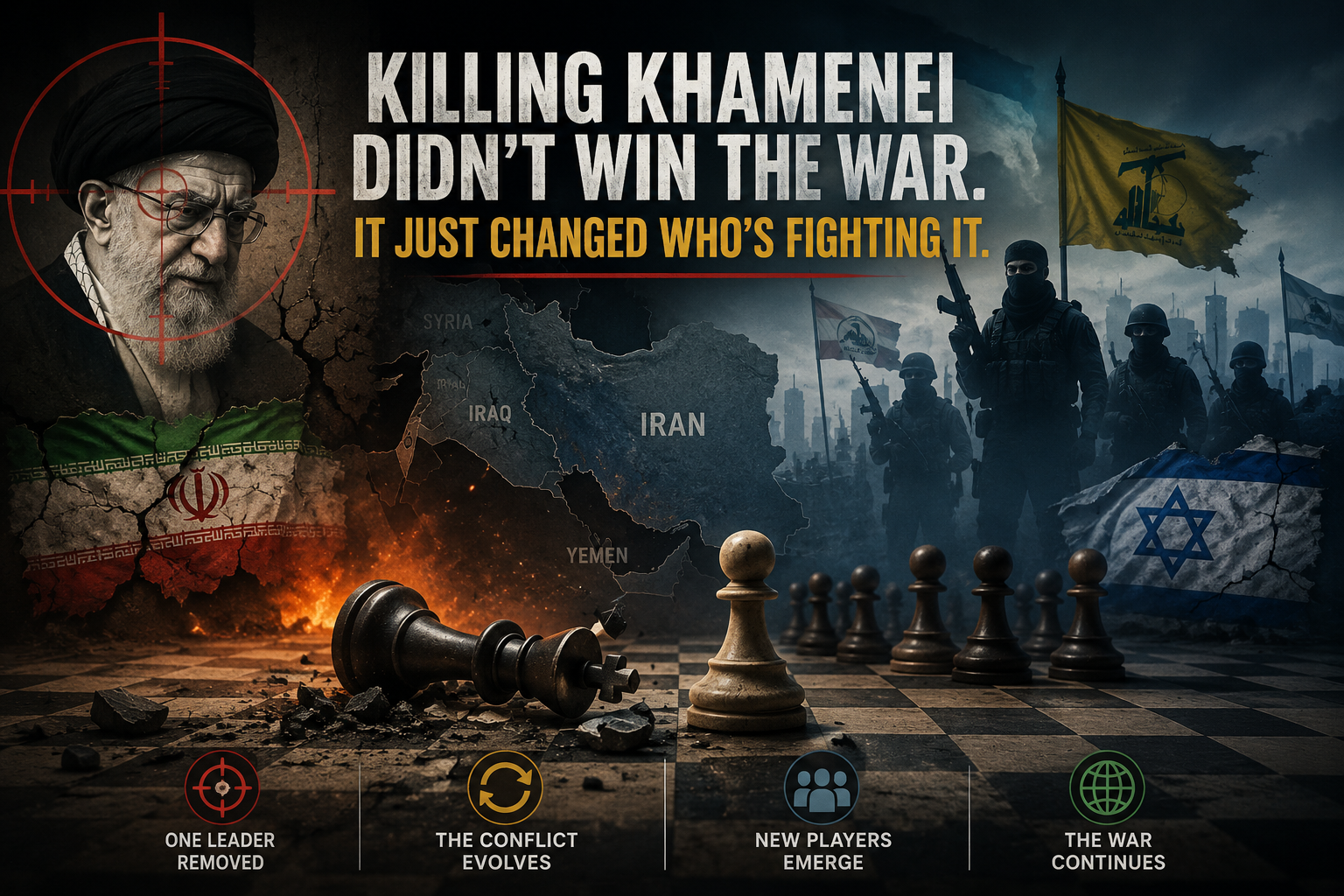
When Israeli aircraft dropped dozens of bombs on a compound in central Tehran (Iran war) on February 28, 2026, and killed Ayatollah Ali Khamenei along with much of his inner circle, the operation was sold as a historic turning point — a decapitation strike that would finally crack open the Islamic Republic. President Trump called Khamenei’s death “the single greatest chance for the Iranian people to take back their Country” and promised the bombing campaign would continue until peace was achieved throughout the Middle East. Six months on, it’s worth asking plainly: did it work?
The honest answer is no. Not in the way it was pitched, anyway. What the strike actually produced is a regime that looks almost identical to the one it replaced, run by a narrower and more militarised clique than before, with a war that has already reignited once since the ceasefire and a Strait of Hormuz that keeps sliding back into crisis. If the goal was regime collapse or a decisive strategic reset, this was not that. If the goal was removing the last civilian-facing brake on Iran’s security services, this succeeded — just not in America’s favour.
The theory of the case, and why it hasn’t held up
The logic behind decapitation strikes is straightforward: remove the man at the top, and the system beneath him either fractures or bends toward moderation as rivals compete for legitimacy. It’s a bet that individuals matter more than institutions. Iran’s case argues the opposite. Khamenei’s death set off an unprecedented succession crisis, with over 40 Iranian officials killed in the operation, which should have been exactly the kind of chaos that produces opportunity. Instead, within days the Revolutionary Guard Corps had effectively taken control of the succession process, pushing through Mojtaba Khamenei’s selection as the new supreme leader over the objections of members of the Assembly of Experts, whom the IRGC reportedly pressured directly.
That is not a system cracking open. That is a system’s most hardline faction consolidating control faster and more openly than it had ever needed to before.
A son, not a reformer
There was a brief window when outside observers wondered whether Mojtaba — untested, reportedly beholden to the IRGC for his own position — might be a weaker, more pliable leader than his father. One Middle East Institute analyst put it bluntly: Mojtaba owes his position to the Revolutionary Guards, and as a result he will never hold the same independent authority his father did. That should have been the moderating force everyone hoped for. It wasn’t.
Instead, the appointments that followed told the real story. By August, Mojtaba had filled seven senior security posts, and analysts were blunt about what that meant: the two most consequential appointments — the Supreme National Security Council and the Basij paramilitary force — went to hardliners, one tasked with directing the war and the other with internal repression, meaning Washington is now negotiating with the same uncompromising faction, just wearing different titles. A separate round of military appointments drew the same conclusion from analysts: the picks were widely read as empowering the hardline old guard and prioritising loyalty over any kind of institutional reform.
This is the part that should trouble anyone who framed the assassination as a step toward Iranian liberalisation. Regime survival analysts have gone further, arguing that even Mojtaba’s own death at this point would likely deepen IRGC and hardliner control rather than loosen it, since the security establishment itself — not any individual leader — is now the load-bearing structure of the regime. If that reading is right, the US and Israel didn’t remove a chokepoint in the system. They proved the chokepoint doesn’t exist — that the Islamic Republic can lose its supreme leader, its defence minister, its IRGC chief, and dozens of others in a single weekend and still reconstitute itself around the same institutional core within two weeks.
The war didn’t end. It went dormant, then came back.
The clearest evidence that this wasn’t a strategic knockout is that the fighting didn’t actually stop. A ceasefire in April bought a pause; talks in Islamabad, then Bürgenstock, then Doha, produced a preliminary agreement and cautious optimism about a 60-day roadmap to peace. And then on July 8, the US struck Iran again, this time over attacks on shipping in the Strait of Hormuz, and Tehran retaliated. A conflict that was supposedly ended by removing its central figure has now gone through an assassination, a succession crisis, a ceasefire, three rounds of diplomacy, and a second round of open combat — all in under half a year.
That is not what victory looks like. That is a war grinding forward under new management.
What actually changed
None of this means the strike was pointless from a narrow military standpoint — Iran’s air defences, missile production, and command structure absorbed real damage, and a generation of IRGC and nuclear officials was wiped out in a single operation. But strategic goals were never framed around attrition alone; they were framed around ending the regime’s threat to the region or forcing fundamental change in how Tehran behaves. On that measure, the assassination mostly proved that the Islamic Republic’s centre of gravity was never really one man. It was always the security apparatus around him, and that apparatus is, if anything, more entrenched and more openly in charge than it was on February 27.
Removing Khamenei didn’t remove the check on hardliners in Iran. It removed the fiction that there ever was much of one.