
The Psychology of Long-Term Rivalry in International Relations
Introduction: The Uncomfortable Question
It sounds like a category error the moment you say it out loud. Countries don’t have feelings. They have interests, alliances, treaties, tanks, and GDP figures. Attachment is something that happens between people — lovers, friends, parents and children — not between the abstract legal entities we call “states.” And yet, spend enough time watching how nations behave toward their oldest rivals, and a stranger pattern starts to emerge. Enmities that should have ended decades ago don’t end. Adversaries that lose all strategic relevance to each other keep circling one another anyway. And when a long-standing enemy finally collapses or reconciles, the “winning” side often doesn’t celebrate for long — it drifts, as if something load-bearing had been removed from the structure of its own self-understanding.
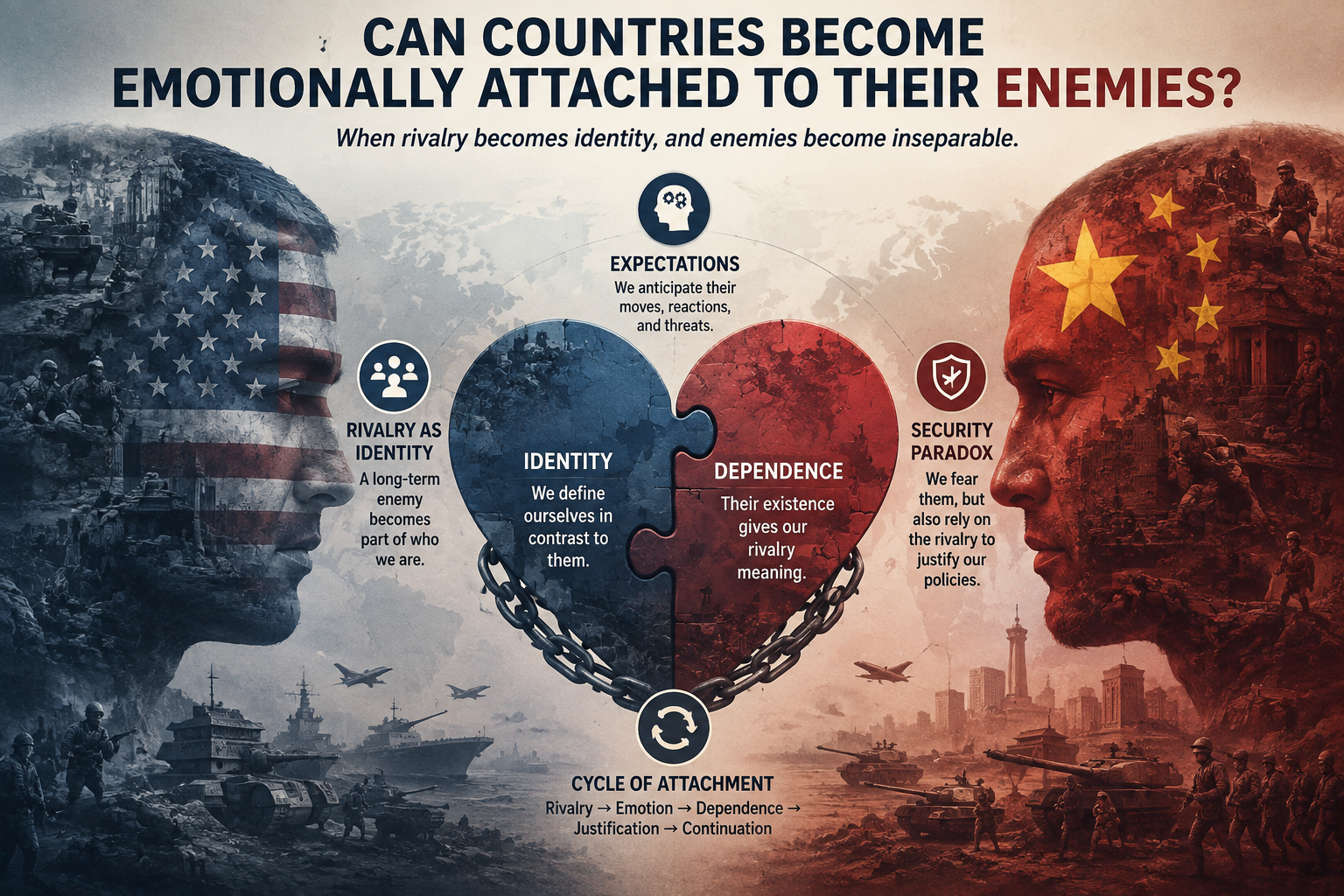
This essay argues, unapologetically as an opinion piece grounded in historical pattern rather than hard science, that something functionally indistinguishable from emotional attachment can and does form between long-term rivals at the level of national identity, political culture, and institutional habit. Not because states literally feel affection, but because the people who make up a state’s political class, media, military, and public imagination build so much of their self-concept around an adversary that the adversary becomes, in effect, part of who they think they are. Rivalry, sustained long enough, stops being merely a conflict of interests and starts being a relationship. And relationships — even hostile ones — create dependency.
1. What “Attachment” Would Even Mean for a Country
Before going further, it’s worth being precise about what claim is actually being made, because the psychological literature on attachment was built for individual humans, not nation-states. Psychologist John Bowlby’s attachment theory describes how early bonds — even with caregivers who are inconsistent or harmful — become internalized as templates for relating to the world. A child with an unpredictable or even harmful caregiver doesn’t necessarily reject that bond; sometimes they cling to it more tightly, because the bond itself, however painful, is a known and organizing structure in an otherwise chaotic world.
Nation-states obviously don’t have attachment systems in a neurological sense. But nations are made of people, institutions, and narratives, and those narratives can absolutely encode something structurally similar: a rival that is threatening, but also familiar, legible, and identity-defining, becomes woven into the story a country tells about itself. The claim here is not that Washington “misses” Moscow the way a person misses an ex. It’s that the institutional and cultural apparatus built around a rivalry — the military postures, the media narratives, the school curricula, the domestic political incentives — can become so entangled with a nation’s sense of purpose that losing the rival produces a genuine identity crisis, not just a strategic recalculation.
This is a testable-ish claim, and it has real historical evidence behind it. Let’s look at where it shows up.
2. Social Identity Theory and the Manufacturing of a “Significant Other” Enemy
Social psychologist Henri Tajfel’s work on social identity theory showed that group identity is formed relationally — you know who “we” are partly by knowing who “we are not.” International relations scholars, particularly those in the constructivist tradition (Alexander Wendt being the most cited name here), extended this insight to states: a state’s identity is not a fixed, pre-social fact but something continuously constructed through interaction with other states, especially adversarial ones.
Wendt’s famous formulation — “anarchy is what states make of it” — implies something important: enmity is not an automatic byproduct of a lawless international system. It’s a choice, repeated over time, that becomes so habitual it starts to feel natural. The United States and Canada share the longest undefended border in the world and are not enemies, despite anarchy applying equally to them as it does to any other state pair. The United States and Russia, or India and Pakistan, or North and South Korea, have chosen — through decades of accumulated decisions, grievances, and narrative reinforcement — to treat each other as existential threats. Once that choice calcifies into institutional memory, it becomes what Wendt would call a “culture of enmity” that is remarkably resistant to change even after the original strategic rationale evaporates.
This is where the idea of a “significant other” enemy becomes useful. In interpersonal psychology, a significant other is the person against whom, or in relation to whom, you define your own values and behaviour. Nations do this too. Iran’s revolutionary identity is defined substantially in opposition to the United States — “Death to America” is not merely a slogan; it is a piece of load-bearing ideological architecture for the Islamic Republic’s founding myth. Remove the American antagonist from Iranian political rhetoric, and you don’t just lose a talking point; you destabilise part of the regime’s reason for existing in its current form. The same is true in reverse for hardline anti-Iran factions in Washington, for whom Iran functions as a stable, reliably threatening “other” against which hawkish policy positions can always be justified.
3. Case Study: The United States and Russia — Withdrawal Symptoms After the Cold War
Perhaps the clearest historical illustration of this phenomenon is the disorientation that gripped American foreign policy institutions after the collapse of the Soviet Union in 1991. For over four decades, the entire architecture of American grand strategy — NATO, the nuclear triad, the CIA’s covert operations doctrine, defence budgeting, even the shape of American higher education (area studies departments, Russian-language programs, Sovietology as a discipline) — had been organised around a singular adversarial relationship. The Cold War wasn’t just a conflict; it was a total worldview, complete with its own vocabulary (containment, domino theory, mutually assured destruction), its own heroes and villains, and its own sense of moral clarity.
When the Soviet Union dissolved, American foreign policy did not settle into a relaxed, threat-free posture. Instead, the 1990s became what political scientists have sometimes called a “decade of drift” in U.S. grand strategy — a period marked by a search for organising threats to replace the one that had disappeared. Francis Fukuyama’s “End of History” thesis, published in 1992, captured the era’s triumphalism, but it also inadvertently revealed the anxiety underneath it: if there is no more history-defining ideological rival, what exactly organises American purpose in the world? Samuel Huntington’s 1993 “Clash of Civilisations” thesis, proposing that future conflict would be civilizational rather than ideological, can be read as an attempt to supply a replacement enemy structure before one had organically emerged. September 11, 2001, then provided what the foreign policy establishment had been groping toward for a decade: a new, total, identity-organising adversary in the form of transnational jihadist terrorism.
And tellingly, when U.S.-Russia relations began to sour again in the 2010s — over Crimea in 2014, election interference allegations in 2016, and the full-scale invasion of Ukraine in 2022 — a notable strain of American commentary greeted this deterioration with something almost like relief mixed with dread. Cold War metaphors flooded back into circulation immediately and fluently, as though merely dormant rather than genuinely forgotten. Foreign policy institutions that had struggled to define their mission in the unipolar 1990s suddenly had their organising narrative handed back to them. This is not to say anyone wanted a war in Ukraine — that would be a grotesque overstatement — but it is to say that the speed and fluency with which Cold War-era institutional muscle memory reactivated suggests that the adversarial relationship with Russia had never fully been dismantled; it had been dormant, waiting, structurally intact.
4. Case Study: India and Pakistan — Rivalry as National Founding Myth
If the U.S.-Russia case shows attachment surviving dormancy, India and Pakistan show attachment sustained through continuous, active reinforcement since the very moment of national birth. Partition in 1947 was not merely a border-drawing exercise; it was a mutual founding trauma, and each country’s national identity was constructed in substantial part through opposition to the other. Pakistan’s raison d’être as a state was built on the two-nation theory — the idea that Muslims of the subcontinent required a separate homeland distinct from a Hindu-majority India. India’s secular nationalist self-conception, in turn, was partly defined by rejecting that very premise, positioning itself as a pluralistic alternative to Pakistan’s confessional nationalism.
Four wars (1947, 1965, 1971, and the Kargil conflict of 1999), a permanently militarised border in Kashmir, and a nuclear arms race have followed. But what’s most relevant to the “emotional attachment” thesis is how central Kashmir and Pakistan remain to Indian domestic politics, and how central India remains to Pakistani military and political identity, even during periods when neither state gains anything strategically from escalation. The Pakistani military’s outsized role in national governance — sometimes called a “state within a state” — derives much of its budgetary and political legitimacy from the ongoing India threat. Retired Pakistani generals and Indian hawkish commentators alike have, at various points, been remarkably candid that a genuine, lasting peace would strip their institutions of purpose and prestige. This is attachment functioning almost exactly like Bowlby’s anxious-ambivalent bond: the relationship is a source of chronic pain and existential risk (nuclear brinkmanship, repeated terrorist attacks and reprisals), and yet neither side’s political establishment can imagine — or particularly wants — a version of national identity that doesn’t include the other as antagonist.
5. Case Study: North and South Korea — Divided Twins
The Korean case is perhaps the starkest illustration because it involves not just rivalry but a literally severed sibling relationship — one nation, one language, one shared history until 1945, split by external Cold War geopolitics rather than any organic internal division. Both Korean states have spent over seventy years constructing national identities substantially defined by opposition to, and periodic yearning for, the other.
South Korea’s constitution still nominally claims sovereignty over the entire peninsula. Reunification ministries exist in Seoul with genuine institutional weight, and generations of South Korean schoolchildren have been raised with reunification as an assumed, if endlessly deferred, national aspiration. North Korea’s Juche ideology and its entire propaganda apparatus are structured around framing South Korea (and its American backers) as an occupied, puppet state awaiting liberation. Neither government, in other words, has fully accepted the other’s separate existence as final — which is a strange thing to say about two states that have been formally divided for three-quarters of a century and fought an devastating war (1950-1953) against each other.
What’s revealing is South Korean public opinion research from the past two decades, which has repeatedly shown that younger South Koreans are markedly less enthusiastic about reunification than their grandparents’ generation — not despite decades of hostility fading, but partly because the emotional attachment (familial memory of a unified peninsula, direct experience of separated families) that sustained reunification desire is a generational phenomenon that weakens as lived memory disappears. This is oddly consistent with the attachment framework: the yearning for reunification was never a coldly rational cost-benefit calculation (South Korean economists have long warned reunification could be catastrophically expensive) — it was an emotional bond to a lost sibling-nation, and like any attachment bond, it is strongest among those who actually remember the relationship before the rupture.
6. Case Study: The United States and Cuba — A Rivalry Preserved in Amber
Few rivalries better demonstrate the sheer institutional inertia of adversarial identity than the six-decade U.S. embargo on Cuba. By any conventional strategic measure, Cuba stopped posing a meaningful threat to the United States decades ago — the Soviet Union that once made Cuba a genuine Cold War flashpoint dissolved in 1991, and Cuba’s economy has been a fraction the size of even mid-sized American states for generations. Yet the embargo persisted in near-total form until partial normalisation under the Obama administration in 2014-2016, and much of that normalisation was subsequently reversed under the following administration.
The persistence of U.S.-Cuba hostility long after its strategic logic expired is best explained not by security calculation but by domestic identity politics: a politically influential Cuban-American exile community in Florida for whom hostility toward the Castro government became a core piece of personal and communal identity, transmitted across generations, largely independent of the island’s actual capacity to threaten the American mainland. This is attachment in a very literal, almost familial sense — grievance and rupture (forced exile, confiscated property, family separation) calcified into multi-generational political identity, sustained by memory and narrative long after the original antagonist’s power had faded to near-irrelevance.
6b. Case Study: Greece and Turkey — NATO Allies Who Never Stopped Rehearsing War
Greece and Turkey present one of the strangest cases in this entire discussion, because both countries have been formal military allies within NATO since 1952, bound by treaty to defend one another against outside aggression, and yet have come to the brink of open war with each other on multiple occasions since — most seriously in 1974 over Cyprus, and again in 1996 over the uninhabited Imia/Kardak islets. Both nations maintain military postures explicitly oriented around the other despite sharing an alliance structure that should, in theory, make such postures unnecessary.
The roots run deep: centuries of Ottoman rule over Greek lands, the catastrophic Greco-Turkish population exchanges of 1923, and a modern rivalry over Aegean airspace, continental shelf boundaries, and Cyprus that has never been fully resolved. What’s notable for this essay’s argument is how thoroughly the rivalry has been absorbed into each country’s domestic political culture independent of any live territorial dispute at a given moment. Greek and Turkish military budgets remain, proportionally, among the highest in NATO, overwhelmingly justified by reference to the other. Politicians on both sides have found that a flare-up of nationalist rhetoric toward the other reliably boosts domestic approval, a pattern political scientists sometimes call “diversionary nationalism” — using an external rival to paper over internal political weakness. The rivalry, in other words, has become a renewable domestic political resource, refreshed periodically regardless of the underlying strategic reality, which is exactly what we’d expect if the relationship had become identity-sustaining rather than merely threat-responsive.
6c. Case Study: China and Japan — Historical Memory as a Permanent Adversarial Reservoir
The China-Japan relationship offers a particularly instructive variant: economic interdependence so deep that a genuine military conflict would be mutually catastrophic, paired with a historical grievance architecture (the Second Sino-Japanese War, the Nanjing Massacre, contested wartime memory and textbook controversies) that continues to generate diplomatic crises on what feels like a near-annual cycle, often triggered by symbolic acts — a cabinet minister’s visit to the Yasukuni Shrine, a disputed history textbook, a dispute over the Senkaku/Diaoyu islands.
What makes this case valuable is how clearly it separates the material and identity dimensions of rivalry. Materially, China and Japan have every reason to cooperate — they are each other’s major trading partners, and armed conflict would devastate both economies. Yet Chinese state media and educational curricula continue to feature Japanese historical aggression as a central pillar of modern Chinese national identity and Communist Party legitimacy, an approach scholars have described as “patriotic education” built substantially around victimhood narratives from the “Century of Humiliation.” This is a case where a government appears to be actively cultivating adversarial memory as a nation-building tool, independent of, and sometimes in tension with, the country’s own material interests in stable relations. It suggests that identity-level attachment to an adversary can be not just an organic byproduct of history but a deliberately manufactured and maintained state project — which, if anything, strengthens rather than weakens the case that rivalry can function as a resource nations are unwilling to give up even when it costs them.
6d. Case Study: England and France — The “Auld Enemy” That Became Affectionate Ritual
Not every long rivalry curdles into danger; some soften into something closer to a fond, ritualized grudge, and this trajectory is itself revealing. England and France fought each other, on and off, for the better part of a millennium — the Hundred Years’ War, Agincourt, Waterloo, colonial rivalries across three continents. Today, of course, the two nations are close allies, EU-adjacent (notwithstanding Brexit’s own complications), and NATO partners. Yet the rivalry has not disappeared so much as transformed into a lower-stakes cultural performance — sporting rivalries, particularly in rugby and football, self-deprecating national jokes about “surrender monkeys” and English cuisine, and an enduring, almost affectionate use of the phrase “our closest enemy.”
This case matters because it demonstrates that adversarial attachment doesn’t have to resolve into either perpetual danger or a clean identity vacuum — it can be sublimated into low-stakes ritual that preserves the emotional structure of rivalry (the in-group/out-group distinction, the friendly needling, the shared history of conflict as a bonding narrative) while stripping out the actual danger. This is arguably the healthiest endpoint the attachment framework predicts: not the disappearance of the adversarial relationship, but its domestication into something closer to sibling rivalry than existential threat.
7. Why Rivalries Outlive Their Strategic Usefulness: The Mechanisms
Drawing across these cases, a few recurring mechanisms explain why adversarial attachment persists past its rational shelf life.
Identity substitution. When a rivalry runs long enough, it stops being a means to an end (security, territory, ideology) and starts being an end in itself — a load-bearing pillar of how a nation narrates its own history and purpose. Removing it requires rebuilding identity from scratch, which societies resist even when the old identity is costly to maintain.
Institutional capture. Militaries, intelligence agencies, defence contractors, diaspora political lobbies, and academic subfields all build careers, budgets, and prestige around a specific adversary. These constituencies have concrete incentives — not abstract psychological ones — to keep the rivalry alive, and they are often the loudest domestic voices shaping foreign policy discourse.
Narrative simplicity and moral clarity. A stable, known enemy offers something genuinely comforting: a simple moral frame in a complicated world. Ambiguity is uncomfortable; having a clearly defined “bad actor” against whom one’s own state can be framed as righteous is psychologically and politically convenient, even addictive, for domestic political actors.
Generational transmission. Grievance narratives, once encoded into school curricula, national holidays, memorials, and popular culture, get transmitted to generations who never experienced the original conflict directly. The relationship becomes inherited rather than chosen, exactly the way children of estranged families sometimes inherit feuds whose original cause they can barely explain.
Loss aversion at the systemic level. Prospect theory, from behavioural economics, tells us humans weigh losses more heavily than equivalent gains. Applied to states: the loss of a familiar, legible threat can feel more destabilising than the ambiguous gain of “peace,” because peace requires improvising a new sense of purpose, while war or rivalry offers a script everyone already knows how to perform.
Ritual and calendar reinforcement. Rivalries that persist for generations typically accumulate their own calendar of commemorations — anniversaries of battles, independence days defined by separation from the rival, memorial days for war dead. These are not neutral historical markers; they are recurring, scheduled opportunities for a society to re-experience and re-affirm the adversarial relationship, functioning much like anniversaries in a personal relationship, except the emotional content being rehearsed is grievance rather than affection. Pakistan’s Defence Day, commemorating the 1965 war with India, and India’s own Kargil Vijay Diwas are not merely historical remembrances; they are yearly identity-refreshing rituals built directly around the rival.
The comfort of predictability. Perhaps the most psychologically underrated mechanism is simply this: a known adversary, however dangerous, is predictable in a way that a newly resolved, ambiguous relationship is not. Cold War planners on both sides of the Iron Curtain often noted, in retrospect, that the bipolar standoff — for all its terror — produced a strange kind of stability, because both sides understood the other’s incentives, red lines, and likely behavior with a precision that the more fragmented, multipolar world after 1991 never quite replicated. Attachment theorists would recognize this immediately: an anxious but predictable bond can feel psychologically safer than an unpredictable, unresolved one, even when the predictable bond is objectively more dangerous.
8. Measuring the Unmeasurable: What Would Count as Evidence?
A sceptical reader is right to ask: how would we even know if this were true, as opposed to merely a compelling metaphor? A few empirical proxies are worth naming, even if none is individually conclusive.
First, survival of hostile rhetoric past the disappearance of the material threat — as with the U.S.-Cuba case, where embargo-supporting rhetoric persisted essentially unchanged for decades after Cuba’s capacity to threaten the U.S. mainland had become negligible. Second, generational divergence in attitudes correlated with lived memory rather than material self-interest — the South Korean reunification polling is a clean example, since the group with the most to materially gain from reunification (younger South Koreans facing demographic and economic headwinds a unified, larger labor market could partly address) shows the least enthusiasm, while the group with the most direct emotional connection to the pre-division nation shows the most. Third, institutional behaviour that actively works against reconciliation processes that would materially benefit the institution’s home country — Pakistani military resistance to normalisation with India despite the economic benefits normalisation would bring to Pakistan’s chronically strained economy is a recurring feature of South Asian foreign policy analysis. Fourth, and perhaps most tellingly, the specific emotional vocabulary used by former officials and historians describing the end of a rivalry — words like “disorientation,” “drift,” “unmoored,” and “adrift” appearing disproportionately in retrospective accounts of the immediate post-Cold War period, rather than the vocabulary of relief or triumph we might expect from a purely rational actor whose threat had simply been removed.
None of this constitutes laboratory-grade proof — you cannot run a controlled experiment on the collapse of a superpower. But taken together, the pattern across genuinely unrelated cases (Cold War-era Washington, post-partition Islamabad and New Delhi, divided Korea, post-revolutionary Cuba) is difficult to explain through purely material or purely coincidental accounts, and it accumulates into a reasonably strong circumstantial case.
9. The Counterargument: This Is Just Power Politics Wearing a Costume
A rigorous essay has to take seriously the realist rebuttal, which is not trivial. Realist scholars of international relations — John Mearsheimer being the most prominent contemporary voice — would argue that everything described above is simply rational self-interest dressed up in emotional language. States don’t get “attached” to enemies; institutions, lobbies, and bureaucracies pursue budgets, relevance, and power, and it’s a category error to psychologize what is really just interest-group politics. The Pentagon doesn’t “miss” the Soviet Union — defence contractors simply need a threat to justify appropriations, and that’s boring, well-understood public-choice theory, not psychology.
This critique has real force, and intellectual honesty requires taking it seriously rather than dismissing it. But it doesn’t fully account for the timing and intensity of some of the phenomena described above. Purely material interest-group explanations struggle to explain why South Korean generational cohorts differ so sharply in reunification enthusiasm based on lived memory rather than economic self-interest (younger South Koreans, who would benefit economically from a wealthier, more stable long-term peninsula, are often less enthusiastic than older generations who lived through actual separation). It also struggles to explain the specific emotional register — nostalgia, disorientation, grief-adjacent language — that policymakers and commentators have used, on the record, when describing the end of long rivalries. When former CIA officials describe the dissolution of the Soviet Union using words like “unmoored” or “adrift,” that is not merely bureaucratic budget anxiety; it is closer to the language people use to describe losing a defining relationship.
The most honest synthesis is probably this: material institutional interest and genuine identity-level attachment are not competing explanations; they are mutually reinforcing ones. Institutions build careers and budgets around rivalries because those rivalries provide identity and narrative structure to the societies that fund them; and rivalries persist psychologically because institutions with real material stakes keep reinforcing and amplifying the narratives that sustain them. Neither the purely material nor the purely psychological account is sufficient alone.
10. What Happens When the Enemy Actually Disappears
The clearest test of the attachment hypothesis is what happens after reconciliation or an adversary’s collapse — because if the relationship really is functionally an attachment bond, we should expect grief-like disorientation rather than simple relief, and history bears this out with striking consistency.
Post-Soviet America, as discussed, drifted through the 1990s searching for a new organising threat before settling on terrorism. Post-apartheid South Africa, having spent decades organising its resistance identity around a specific enemy (the apartheid state and its international allies), faced a genuinely difficult period of redefining what “the struggle” was for once its primary antagonist had formally ceased to exist — the Truth and Reconciliation process itself can be read as an institutional mechanism for managing this identity transition rather than merely a justice mechanism. Even smaller-scale reconciliations show this pattern: after the 1998 Good Friday Agreement largely ended the Troubles in Northern Ireland, several sociological studies of loyalist and republican communities found identity confusion and even a kind of purposelessness among former paramilitary-adjacent populations whose entire adult identity had been organized around active conflict, sometimes manifesting as spikes in intra-community violence and mental health crises once the external adversarial structure was removed.
This pattern — disorientation and identity crisis following the removal of a long-term enemy — is, frankly, hard to explain without invoking something like attachment. If rivalry were purely instrumental, its resolution should simply free up resources for other priorities with minimal psychological residue. Instead, we consistently observe something closer to bereavement.
11. An Opinion: Why This Matters for How We Think About Peace
Here is where I will step fully into opinion, because I think this pattern has an uncomfortable implication that policymakers rarely say out loud: peace processes often fail not because the material terms are unreasonable, but because they ask societies to give up something they have, on some level, come to need. Diplomats negotiate over borders, sanctions, and security guarantees, as though rivalry were purely a dispute over resources and terms. But if identity-level attachment is real, then durable peace requires something much harder than a signed treaty — it requires both societies to do the work of building a replacement identity that doesn’t depend on the old adversary, and that work is generational, not diplomatic.
I’d go further: I think this explains why some of the most successful reconciliations in modern history (West Germany and France after 1945, for instance) worked specifically because they didn’t just end hostilities — they built an entirely new shared project (European integration) that gave both societies a new organizing purpose to replace the old rivalry, rather than simply leaving a vacuum where the enemy used to be. The Franco-German rivalry that had structured European conflict for nearly a century didn’t just get resolved; it got sublimated into a joint identity project, first through coal and steel cooperation and eventually the European Union itself. That, to me, is the real lesson: you cannot simply subtract an enemy from a national identity and expect stability. You have to replace the function the enemy was serving, or the vacuum will eventually get filled by something else — sometimes a new enemy, sometimes a debilitating national drift.
If I’m right about this, it also means we should be deeply sceptical of political leaders who seem unusually invested in maintaining a rivalry beyond its strategic usefulness, and we should ask harder questions about what psychological or institutional function that rivalry is serving domestically. When a leader’s popularity depends heavily on an external adversary, that’s not incidental — it’s often the entire point, and it should make us suspicious of that leader’s actual appetite for resolution, regardless of what their diplomats say at the negotiating table.
12. Conclusion: Enemies as Mirrors
Countries do not love their enemies. But they can absolutely become dependent on them in a way that mimics attachment closely enough to deserve the word. Long-term rivals function as mirrors, and a nation that has spent generations defining itself in opposition to another risks not knowing who it is when that mirror is removed. This is not a flaw unique to any one country or culture — it shows up in superpowers and small nations, democracies and authoritarian states alike, from Washington and Moscow to New Delhi and Islamabad, Seoul and Pyongyang, Havana and Miami.
Recognising this pattern doesn’t excuse the real human costs of prolonged conflict, nor does it mean every rivalry is secretly a comfort blanket rather than a genuine threat — some enemies really are dangerous, and vigilance against them is entirely rational. But it should make us more honest about a genuinely uncomfortable truth: ending a long rivalry is not simply a matter of negotiating better terms. It requires nations to answer a much harder question — who are we, if not the people standing against them? Until a society has a real answer to that question, peace, even when signed on paper, may remain something closer to a ceasefire in a relationship neither side has actually learned to leave.