
Introduction
In the fiscal year that ended in June 2026, Pakistan spent roughly $16.86 billion importing petroleum — about $1.58 billion more than the International Monetary Fund had projected for the year, and a 5.76 per cent increase over the previous twelve months. That single overshoot, driven largely by a spike in global crude prices tied to renewed conflict in the Middle East, tells you almost everything you need to know about the structural position Pakistan occupies in the global energy economy: a country whose fiscal and external accounts can be knocked off course by a war it is not fighting, in a region it does not control, over a commodity it cannot produce enough of at home.
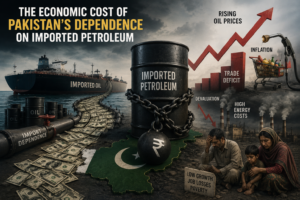
This is not a new story for Pakistan. It is, in fact, one of the oldest and most consistent threads running through the country’s economic history since independence. Pakistan currently produces only a small fraction of the oil it consumes — domestic output covers roughly a fifth of national demand, with the rest arriving by tanker, priced in dollars, and settled against foreign exchange reserves that are chronically thin to begin with. Every time global crude prices rise, Pakistan’s import bill rises with them, almost mechanically, and that rise ripples outward into the exchange rate, the inflation rate, the fiscal budget, and ultimately into household budgets across the country.
This essay makes the case that Pakistan’s dependence on imported petroleum is not simply an energy-sector problem to be managed by the Ministry of Petroleum. It is a recurring macroeconomic shock absorber — the single point in the economy most exposed to events entirely outside Pakistan’s control, and the mechanism through which those external events translate into currency depreciation, inflation, fiscal strain, and periodic balance-of-payments crises. The essay walks through the scale of the dependence, the specific channels through which its costs spread across the economy, the sector-by-sector damage it causes, why the dependence has proven so difficult to reduce, how Pakistan’s position compares with other oil-importing economies, and what a realistic policy response would actually require.
The Scale of Pakistan’s Import Dependence
To understand the size of the problem, it helps to start with a simple supply-and-demand picture. Pakistan’s total oil demand runs at roughly 500,000 barrels per day, while domestic production covers something in the neighbourhood of 70,000 barrels per day — leaving well over 80 per cent of the country’s oil needs to be met through imports. On top of crude oil and refined petroleum products, Pakistan also imports significant volumes of liquefied natural gas to feed its power generation fleet and industrial base, adding a second, related import burden on top of the oil bill itself.
The scale of this becomes clearest when petroleum is placed alongside Pakistan’s other imports. Pakistan’s Finance Minister stated in 2026 that petroleum imports account for roughly 22 per cent of the country’s total import bill — making energy, by a wide margin, the single largest category of goods Pakistan buys from abroad, ahead of machinery, edible oil, and every other major import class. In dollar terms, that 22 percent has translated into an annual petroleum bill that has generally sat in the $15-17 billion range in recent years, though the exact figure swings considerably with global crude prices: government data show the FY2025-26 bill reaching $16.86 billion, comfortably exceeding the IMF’s own forecast of $15.28 billion for the same period, while the Fund’s projection for the following fiscal year sits at $16.31 billion — a number analysts already regard as fragile given how quickly regional tensions have moved oil prices this year.
Those swings are not small. One widely circulated 2026 analysis estimated that with import volumes held roughly constant, a rise in crude prices from $80 to $90 per barrel would add close to $1.6 billion to Pakistan’s annual import bill, while a further move to $100 per barrel would add over $3 billion relative to the $80 baseline — increases equivalent to several percentage points of the entire trade deficit, driven purely by a price move Pakistan has no ability to influence. During March 2026, average Brent crude prices were reported at roughly $103.7 per barrel, well above the levels most budget planning had assumed only months earlier, illustrating just how quickly the arithmetic can turn against the country.
This is the essential structural fact from which everything else in this essay follows: petroleum is not just one import among many for Pakistan. It is the single largest, least substitutable, and most price-volatile category of spending the country undertakes abroad, and its cost is set almost entirely in markets thousands of miles away.
Macroeconomic Transmission Channels
Understanding the scale of the import bill is only the first step. The more important question is how that cost actually moves through the rest of the economy — because petroleum dependence rarely shows up as a single, isolated line item. It transmits through at least five interconnected channels.
Trade Balance and the Current Account Deficit
Petroleum imports are, structurally, the single largest swing factor in Pakistan’s trade balance. Consider the numbers from the fiscal year that closed in June 2026: total imports reached $76.4 billion against a trade deficit of over $35.5 billion for the year. Remarkably, the current account deficit for that same year was reported at a relatively modest $139 million — a figure that, taken at face value, might suggest the external account was broadly under control. But that headline number conceals the real story. The current account was kept close to balance almost entirely because remittances from overseas Pakistani workers rose to $41.585 billion in FY26, up roughly $3.3 billion from the previous year. Strip out that remittance cushion and the underlying trade position — driven in large part by the petroleum bill — looks considerably more precarious.
This pattern matters because it shows that Pakistan’s apparent external stability in any given year can be a function of a completely separate variable — the willingness and ability of overseas workers to send money home — rather than genuine resilience in the trade account itself. A year in which remittance growth slows, even modestly, while oil prices stay elevated, would very quickly convert a “contained” current account deficit into a serious one. Given that the fiscal year in question also coincided with a Gulf war that began in February 2026 and disrupted regional oil markets, the fact that Pakistan’s current account held together at all owes more to labor migrants abroad than to any structural improvement in the country’s energy balance.
Foreign Exchange Reserves and Currency Pressure
Pakistan’s foreign exchange reserves stood at $21.3 billion as of the end of April 2026 — a figure that sounds more comfortable than it actually is once its composition is examined. A meaningful share of that reserve position rests not on organically earned foreign exchange from exports or sustainable capital inflows, but on deposits and rollovers from Gulf allies: an additional $3 billion deposit from Saudi Arabia arrived in 2026 on top of the extension of an earlier $5 billion deposit, alongside proceeds from Eurobond issuance in international capital markets. In other words, a substantial portion of the reserve cushion Pakistan uses to pay for its next tanker of crude oil is itself borrowed or gifted from abroad, rather than earned through the country’s own trade performance.
This matters because it creates a fragile, circular relationship between the petroleum bill and the exchange rate. A rising oil import bill increases dollar demand; if reserves are not replenished by genuine export or remittance growth, the rupee comes under depreciation pressure; and a weaker rupee then makes the next round of dollar-denominated oil imports more expensive in local-currency terms, which in turn worsens the fiscal and inflationary picture described below. This is, in effect, a slow-motion feedback loop in which currency weakness and import costs reinforce one another, and it is a loop that Pakistan has found itself caught in repeatedly over the past two decades, each time requiring either a fresh round of external borrowing or a fresh IMF program to break.
Inflation and Cost-Push Dynamics
Fuel prices are not merely a consumer expense in Pakistan; they are a direct input into the cost of transporting goods, generating electricity, and running the machinery and pumps that underpin agricultural output. When global crude prices rise and translate into higher petrol and diesel prices at the pump — as they did through much of 2026, pushing both petrol and high-speed diesel to record levels — the effect is not confined to what drivers pay to fill their tanks. It cascades into the price of freight, which raises the retail cost of food and manufactured goods; into the price of electricity generated by furnace-oil and LNG-fired power plants; and into the cost of running diesel-powered irrigation pumps and tractors that much of Pakistan’s agricultural sector still depends on.
This cost-push inflation channel disproportionately affects lower-income households, who spend a larger share of their income on food, transport, and energy than wealthier households do. In this sense, a spike in global oil prices functions almost like a regressive tax that Pakistan’s poorest citizens pay involuntarily, mediated through a global commodity market rather than through any deliberate domestic tax policy — even as the government simultaneously imposes actual petroleum levies on top of that market-driven price increase, a point addressed below.
Fiscal Impact and the Energy Sector’s Circular Debt
Petroleum dependence also strains the fiscal side of the ledger directly. Pakistani governments have long used petroleum levies — additional taxes charged per litre of petrol and diesel — as one of the more reliable revenue tools available to them, precisely because fuel consumption is relatively inelastic and the levy is simple to collect at the refinery or import stage. In 2026, a government task force working alongside international consultants proposed raising the petroleum levy by up to five rupees per liter on petrol and diesel as part of a broader plan to address a mounting energy-sector debt problem. That plan also included diverting a significant number of LNG cargoes and drawing on dividends from public-sector oil and gas companies, explicitly aimed at reducing the fuel import bill by more than a billion dollars and generating roughly 160 billion rupees annually to help retire the sector’s debt.
The debt in question — commonly referred to as circular debt — is itself a direct byproduct of Pakistan’s energy import dependence combined with a long-standing pattern of subsidized or below-cost energy pricing. By 2026, Pakistan’s gas-sector circular debt alone had risen to approximately 3,200 billion rupees, an enormous sum that represents unpaid bills accumulating across the entire energy supply chain — from importers to distribution companies to power producers — because the price consumers and industry actually pay for gas and electricity has often failed to keep pace with the true cost of imported fuel. Retiring this debt requires either raising consumer prices (which is politically painful and adds to inflation) or finding fiscal resources elsewhere (which crowds out other government spending), and in practice Pakistan has typically done a difficult, unpopular mixture of both, repeatedly, without ever fully resolving the underlying imbalance.
External Debt and Dependence on External Support
Finally, petroleum dependence feeds into Pakistan’s broader relationship with external creditors and allies. Recurring IMF programs — Pakistan has entered more than twenty since the 1950s — are frequently justified, at least in part, by the fragility of the external account, of which the petroleum bill is a central component. Equally, the pattern of Gulf financial support described above — Saudi deposits, rollovers, and similar arrangements from other Gulf states — has become a semi-permanent feature of how Pakistan manages its external position, rather than an occasional emergency measure. This creates a form of dependence that goes beyond energy itself: Pakistan’s macroeconomic stability has become partly contingent on the continued goodwill of a small number of external patrons, a position that limits the country’s policy autonomy and leaves it vulnerable whenever that external support becomes less forthcoming or more conditional.
Sector-Specific and Structural Costs
Beyond these macro-level transmission channels, petroleum dependence imposes costs that show up unevenly across specific sectors of the economy.
The power sector bears some of the heaviest direct exposure. A meaningful share of Pakistan’s electricity generation still relies on imported furnace oil and LNG, meaning that a large portion of the country’s power costs are effectively set by international energy markets rather than domestic conditions. This raises the underlying cost of electricity generation, which in turn feeds into the circular debt problem described above, since retail electricity tariffs have often lagged behind the true cost of generation.
Transport and logistics absorb the fuel-price shock almost immediately, given how central diesel and petrol are to the movement of goods across a country with limited rail freight capacity relative to its size. Higher fuel costs raise the price of moving agricultural produce from farm to market, industrial inputs from port to factory, and finished goods from factory to consumer — a chain of cost pass-through that touches nearly every sector of the economy, even those with no direct connection to energy markets.
Industrial competitiveness, particularly in Pakistan’s export-oriented textile sector, suffers from both the direct cost of energy and its volatility. Manufacturers competing against firms in Bangladesh, Vietnam, or India for the same export orders must factor in Pakistan’s comparatively higher and less predictable energy costs, a disadvantage that is difficult to offset through other means once a rival economy has more reliable and often cheaper power.
Balance-of-payments crises in Pakistan have shown a recurring — though not perfectly deterministic — correlation with periods of elevated global oil prices: the late 1990s, 2008, 2011-2014, and again in 2022-2023 and 2025-2026 have all featured some combination of oil price spikes and external account stress arriving together. This is not a coincidence; it reflects the structural reality that when the single largest and most volatile component of the import bill rises sharply, the rest of the external account frequently does not have enough slack to absorb the shock without triggering wider instability.
Finally, there is an opportunity cost that rarely appears in headline economic reporting but matters enormously in the long run: every dollar spent importing petroleum is a dollar that is not available for infrastructure investment, healthcare, education, or debt reduction. Over the sweep of decades, the cumulative value of Pakistan’s petroleum import bill represents a very large sum of foreign exchange that has, by necessity, been diverted away from developmental spending and toward simply keeping the lights on and the vehicles moving — a cost that is real even though it never appears as a single number on any government balance sheet.
Why Pakistan Remains Structurally Dependent
Given how well-documented and long-standing this problem is, a reasonable question is why Pakistan has not made more progress in reducing its exposure. Several structural and political factors explain the persistence of the dependence.
First, domestic exploration and production have been chronically underinvested. Pakistan’s upstream oil and gas sector has struggled to attract the scale of exploration investment that would meaningfully close the gap between domestic production and consumption, in part because of security concerns in some prospective exploration areas, in part because of regulatory and pricing uncertainty that has made the sector less attractive to international investors than comparable opportunities elsewhere.
Second, renewable energy investment has lagged Pakistan’s genuine natural potential. The country has strong solar and wind resources in provinces like Sindh and Balochistan, and substantial hydropower potential that remains only partially developed, yet the pace of renewable capacity addition has been slower than the country’s resource endowment would justify, held back by financing constraints, transmission infrastructure gaps, and a power sector already burdened by the circular debt problem described earlier.
Third, energy consumption patterns remain inefficient. An aging vehicle fleet with poor fuel economy, power plants that are not always operating at optimal efficiency, and a chronic underinvestment in mass transit that would reduce private vehicle fuel consumption all mean that Pakistan uses more imported energy per unit of economic output than it arguably needs to.
Fourth, and perhaps most importantly, the political economy of energy pricing makes reform difficult. Subsidized or price-controlled fuel and electricity have long been treated as politically sensitive in Pakistan, and governments across the political spectrum have been reluctant to allow domestic energy prices to fully reflect international costs, for fear of the public backlash that comes with visibly higher prices at the pump or on electricity bills. This reluctance is precisely what has allowed circular debt to accumulate in the way described above — a form of deferred political cost that eventually has to be paid, usually through a combination of belated price increases and fiscal bailouts, but rarely through a clean, timely pricing adjustment.
Fifth, Pakistan has generally lacked structured financial tools to manage oil price volatility. Unlike some economies that use hedging instruments to lock in future oil prices or that maintain sizable strategic petroleum reserves as a buffer against short-term price spikes, Pakistan has historically managed its exposure on a largely unhedged, cargo-by-cargo basis, leaving the country fully exposed to whatever the spot market happens to be doing at the moment a shipment is purchased.
A Comparative Perspective
Placing Pakistan alongside other oil-importing developing economies helps clarify both the scale of the problem and the range of tools available to address it. India, a much larger oil importer in absolute terms, has invested in strategic petroleum reserves and has worked to diversify its supplier base across multiple exporting countries and payment arrangements, giving it somewhat more flexibility to smooth over short-term price and supply disruptions than Pakistan currently has. Bangladesh has, at various points, managed its own fuel subsidy burden through more disciplined and more frequently adjusted pricing mechanisms than Pakistan has generally been willing to implement, reducing the buildup of the kind of large, sudden circular debt that has plagued Pakistan’s energy sector. Gulf-adjacent economies that import energy despite being in an oil-producing region have, in some cases, built sovereign wealth buffers or long-term supply agreements that provide a cushion against short-term market volatility.
What stands out in this comparison is not that Pakistan’s underlying vulnerability — a large, structural gap between domestic production and consumption — is unique. Many developing economies share that same basic vulnerability. What differs is the degree to which Pakistan has built institutional and financial buffers against it: meaningful strategic reserves, diversified long-term supply contracts, active price hedging, and a more disciplined domestic pricing mechanism are all tools that exist and are used elsewhere, but that Pakistan has adopted only partially, if at all.
A Brief Historical Arc: This Is Not a New Story
It is worth situating the current episode within a longer historical pattern, because one of the most striking features of Pakistan’s petroleum dependence is how consistently it has resurfaced across very different political eras, global contexts, and economic policy regimes.
The first major shock came with the global oil price increases of the 1970s, which hit a young Pakistan — still rebuilding after the loss of East Pakistan in 1971 — at a moment when it had little capacity to absorb an external cost shock of that scale. The second wave arrived with the price volatility of the late 1970s and early 1980s, compounding fiscal pressures during a period of heavy defence spending and regional instability tied to the Soviet-Afghan war. A third distinct episode came in the mid-2000s and again around 2008, when global crude prices surged past $100 a barrel for the first time, straining a Pakistani economy that was simultaneously dealing with domestic political transition and a worsening security environment. A fourth wave followed in 2011-2014, and a fifth in 2022-2023, when the global energy market disruption following Russia’s invasion of Ukraine pushed Pakistan into one of its most severe balance-of-payments crises in decades, forcing yet another IMF program and a period of severe import restrictions that left industries starved of raw materials. And now a sixth episode is playing out in 2025-2026, driven by renewed conflict in the Middle East.
What is notable across all six of these episodes is not just their recurrence, but how similar the transmission mechanism has looked each time: a global price shock, an immediate widening of the import bill, pressure on the rupee, a scramble for external financing (IMF programs, Gulf deposits, or both), and a round of domestic price increases and subsidy adjustments that impose real hardship on ordinary households. Each time, once the immediate crisis passes, structural reform slows again, and the underlying dependence remains largely unchanged heading into the next shock. This pattern is itself a form of evidence: it suggests that the problem is not primarily one of bad luck or unusually severe individual shocks, but of an underlying structural exposure that Pakistan has never fully addressed, allowing each new global oil price cycle to reproduce a familiar domestic crisis.
Distributional Consequences: Who Actually Bears the Cost
It is easy to discuss balance-of-payments arithmetic in the abstract, but the costs of petroleum dependence are not distributed evenly across Pakistani society, and this distributional dimension deserves attention in its own right.
Lower-income households, who spend a disproportionately large share of their income on transport, cooking fuel, and food (whose prices are themselves sensitive to transport and fertiliser costs, both energy-intensive), absorb the effects of oil price shocks earlier and more severely than wealthier households, who have greater capacity to adjust consumption or absorb price increases without cutting into essential spending. Small businesses and informal-sector workers — a very large share of Pakistan’s actual workforce — are similarly exposed, since they often lack the working capital buffers that larger firms use to smooth through periods of elevated input costs.
Regional disparities matter as well. Areas with weaker access to the national grid or with a heavier reliance on diesel generators for basic electricity — common in parts of Balochistan and rural Sindh, for instance — face a more direct and immediate translation of global oil prices into local costs than urban centers with more reliable grid electricity. In this sense, petroleum dependence does not just impose an aggregate macroeconomic cost on Pakistan; it also tends to widen existing inequalities between income groups and between regions, making it as much a social policy concern as a purely macroeconomic one.
Addressing this dependence requires action across three different time horizons, and it is worth being honest that none of these are easy or cost-free.
In the short term, fiscal tools like the petroleum levy adjustments and LNG cargo diversion measures proposed in 2026 can help manage the immediate cash-flow crisis in the energy sector, and targeted subsidy reform — protecting only the most vulnerable households rather than subsidizing fuel broadly — can reduce the fiscal burden without abandoning social protection entirely. These are stopgap measures, however, and they tend to be politically costly precisely because they involve raising visible prices on ordinary consumers.
In the medium term, Pakistan would benefit from renewed, better-structured incentives for domestic oil and gas exploration, investment in expanding and modernizing refining capacity so that more value is captured domestically rather than through imported refined products, and the establishment of meaningful strategic petroleum reserves that would give the country more room to absorb short-term price spikes without immediate balance-of-payments stress.
In the long term, the most durable solution is structural: an accelerated transition toward renewable energy sources that Pakistan has in genuine abundance — solar, wind, and hydropower — paired with investment in mass transit and vehicle efficiency standards that reduce the overall volume of fuel the country needs to import in the first place. Electrification of transport, where it is powered increasingly by domestic renewable generation rather than imported furnace oil or LNG, would attack the problem at its structural root rather than simply managing its symptoms year to year.
On the financial side, Pakistan would also benefit from developing genuine oil price hedging mechanisms, diversifying its supplier base and payment terms — building on the deferred-payment arrangements it already has with some Gulf partners — and, most importantly, strengthening the underlying export and remittance base so that the country’s external account rests on durable, earned foreign exchange rather than on periodic emergency deposits from allied governments.
It is worth being realistic about the obstacles to all of this. Fiscal space is limited, circular debt already consumes resources that might otherwise fund new investment, and the political willingness to impose short-term pain — whether through price reform or through the upfront capital costs of a renewable transition — has historically been in short supply in Pakistan, regardless of which party has held office. None of the solutions outlined above are quick fixes, and each carries real political and financial costs of its own. But the alternative — continuing to absorb global oil price shocks directly into the exchange rate, the inflation rate, and the fiscal balance, year after year — has a cost of its own, one that Pakistan has now been paying, in one form or another, for decades.
Conclusion
Pakistan’s dependence on imported petroleum is best understood not as a single line item in the country’s trade statistics, but as a structural fault line running through nearly every part of its macroeconomy. It shapes the trade balance and the current account. It drives pressure on foreign exchange reserves and the exchange rate. It feeds directly into inflation that falls hardest on the poorest households. It strains the fiscal budget through levies and subsidies alike, and it lies at the heart of the energy sector’s chronic circular debt problem. And in years when the bill spikes unexpectedly — as it did in fiscal year 2025-26, when petroleum imports exceeded the IMF’s own forecast by nearly a billion and a half dollars amid a regional war that Pakistan had no part in starting — it exposes just how thin the country’s margin for error really is.
The fact that Pakistan’s current account deficit for that same year was reported as almost negligible should not be read as evidence that the underlying problem has been solved. It was, instead, evidence of how much the country’s external stability now depends on a single alternative variable — remittances from overseas workers — rather than on any structural improvement in the balance between what Pakistan produces and what it must import to keep its economy running. Should remittance growth slow in a future year while oil prices remain elevated, the same vulnerability that has surfaced repeatedly over the past several decades will resurface again, in a familiar shape: a widening trade gap, pressure on the rupee, rising inflation, and another round of difficult borrowing.
Breaking that cycle will require Pakistan to treat energy diversification not as a peripheral environmental goal but as a central plank of its macroeconomic strategy — because as long as roughly a fifth of everything Pakistan buys from the rest of the world is a commodity priced in a market it cannot influence, consumed in a form it has limited ability to substitute, the country will remain one geopolitical shock away from its next balance-of-payments crisis.
This essay draws on publicly reported economic data from Pakistani government sources, the State Bank of Pakistan, and the International Monetary Fund as of mid-2026. Economic figures such as the current account balance, foreign exchange reserves, and import bills are subject to periodic revision and should be verified against the original sources for any formal or academic use.
Pakistan’s Policy on ISRAEL
Geopolitical flashpoints SHAPING THE WORLD IN 2026
PAKISTAN’S place in emerging Global Order