
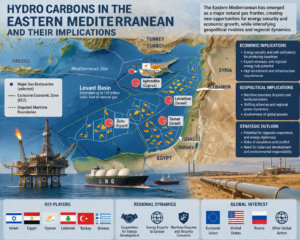
The discovery of hydrocarbons—primarily natural gas—in the Eastern Mediterranean has transformed the region into one of the most strategically significant energy frontiers of the 21st century. Stretching across the Levant Basin and adjacent offshore zones of countries such as Israel, Egypt, Cyprus, and Lebanon, these reserves have introduced new economic opportunities while simultaneously intensifying geopolitical rivalries. The Eastern Mediterranean, historically marked by political instability and unresolved conflicts, now faces an additional layer of complexity driven by energy competition and cooperation. This article explores the nature of hydrocarbon discoveries in the region and examines their economic, geopolitical, and strategic implications.
The Eastern Mediterranean’s hydrocarbon potential gained global attention in the early 2000s, with major discoveries such as the Tamar and Leviathan gas fields off Israel, the Zohr field in Egypt, and the Aphrodite field near Cyprus. These discoveries confirmed the presence of substantial reserves within the Levant Basin, which is estimated to contain up to 122 trillion cubic feet of technically recoverable natural gas. The scale of these reserves has raised hopes that the region could emerge as a significant energy supplier, particularly to Europe, which has been seeking to diversify its energy imports and reduce dependence on traditional suppliers.
From an economic perspective, hydrocarbons in the Eastern Mediterranean offer significant opportunities for energy-producing states. For countries like Israel and Egypt, gas discoveries have already contributed to energy self-sufficiency and export potential. Egypt, for instance, has repositioned itself as a regional energy hub, utilizing its existing liquefied natural gas (LNG) infrastructure to process and export gas. Similarly, Israel has entered into agreements to export gas to neighboring countries, strengthening its economic and diplomatic ties. For smaller or economically strained countries like Lebanon, the potential exploitation of offshore gas reserves represents a possible pathway to economic recovery, though progress has been hindered by political instability and governance challenges.
However, the economic promise of hydrocarbons is closely intertwined with significant financial and technical challenges. Offshore drilling in deep waters requires advanced technology and substantial investment, often necessitating partnerships with multinational energy companies. Moreover, fluctuating global energy prices can affect the commercial viability of these projects. As noted in studies of the region, decisions regarding exploration and export are influenced not only by economic considerations but also by geopolitical risks and security concerns.
The geopolitical implications of Eastern Mediterranean hydrocarbons are perhaps even more profound than their economic impact. The discovery of gas has intensified existing disputes and created new ones, particularly regarding maritime boundaries and exclusive economic zones (EEZs). Countries in the region have competing claims over offshore territories, leading to diplomatic tensions and, in some cases, military posturing. For example, disputes between Cyprus and Turkey over drilling rights, as well as disagreements between Israel and Lebanon over maritime boundaries, highlight the contentious nature of resource ownership in the region.
These tensions are further exacerbated by the broader geopolitical landscape of the Eastern Mediterranean, which includes longstanding conflicts such as the Israel-Palestine issue, the division of Cyprus, and the Syrian civil war. The introduction of valuable energy resources into this already volatile environment has the potential to both aggravate conflicts and incentivize cooperation. As scholars have observed, hydrocarbon discoveries can lead to either competitive or cooperative behavior among states, depending on their strategic interests and political calculations.
In recent years, the region has witnessed the emergence of new alliances centered around energy cooperation. One notable development is the formation of partnerships among Greece, Cyprus, Israel, and Egypt, aimed at coordinating exploration efforts and facilitating gas exports to Europe. These alignments are often supported by external actors such as the European Union, which views Eastern Mediterranean gas as a means of enhancing energy security. Conversely, Turkey has pursued its own strategy, asserting claims in contested waters and positioning itself as a key transit route for gas exports. This has led to a complex web of alliances and rivalries that continue to shape the region’s geopolitical dynamics.
The involvement of global powers adds another dimension to the Eastern Mediterranean energy equation. The United States, Russia, and the European Union all have strategic interests in the region, ranging from energy security to geopolitical influence. European countries, in particular, have shown strong interest in Eastern Mediterranean gas as an alternative to Russian supplies, especially in the wake of geopolitical tensions affecting traditional energy routes. This has increased the strategic value of the region and encouraged further investment in exploration and infrastructure development.
Despite these opportunities, the path to fully realizing the potential of Eastern Mediterranean hydrocarbons is fraught with challenges. One of the primary obstacles is the lack of clear and mutually agreed-upon maritime boundaries. Without resolution of these disputes, large-scale development projects remain vulnerable to political disruptions. Additionally, the high costs associated with offshore drilling and infrastructure, such as pipelines and LNG facilities, require long-term stability and cooperation among regional actors.
Another important consideration is the environmental impact of hydrocarbon extraction. As the global community moves toward renewable energy and decarbonization, questions arise بشأن the long-term sustainability of investing heavily in fossil fuel infrastructure. Some analysts argue that Eastern Mediterranean countries must balance short-term economic gains with long-term environmental responsibilities, particularly in light of global climate commitments.
Furthermore, the development of hydrocarbons in the region has significant implications for global energy markets. Increased production from the Eastern Mediterranean could contribute to greater supply diversity, potentially stabilizing prices and reducing dependence on traditional energy exporters. However, the extent of this impact depends on the scale of production and the ability of regional actors to overcome logistical and political barriers.
The concept of energy diplomacy has also gained prominence in the Eastern Mediterranean context. Countries are increasingly using energy resources as tools of foreign policy, leveraging gas exports and partnerships to strengthen their geopolitical positions. For example, bilateral agreements between Israel and neighboring states have not only facilitated energy trade but also contributed to broader diplomatic normalization efforts. Similarly, regional forums and initiatives aimed at coordinating energy policies have emerged as platforms for dialogue and cooperation.
At the same time, the risk of conflict remains a significant concern. The competition for control over hydrocarbon resources has the potential to escalate into military confrontations, particularly in areas where maritime boundaries are disputed. The presence of naval forces and the conduct of military exercises in contested waters underscore the seriousness of these tensions. While outright conflict has so far been avoided, the situation remains fragile and requires careful management through diplomacy and international mediation.
In conclusion, hydrocarbons in the Eastern Mediterranean represent both an opportunity and a challenge. On one hand, they offer the prospect of economic growth, energy security, and regional cooperation. On the other hand, they exacerbate existing conflicts, create new geopolitical rivalries, and pose environmental and financial risks. The future of the region’s energy landscape will depend on the ability of states to navigate these complexities and strike a balance between competition and cooperation. If managed effectively, Eastern Mediterranean hydrocarbons could serve as a catalyst for stability and prosperity. However, if mismanaged, they risk deepening divisions and contributing to further instability in an already volatile region.